
Lifetimes
Adam Apollo explores past-life remembrance as a spiritual framework for self-inquiry, connection, and personal meaning.
Books worth discovering. Authors worth knowing.
What might a sense of familiarity mean to someone who believes memory reaches beyond a single lifetime?
S.
When Familiarity Feels Older Than Memory
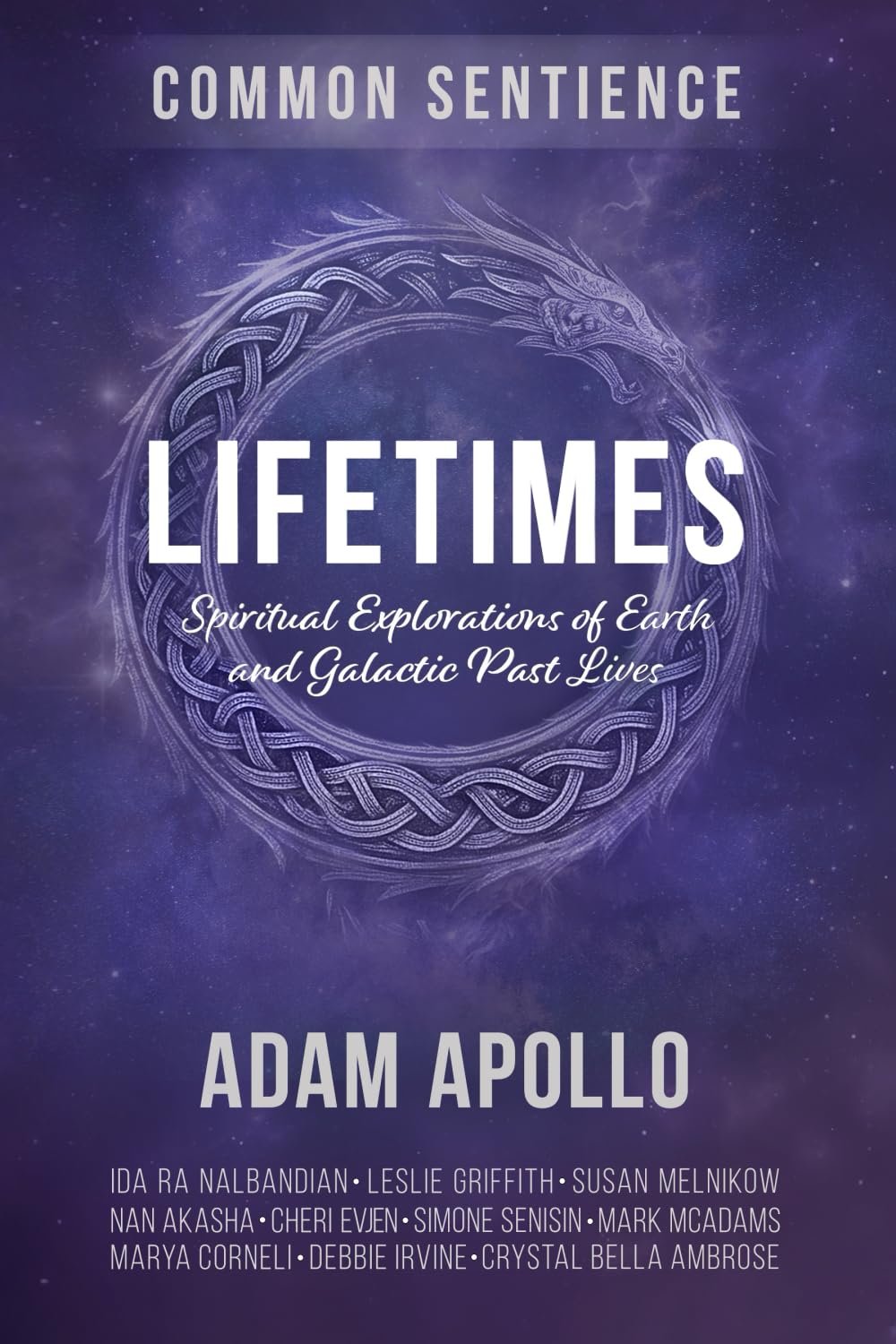
Adam Apollo’s Lifetimes: Spiritual Explorations of Earth and Galactic Past Lives begins with an unusual question about the experiences people carry into ordinary life. Why might a place never visited feel strangely familiar? Why do some relationships seem to arrive with a history that cannot be explained by a first meeting? Apollo approaches such experiences through a spiritual belief in multiple lifetimes, inviting readers to ask whether identity might extend beyond the biographical facts a person can document. The proposition is mystical, not an established scientific account of memory, and the distinction matters to understanding the book’s purpose.
The publisher presents Lifetimes as part of its Common Sentience collection, which gathers books on consciousness and spiritual inquiry. Apollo’s volume examines reincarnation, karmic patterns, intuition, and what he describes as soul remembrance. Those concepts will already be meaningful to some readers and entirely unfamiliar to others. The book’s distinctive appeal lies in offering them as a framework for reflection rather than simply presenting an exotic catalogue of supernatural claims. It asks what someone might do differently today after interpreting an experience as part of a much longer personal journey.
Reading a work like this calls for two kinds of attentiveness. One concerns the author’s actual assertions: accounts of remembered lives are experiences reported or interpreted within a spiritual tradition, not independently verified histories. The other concerns the questions raised by those assertions. Even a reader who does not accept reincarnation can consider how memories, family stories, intuitions, and recurring emotional patterns influence present choices. Apollo’s expansive premise opens a conversation about continuity while leaving room for critical distinctions between belief, metaphor, personal testimony, and evidence.
The Appeal of a Larger Personal Story
Human beings are skilled at linking seemingly disconnected moments into coherent narratives. A repeated dream, an unexpected sense of recognition, or a powerful response to an unfamiliar culture may invite interpretation. Apollo suggests that some of these moments are traces of other lifetimes. Readers should understand that explanation as the book’s spiritual outlook rather than a conclusion established by conventional psychological research. The appeal is understandable nonetheless: it offers a narrative in which puzzling feelings belong to an intelligible, if invisible, history.
That outlook also changes the implied scale of personal development. A single life has finite beginnings, relationships, losses and opportunities. A framework of many lives presents growth as an extended process of learning, revisiting and potentially resolving unfinished patterns. The publisher’s description highlights the possibility of reclaiming gifts, recognizing connections, and cultivating service. None of these results should be promised as guaranteed outcomes. They do, however, explain why the subject is attractive to readers looking for language that makes their experience feel less random or isolated.
The most productive way to approach such material may be through careful questions rather than instant agreement or dismissal. What does a purported memory change about someone’s behavior? Does it encourage kindness, responsibility and attention to the present, or does it become an excuse to avoid difficult evidence? What happens when different interpretations of the same experience compete? Apollo’s premise can lead toward meaningful reflection, but curiosity works best when joined by proportion. A compelling account should not be confused with a universal method of verifying ancient personal histories.
Identity, Recognition and the Desire to Belong
A striking element of the book’s public description is its interest in relationships that feel immediately significant. The language of instant recognition and déjà vu speaks to a common human wish: that important encounters might mean more than chance. People often describe meeting a friend or partner as feeling as though they have known that person forever. In everyday conversation, such phrases are figurative. Apollo’s spiritual model explores the possibility that they indicate a prior connection, giving familiar language a more literal metaphysical meaning.
That invitation can be emotionally powerful because the question of belonging is rarely abstract. People seek explanations for longing, unusual affinity, and even persistent conflict. A past-life interpretation may supply a story that organizes those feelings, but it remains only one possible account. Personality, memory, culture, projection and coincidence also shape human experience. A thoughtful reading does not need to flatten these possibilities into a single answer. It can appreciate the emotional questions without converting every meaningful coincidence into proof of a spiritual event.
Apollo’s emphasis on love and service provides another route into the material. If the idea of a long-lived soul encourages compassion toward strangers, patience with mistakes or a willingness to reconsider entrenched patterns, readers may find a constructive ethical question within an unverified premise. Yet the present remains the place where care is practiced. Whatever someone believes about lives before this one, responsibility to another person still depends on consent, honesty, boundaries and action in the world that can actually be observed.
From Mystical Memory to Present-Day Choice
The subtitle promises exploration, a useful word because it makes room for uncertainty. Readers may enter with firmly held spiritual beliefs, simple curiosity, or a skeptical interest in accounts of anomalous experience. Apollo’s project addresses those audiences unevenly: it clearly belongs to spirituality rather than a controlled scientific study. Its published descriptions emphasize awakening, remembrance and personal transformation. The appropriate question, therefore, is not whether it delivers a laboratory demonstration but how responsibly it frames the experiences and practices it asks readers to contemplate.
An especially important distinction concerns the difference between reflection and treatment. Remembering an alleged earlier lifetime should not be treated as a diagnosis of emotional distress or a replacement for qualified mental-health care. The publisher’s own excerpt includes a notice that the book is not intended to diagnose or treat medical conditions. That boundary protects the reader’s ability to explore spiritual ideas without assuming that evocative stories can establish causes of symptoms or dictate care. Inner work and evidence-based treatment need not be confused with each other.
The book also invites a practical question about personal agency. If a reader chooses to regard a recurring fear or talent as connected to another life, does that interpretation increase freedom in the present? Or does it harden into a narrative that cannot be questioned? A helpful story about identity should leave room for change. Readers can test whether a belief promotes humility, curiosity, and more generous behavior while remaining cautious about precise historical claims that they cannot independently corroborate.
A Place Within the Common Sentience Collection
Lifetimes is catalogued as volume seventeen in Sacred Stories Publishing’s Common Sentience series. That context matters because it situates the book within a wider conversation among writers who approach consciousness through spiritual, mystical and experiential frameworks. Apollo’s work is not presented as an isolated travelogue into the past but as one contribution to a curated body of writing about human awareness. A reader who responds to the central questions may find the series structure useful for comparing voices and methods.
Apollo’s public-facing work also connects spiritual education with ambitious discussions of physics and consciousness. Those combinations can be attractive to readers interested in bridges between philosophical traditions and modern scientific language. They also call for precision. Scientific vocabulary can help organize analogies, but the use of terms drawn from physics does not by itself validate reincarnation or extra-sensory recollection. Distinguishing metaphor, hypothesis and measured finding is part of respectful engagement with any text that crosses disciplinary boundaries.
Who May Find This Exploration Worthwhile
Lifetimes is most naturally suited to readers already drawn to reincarnation, intuitive experience, transpersonal reflection and spiritual self-inquiry. It may also engage those curious about how contemporary spiritual authors connect personal memory to ethical development. The book is a less obvious choice for someone wanting a conventional popular-science treatment of cognition or a neutral survey of competing theories about consciousness. Choosing it with accurate expectations gives the material its best opportunity to be read on its own terms.
Its recurring questions are the most transferable part of the premise. Which patterns do we keep repeating? Why do some places or relationships affect us so deeply? What stories help us become more attentive to the needs of others? Apollo answers these through the language of past lives, while other readers might answer through psychology, theology, literature or family history. The existence of different frameworks need not prevent serious discussion, provided the strength of each claim remains clear.
Ultimately, Adam Apollo’s Lifetimes asks readers to imagine identity on a cosmic timescale while making choices in the present. The book’s distinctive voice rests on a spiritual assertion that cannot be taken as demonstrated fact, but its questions about continuity, compassion and purpose are recognizable. The invitation is to read with imagination and discernment together: open to the significance people find in their experiences, careful about what those experiences prove, and attentive to what any interpretation asks them to do today.
About the book.
Part of Sacred Stories’ Common Sentience series, this spirituality volume invites readers to consider memories, intuition, karma and identity across imagined or reported past lives.
Editorial book feature, not paid sponsorship. Research-based original commentary from public author, publisher, retailer and bibliographic sources; not a first-hand complete-book review. A cover placeholder will be resolved by the owner’s publishing automation.
Found a book worth opening?
Books worth discovering. Authors worth knowing.
Return to the Journal →