
Melton: Adventures on the RC
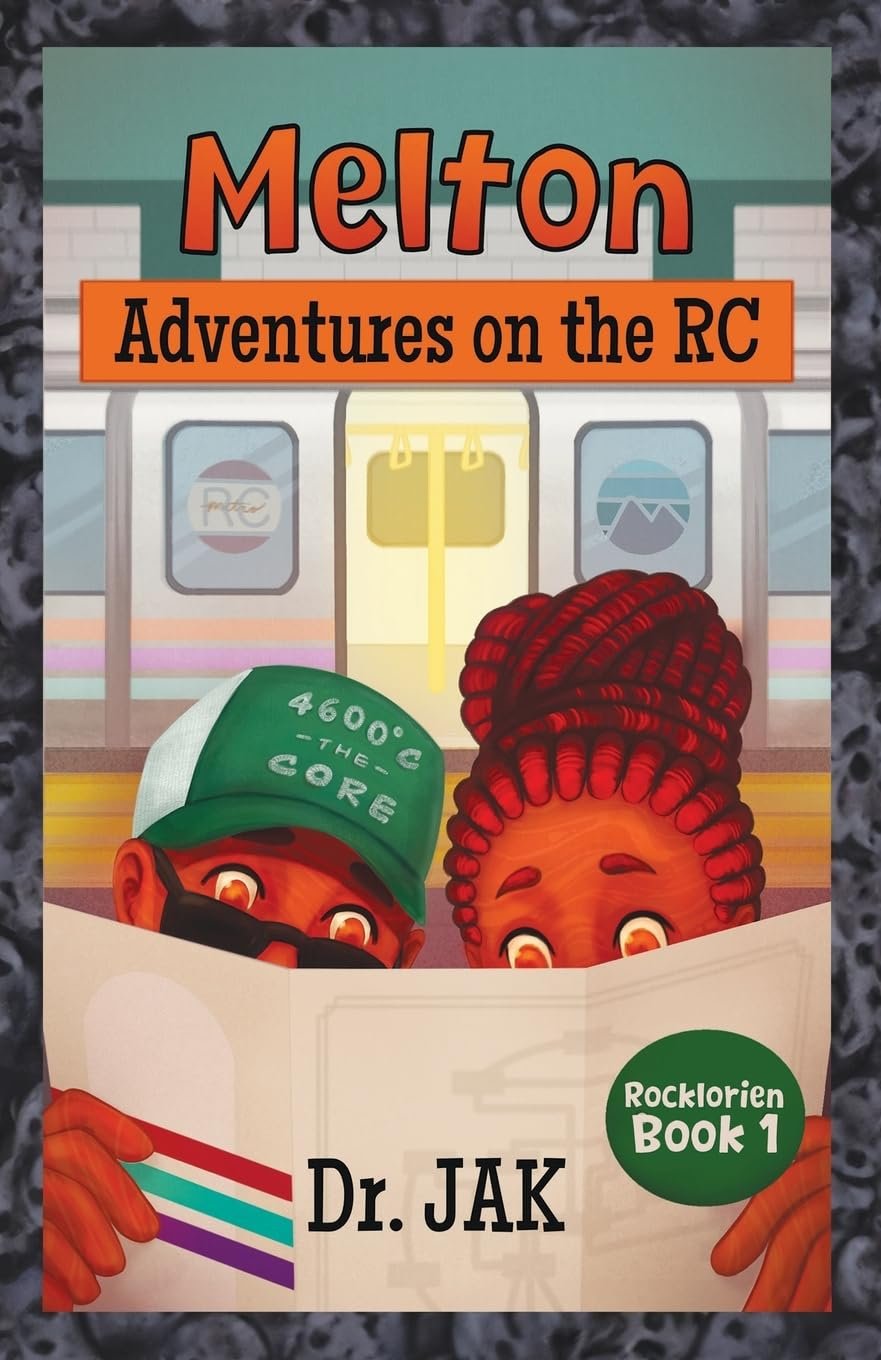
An igneous rock named Melton joins his friend Connie for an adventurous RC Metro journey across Rocklorien.
Books worth discovering. Authors worth knowing.
An igneous rock named Melton joins his friend Connie for an adventurous RC Metro journey across Rocklorien.
In Melton: Adventures on the RC, a children’s fantasy world is imagined beneath the surface of Rocklorien, where rocks live recognizable social lives.
The rock who has never traveled upward
In Melton: Adventures on the RC, a children’s fantasy world is imagined beneath the surface of Rocklorien, where rocks live recognizable social lives. The public synopsis identifies Melton as an igneous rock who has never ventured beyond his hot home. His friend and radio co-host Connie challenges him to make an extraordinary journey toward the surface. The setup is charmingly unusual because it gives the anxiety of leaving a familiar place to a character whose very material nature appears tied to heat and solidity. The plot promise is not simply ‘a rock rides a train’; it is a journey from comfort toward a world that may be physically and emotionally unfamiliar. The book’s RC Metro journey includes regions called Sedland, Igland, and Metaland, labels that invite playful connections with geology. The available description also mentions Melton’s fear of freezing, drowning, or flying. These concerns are stated in the synopsis, though how any are resolved should not be invented. The title provides an approachable adventure structure with a distinctive mineral-based cast and a central problem of courage.
Turning geology into imaginative geography
A landscape named for categories of rock can encourage children to ask what makes one material different from another. Igneous, sedimentary, and metamorphic rocks are not interchangeable, and their formation processes are important subjects in elementary earth science. The story’s named destinations suggest a playful bridge to those concepts, but the public information does not establish a specific curriculum or promise accurate definitions within every scene. An adult reading alongside a child can keep fiction and science separate while letting each enrich the other. When Melton encounters a region or a new kind of rock, a question about what the name resembles may lead to curiosity about heat, pressure, water, and change. It need not become a quiz that interrupts the story. The engaging idea is that a supposedly ordinary thing underfoot might have its own viewpoint, fears, and map of the world. That kind of personification makes the familiar strange. Children may become newly observant on a walk, but the book should not be advertised as producing a guaranteed educational outcome.
Friendship as the first engine of adventure
The synopsis gives Connie two roles in Melton’s life: best friend and radio show co-host. That is a telling pairing. Friendship already involves conversation and trust, while co-hosting suggests the characters are accustomed to imagining an audience together. Connie’s challenge therefore emerges from an established relationship, not an unexplained summons by a stranger. How their conversations unfold is not detailed in public sources; the reliable point is that she provides the push toward travel. Stories for young readers often use a trusted companion to make risk feel navigable. A friend cannot eliminate every danger, but their encouragement may create room to take a first step. Adults can use this dynamic to discuss the difference between helpful encouragement and pressure that ignores someone’s boundaries. Does courage mean agreeing immediately, or deciding freely to try? What support makes a frightening new experience less overwhelming? These questions fit the premise without inventing dialogue or lessons that have not been verified in the text.
The RC Metro as a promise of movement
The metro is an especially fitting vehicle for a tale about a character learning to cross boundaries. Public descriptions say Melton journeys from Sedland to Igland and through Metaland. Travel invites a sense of sequence: one stop ends, a different environment appears, and the passenger must adapt. Children understand trains as a space where movement can be both exciting and contained. A carriage offers some shelter even as it carries its occupants into unfamiliar places. In an underground fantasy, that contrast can be especially effective. It suggests that exploration need not mean abandoning every source of reassurance. The route’s names also give the story a playful rhythm. This is a description of the book’s documented travel premise and a reading interpretation, not a station-by-station retelling. We cannot claim the characters meet a particular passenger, solve a specified puzzle, or visit a precise number of stops from the evidence at hand. The interesting question is what travel might teach Melton about the place he thought he already understood.
Fear deserves a place in a brave story
One feature of the advertised synopsis is that Melton worries about several kinds of peril. Freezing, drowning, and flying may sound unusual fears for a rock, but they make imaginative sense within a story that treats rock characters as people. They also prevent courage from being reduced to never feeling afraid. A more useful definition for young readers is acting with care while recognizing fear and seeking help when necessary. Fiction can stage that lesson without treating every obstacle as trivial. A child preparing for a first journey, unfamiliar classroom, or new activity may recognize the emotional shape of Melton’s hesitation. That comparison is a reader’s lens, not proof that the book is a therapeutic tool. The safest way to discuss such stories is to invite conversation, not predict results. After reading, adults might ask which parts sounded exciting, which felt scary, and whether the character had choices. A good adventure makes room for both anticipation and caution, and Melton’s starting point supplies both.
An illustrated collaboration and its limits
The connected queue credits Dr. JAK as author and Valerie Whitehead as illustrator. A bibliographic listing also confirms this pairing. Illustrations can be particularly important in a world whose characters are types of rock, because facial expression, texture, and setting help young readers accept imaginative personification. Still, this article does not claim to have inspected every image or establish a precise visual style beyond the credited role. Nor does it assert an unverified age range or classroom standard. The public description is enough to present the book as a children’s imaginative adventure with geological wordplay and an explicit courage theme. If families want to use it in education, pairing it with physical rock samples or a simple geology reference may help distinguish fact from fantasy. Those are optional reading activities, not official exercises certified as part of the book. Responsible commentary preserves the distinction between what the creator wrote and what readers can choose to do afterward.
Who should read Melton
Melton: Adventures on the RC is a promising selection for children who enjoy talking objects, invented worlds, train journeys, and stories in which bravery begins with uncertainty. It could be especially engaging as a shared read for families curious about earth science, provided the whimsical geography is understood as fiction. Young readers who fear unfamiliar places may relate to Melton’s hesitations, while caregivers can use Connie’s encouragement to begin a gentle discussion about support and choice. Readers seeking a fully documented science textbook or a realistic account of geology should choose a different format. The appeal here lies in imaginative travel: an igneous protagonist discovering that the world may be bigger than the safe place he has always known.
About the creators
Dr. JAK is the credited author of Melton: Adventures on the RC, and Valerie Whitehead is identified as its illustrator in the queue and bookseller metadata. The synopsis supports a story about Melton and Connie traveling through Rocklorien on the RC Metro. No additional author biography, invented educational credentials, or details of unverified illustrations are presented here. The children’s-fantasy premise is specific enough to discuss without pretending to know the complete journey.
About the book.
Illustrated children’s fantasy; geology-inspired adventure. An igneous rock named Melton joins his friend Connie for an adventurous RC Metro journey across Rocklorien.
Sponsored book feature. Original research-based commentary, not firsthand complete-book reading. The owner’s Python automation will resolve the cover placeholder.
Found a book worth opening?
Books worth discovering. Authors worth knowing.
Return to the Journal →