
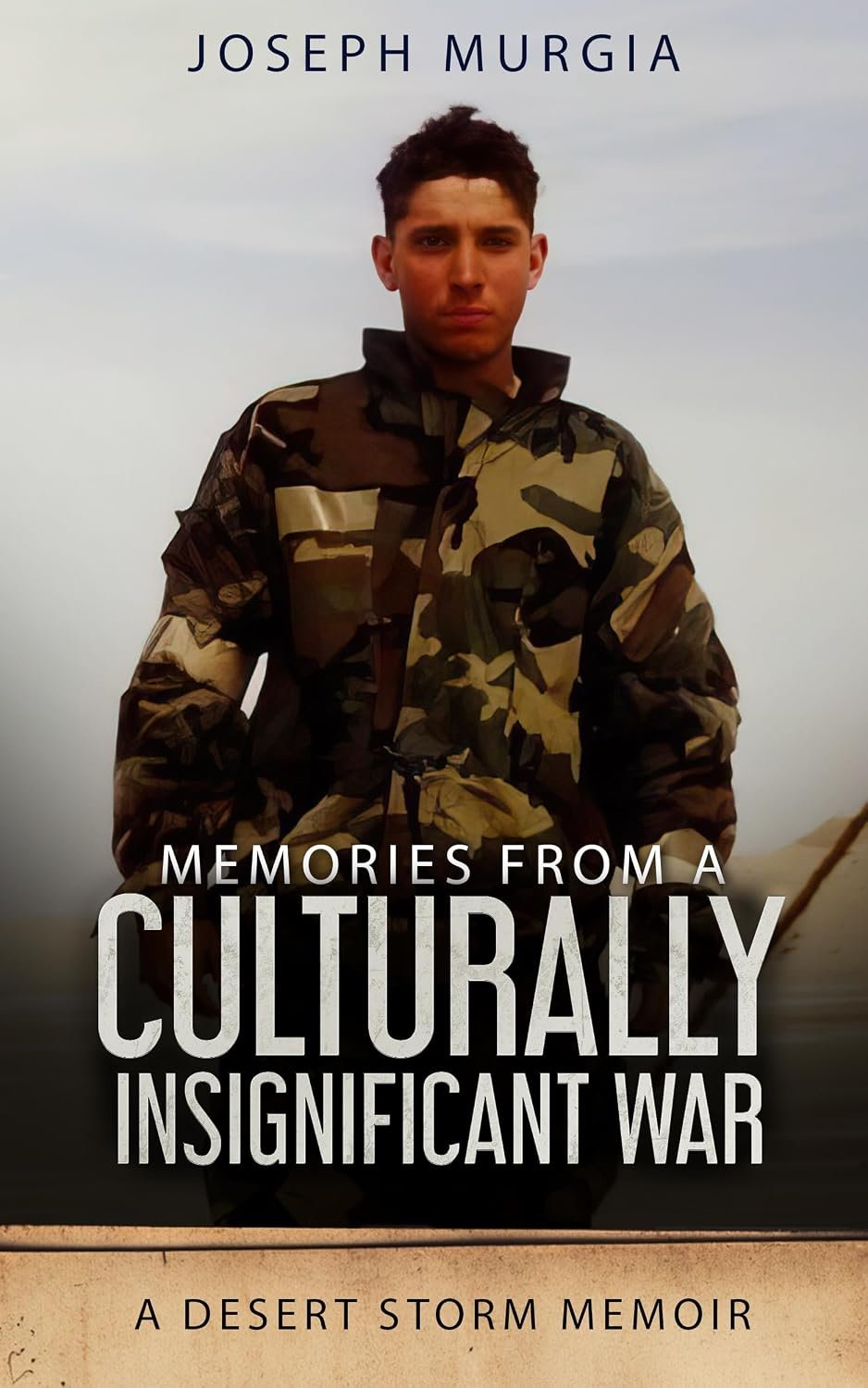
Memories From a Culturally Insignificant War
Joseph Murgia presents an account of the 1991 Gulf War in an extravagantly self-mocking voice. The public description repeatedly inflates the narrator’s importance only to puncture the fantasy with jokes…
Books worth discovering. Authors worth knowing.
Joseph Murgia presents an account of the 1991 Gulf War in an extravagantly self-mocking voice. The public description repeatedly inflates the narrator’s importance only to puncture the fantasy with jokes about military food, sand and personal vanity. The subtitle promises a Desert Storm memoir; the marketing copy promises a soldier who is both participant…
Carefully sourced literary criticism and book-specific interpretation.
Joseph Murgia presents an account of the 1991 Gulf War in an extravagantly self-mocking voice. The public description repeatedly inflates the narrator’s importance only to puncture the fantasy with jokes about military food, sand and personal vanity. The subtitle promises a Desert Storm memoir; the marketing copy promises a soldier who is both participant and unreliable hero of his own legend.
Humour as a challenge to the heroic pose
War memoirs often carry the burden of being understood as testimony to enormous public events. Comedy can be an ethical way of resisting the solemnity that turns every participant into an emblem. Murgia’s promotional narrator appears determined not to let his own experiences harden into national mythology. The strongest possible version of this approach would use humour to disclose confusion, absurd routine and the limits of an individual’s understanding.
Whose experience gets laughed at?
There is a genuine risk in the strategy. An account that laughs at its own swagger might also seem to laugh past the suffering of others. The tone has to distinguish the narrator’s ego from the actual human costs of war. A back-cover description full of jokes cannot settle whether the finished book navigates that distinction with maturity. That is a necessary qualification, particularly when a memoir involves a still-contested conflict.
The irony in the title
The phrase “culturally insignificant” is conspicuously ironic. In one sense it challenges the assumption that a major geopolitical operation automatically transforms every participant into a figure of historical importance. In another it questions what the broader culture remembers or forgets. A memoir with this title can resist official grandeur by attending to the smaller, less scripted experience of deployment.
For readers of personal war stories
Readers who appreciate caustic first-person storytelling and humour inside military nonfiction may find the stated voice refreshing. Those seeking a conventional operational history should be aware that the book is positioned as personal, comic and selective. Historical claims and military recollections must be evaluated as the author’s account, not independently verified fact.
The unreliability that advertises itself
Murgia’s book description almost dares the reader to distrust its narrator’s importance. The speaker claims heroic centrality through exaggeration so conspicuous that the boast becomes its own joke. This is a familiar comic strategy, but it has particular bite in military writing, where official narratives can turn complex collective operations into stories about exemplary individuals. A memoir that makes its own hero ridiculous may restore the sense that history was lived by countless people whose actions could never be condensed into one flattering account.
The difficulty lies in maintaining a credible relation to actual events. Hyperbole can reveal the absurdity of remembering, but an author also owes the reader sufficient orientation to distinguish recollection, invention and joke. The promotional language describes the account as almost or deliberately unreliable, rather than claiming clinical precision. The finished text should make that arrangement legible. A reader who cannot tell when satire is operating may mistake intentional self-parody for an implausible boast, while a reader encouraged to treat every detail as a joke may lose the memoir’s historical weight.
Military routine as comic material
The descriptions single out the unglamorous matter of deployment: food, heat, discomfort and the daily maintenance of a sense of self. These subjects offer a counterweight to strategy and grand rhetoric. Wars are conducted through enormous institutions, yet experienced by individuals who must eat, sleep, wait and improvise. A comic account that attends to those details can make a conflict feel less abstract without pretending that its consequences were trivial.
Comedy can also illuminate the strange gap between expectation and reality. A young person may arrive with a vocabulary borrowed from films or patriotic speeches and discover instead a sequence of inconvenient, occasionally absurd demands. The listing invokes cinema with self-aware exaggeration, inviting the reader to notice that a war story is always also a story about the scripts through which we understand war. The narrator may be mocking not only his younger self but the culture that taught him what heroism was supposed to look like.
Where the laughter should stop
There are limits to every satirical perspective. Military memoirs involve real deaths, geopolitical decisions and the lives of people who may never appear as the narrator’s equals. The book cannot reasonably be expected to provide a complete account of the Gulf War, but it can be expected to maintain clarity about the difference between mocking personal vanity and trivializing suffering. A professional review would look carefully at that boundary and at the range of people permitted to exist beyond the narrator’s comic spotlight.
The subtitle’s reference to Desert Storm gives the book a historical context; the self-mocking title appears to resist the temptation to declare that context universally transformative for the narrator’s own generation. Readers should enter prepared for a deliberately personal account whose humour might be both evasive and revealing. That tension, not any advertised superlative about hilarity, is what makes the memoir’s stated approach worthy of critical attention.
It would be a mistake to demand that a satirical memoir sound solemn merely because it concerns a war. Humour can make a speaker more candid about fear, boredom and embarrassment than elevated rhetoric does. The harder requirement is that comedy retain a sense of proportion. A reader should be able to identify whom a joke targets and what it reveals about the teller. Murgia’s advertised voice aims its loudest jokes at his own pretensions; that is a promising choice. The task for the full book is to sustain that self-scrutiny beyond the opening pitch, especially when private amusement meets events whose meanings exceed one individual’s experience.
The review’s scope
This assessment is based on the identified bibliographic records and available author, publisher and bookseller descriptions. The interpretive claims above are editorial judgments about the documented premise and genre choices, not testimony to having read every chapter or inspected every illustration. The published text may answer, complicate or contradict the critical questions raised here. A finished review would assess the language, structure and ending directly.
About the book.
The title, author/contributor record, source URL and matching cover file ID come from the current MarketAnyBook Journal Queue and its Drive asset folder. The review considers military memoir with satire through verified available descriptions rather than firsthand full-book reading.
Sponsored book review: the source queue marks this book as sponsored. Editorial analysis remains independent and is based on the publicly accessible sources noted in the companion metadata.
Found a book worth opening?
Books worth discovering. Authors worth knowing.
Return to the Journal →