
Mistakes That Made Me a Millionaire
Entrepreneur Kim Perell organizes ten costly mistakes into lessons on decisions, relationships, pivots, and the courage to begin.
Books worth discovering. Authors worth knowing.
Entrepreneur Kim Perell organizes ten costly mistakes into lessons on decisions, relationships, pivots, and the courage to begin.
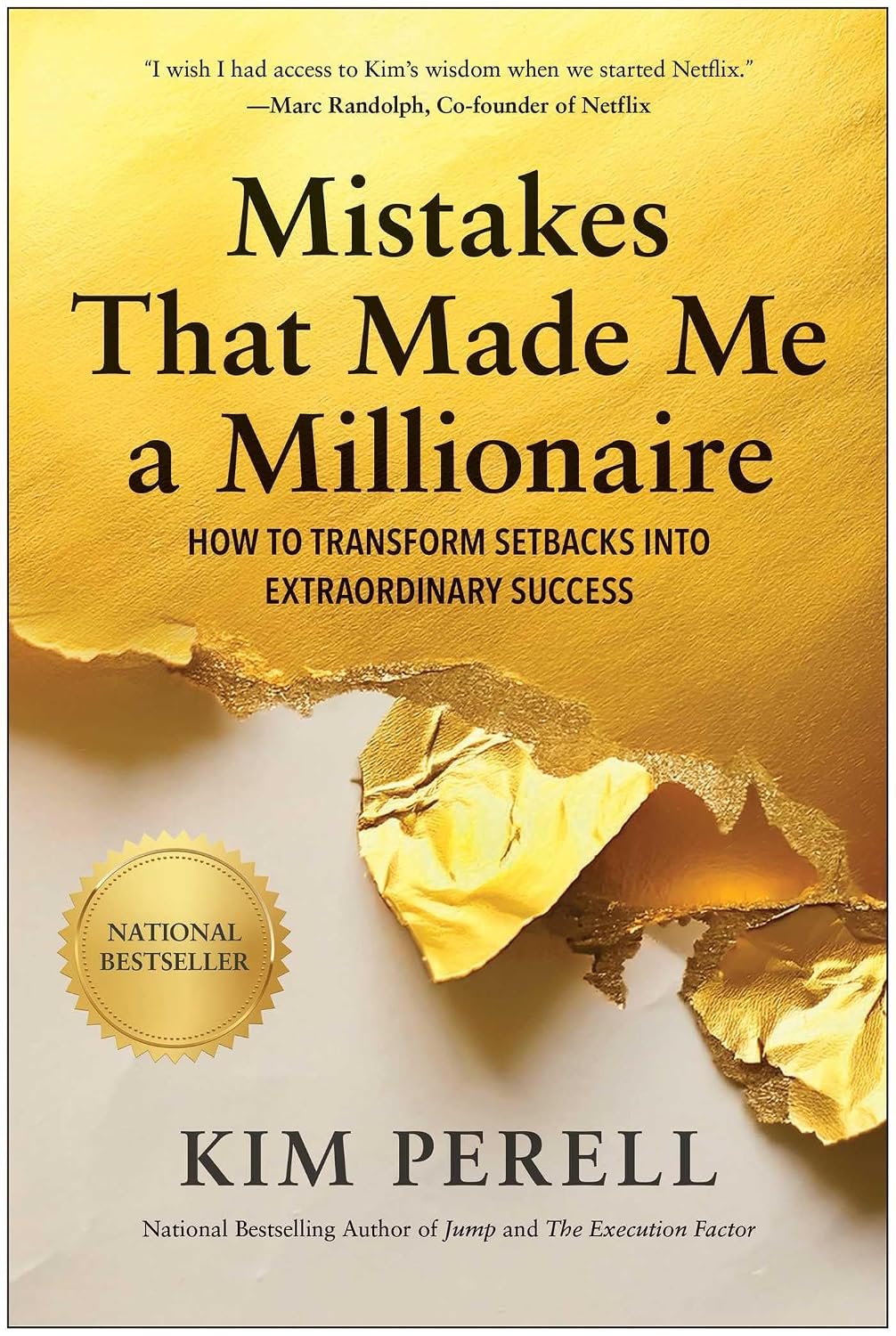
Mistakes That Made Me a Millionaire: How to Transform Setbacks into Extraordinary Success by Kim Perell rejects the familiar business-story structure in which success appears inevitable once the founder finds the right idea.
The Mistake as a Starting Point
Mistakes That Made Me a Millionaire: How to Transform Setbacks into Extraordinary Success by Kim Perell rejects the familiar business-story structure in which success appears inevitable once the founder finds the right idea. Perell’s own website organizes the book around ten mistakes and lessons she considers important to her career. The publisher describes her experience starting a company at twenty-three, building and selling businesses, and investing in numerous startups. Those facts give the book a substantial practitioner context, but they are not proof that any single method will produce the same financial outcome for another reader. Its useful promise is more grounded: costly decisions can be examined instead of hidden, and failure can become material for judgment rather than a permanent verdict on ability. That premise is especially relevant in business cultures that celebrate polished achievements while minimizing the uncertainty that precedes them.
Readiness Is Rarely Complete
The publisher’s table of contents identifies waiting to be completely ready as the first mistake. This is a familiar professional dilemma, whether the task is seeking a promotion, proposing a project, or starting a small venture. Preparation can reduce avoidable risk, but perfection can become an excuse for indefinite delay. The distinction is not a call to act recklessly. A thoughtful reader can ask which information is genuinely necessary and which additional research merely offers emotional comfort. Perell’s emphasis encourages a willingness to learn through measured action. That approach may appeal to people with strong ideas who repeatedly postpone decisions because they cannot guarantee the outcome. At the same time, some situations require extensive diligence, particularly when other people’s livelihoods are at stake. The lesson becomes valuable when it is applied with judgment rather than as a slogan against caution.
The Limits of Doing Everything Alone
Another listed mistake is trying to do everything without help. A founder may equate independence with strength, especially when resources are limited and the team is small. Yet delegation, mentorship, and complementary skills can determine whether a project survives its own growth. Perell’s long experience with businesses and investments makes this topic a credible element of her framework. The challenge for readers is to identify what they must personally understand and what others can contribute more effectively. Seeking support does not mean abandoning responsibility for the result. It means recognizing that judgment often improves when informed by perspectives different from one’s own. Trust matters here, too. Bringing people into a venture creates new obligations around communication, incentives, and accountability. The book’s stated lessons invite reflection on those trade-offs without pretending that finding the right partner is automatic or risk-free.
Fear, Risk, and the Decision to Pivot
The published chapter headings include fear of failure and a reluctance to pivot. These are related but distinct problems. Fear may prevent a person from taking a reasonable first step; stubbornness may prevent them from changing direction once evidence shows a plan is not working. Entrepreneurs need both the nerve to begin and the humility to revise their assumptions. The valuable question is when persistence becomes denial. Readers can treat Perell’s account as an invitation to review how they make decisions under uncertainty: what would count as evidence that an idea needs revision, and what would be an understandable but temporary setback? Neither extreme, endless optimism or immediate abandonment, offers a universal solution. Business outcomes depend on markets, people, timing, capital, and chance. That complexity should remain visible even in a book designed to encourage boldness.
The People Around Success
Perell’s contents also identify the wrong people, toxic relationships, and the belief that business is not personal as costly mistakes. Those categories locate leadership within a network of relationships rather than a solitary contest of ideas. A team can make a promising concept possible or undermine it through mistrust and conflicting priorities. Investors and founders likewise need to understand the motives and expectations behind an agreement, not merely the numerical terms. People decisions are difficult because evidence may be incomplete and loyalty has emotional weight. Rather than turning the book into a simplistic instruction to abandon anyone who challenges an ambition, readers can ask how to recognize harmful patterns while remaining open to disagreement. Healthy teams need constructive dissent. The challenge is distinguishing it from chronic disrespect, manipulation, or a basic mismatch of purpose.
Experience Is Not a Statistical Guarantee
Perell’s biography includes high-profile company sales and investments, and these achievements explain why readers may be interested in her lessons. Yet a successful entrepreneur’s story is not a controlled experiment in causality. Many founders make reasonable decisions and still fail because of circumstances they could not fully control. Some people flourish with strategies that would be unsuitable for another business or life stage. A critical reading does not undermine Perell’s personal experience; it helps assign the correct weight to it. The strongest contribution of practitioner writing is often specificity: which options were considered, what went wrong, and how the decision-maker interpreted the result. The book’s public summaries promise such candid reflection. Readers can draw inspiration from that process without assuming that copying the resulting choices will reproduce the author’s wealth.
Turning Regret Into a Practice
One way to use a book organized around mistakes is to examine a decision without collapsing the person into the outcome. A poor business judgment may be embarrassing, especially when it is public or costly. But useful reflection separates what was knowable at the time from what became clear only afterward. It also records which assumptions were wrong and which risks were simply part of doing something ambitious. Perell’s stated message is to transform setbacks into lessons; that language becomes most meaningful when paired with honest records, conversations, and future adjustments. This interpretation does not assign an unverified worksheet to the book. It offers a way for readers to engage with its confirmed organization and distinguish learning from retrospective self-punishment. Admitting error can be an expression of professional maturity rather than evidence that leadership has failed.
A Useful Challenge to the Success Myth
Mistakes That Made Me a Millionaire will likely speak most directly to entrepreneurs, emerging leaders, and professionals who have begun to fear that visible imperfection disqualifies them from advancement. Its author and publisher provide detailed information about the ten-lesson framework, allowing a substantive introduction without claiming a firsthand full-text critique. The title is deliberately ambitious, but its most durable idea is not that mistakes automatically produce millions. It is that the ability to analyze, recover, and change may matter more than preserving an image of uninterrupted competence. Readers can value the energy of Perell’s approach while applying appropriate skepticism to broad success claims. Failure is not a shortcut to prosperity, but neither must it be the end of a useful effort. Between those extremes lies the book’s practical appeal.
Readers looking for immediate applications may also benefit from identifying a single decision they would handle differently if they stopped defending the original choice. This is not an exercise described verbatim in public book materials; it is a practical way to respond to the author’s theme. Could a project benefit from independent advice? Is a relationship consuming attention better spent elsewhere? Has new information changed a risk assessment? None of those questions requires a person to celebrate the initial error. The purpose is to recover agency after an unfavorable outcome, then make a better informed decision about the next step.
About the book.
Entrepreneurship, personal leadership, and business lessons. Entrepreneur Kim Perell organizes ten costly mistakes into lessons on decisions, relationships, pivots, and the courage to begin.
Sponsored book feature. Independent research-based commentary based on publicly available book details; not a claim of first-hand full-text review. The designated cover placeholder will be resolved by the owner’s publishing automation.
Found a book worth opening?
Books worth discovering. Authors worth knowing.
Return to the Journal →