
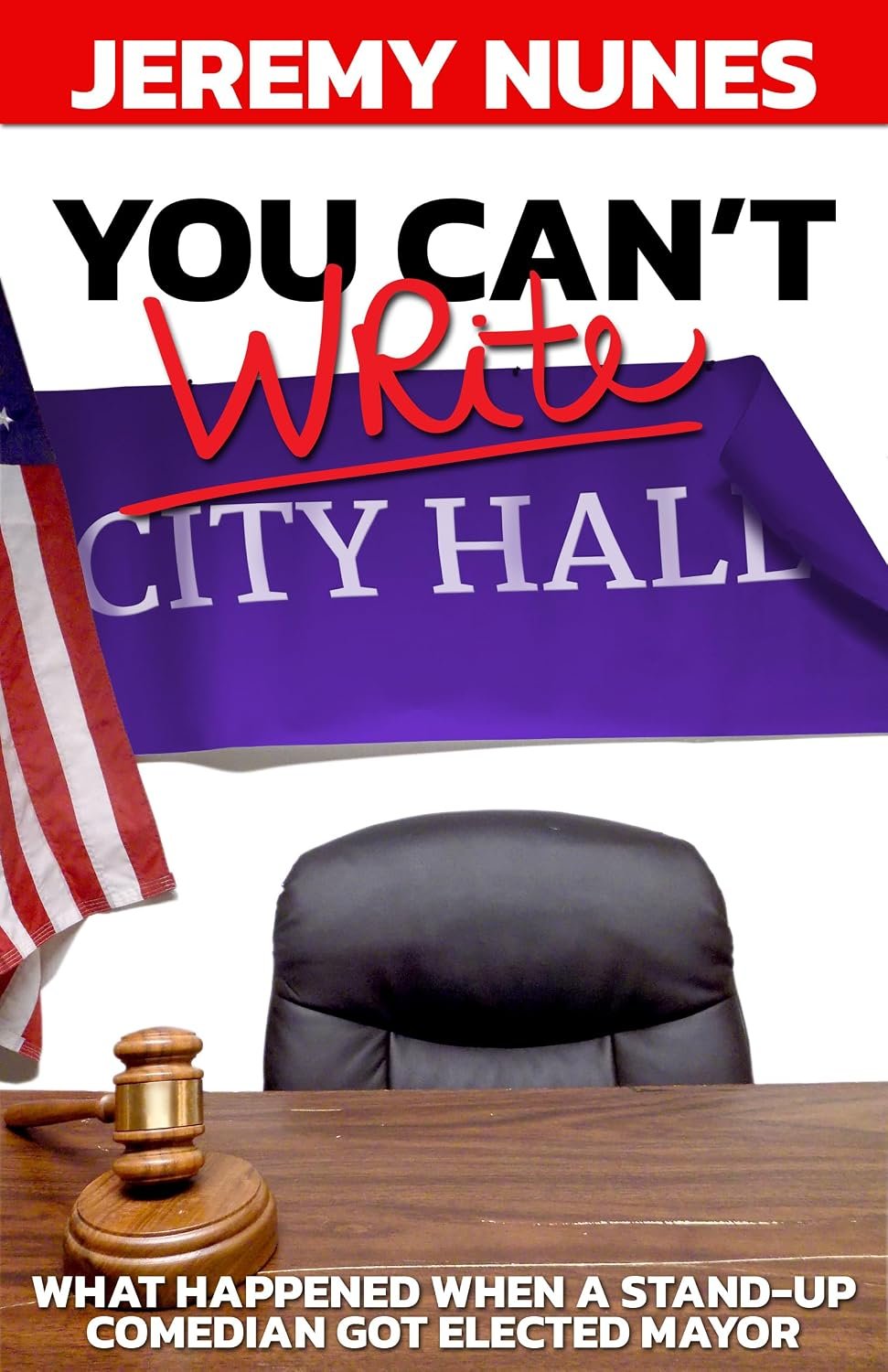
You Can’t Write City Hall
Comedian Jeremy Nunes recounts the real-life culture clash of taking the mayor’s office in tiny Dawson, Illinois.
Books worth discovering. Authors worth knowing.
Comedian Jeremy Nunes recounts the real-life culture clash of taking the mayor’s office in tiny Dawson, Illinois.
You Can’t Write City Hall: What Happened When a Stand-Up Comedian Got Elected Mayor by Jeremy Nunes begins with a premise that sounds manufactured for a comic routine but comes from the author’s own experience.
A Comedian Walks Into City Hall
You Can’t Write City Hall: What Happened When a Stand-Up Comedian Got Elected Mayor by Jeremy Nunes begins with a premise that sounds manufactured for a comic routine but comes from the author’s own experience. Nunes, a stand-up performer, became mayor of Dawson, Illinois, a small town near Springfield. His official book page notes that Dawson had roughly five hundred residents and no stoplights. That scale is central to the story’s appeal. In a place where constituents may know one another personally, public service rarely feels anonymous. An argument about routine municipal business can become a conversation at a doorway, a late-night call, or an encounter with someone who remembers what happened years earlier. Nunes tells the story from the comedian’s perspective rather than claiming the detached voice of a public-administration manual. It is a memoir about responsibility told by someone accustomed to turning absurdity into material.
Why a Small Town Is a Large Stage
A town of about five hundred may have modest administrative reach, yet its conflicts can be intensely visible. Residents want problems solved and frequently know exactly whom to call when something goes wrong. The elected official can become a symbol of every road repair, inconvenience, perceived slight, or dispute about priorities. Nunes’s promotional description mentions knocks at the door, boardroom arguments, and the difficulty of supervising others without lavish compensation. Those details reveal an important mismatch between the popular image of political power and daily municipal work. The position may carry public authority while offering relatively little insulation from frustration. Readers do not need to share the author’s political views to find the situation revealing. His experience invites the question of how communities should expect leaders to respond when every small annoyance becomes a personal demand.
The Comic’s Familiar Problem
Stand-up comedy and local politics both depend on reading a room, but their goals differ sharply. A comic can turn confrontation into a punchline; a mayor must also govern the people involved, including those least amused by the exchange. Nunes’s official summary describes moments when he answered complainers much as he would handle hecklers. That detail promises humor, but it also exposes a potential danger: verbal victory is not the same as resolving an underlying disagreement. A citizen’s complaint may be petty, heartfelt, or both. A strong joke can illuminate absurdity; it can also make the person being laughed at feel unheard. The tension makes the premise more interesting than simply watching a funny person occupy an unexpected job. The memoir becomes a test of whether the instincts that succeed onstage can help or hinder public life.
A Memoir With Names and Consequences
Nunes states that the account is based on true events and that certain identities have been changed. That editorial decision deserves attention because local-government stories concern real communities, even when told for laughs. Altering identifying details can protect privacy or reduce unnecessary embarrassment, but it also reminds readers that memoir is a shaped narrative rather than a transcript of council meetings. Perspective matters: the storyteller chooses which moments to include, where to begin, and how to arrange surprises. Readers can enjoy the author’s comic interpretation while remembering that others involved in the same disputes might remember them differently. This distinction is not an accusation against the writer. It is part of responsible reading for any firsthand political narrative. The book promises an inside account, and the inside view is valuable precisely because it is personal rather than a neutral institutional report.
People Behind the Boardroom Arguments
The publisher’s promotional catalogue describes quirky employees and arguments over seemingly trivial matters. It is tempting to dismiss these as nothing more than colorful anecdotes, but small workplaces create genuine challenges around fairness, communication, and continuity. An elected leader has to work within structures that exist before the election and endure after the term ends. Employees may have expertise the leader lacks; citizens may have urgent needs that do not look urgent from outside. Nunes’s story can encourage readers to think about the human systems behind municipal rules. Why does a modest decision trigger outsized anger? How can an official respond when two reasonable residents demand incompatible outcomes? The marketing synopsis does not supply every answer, and its anecdotes should not be converted into fabricated scenes. Its strongest verified contribution is to show how ordinary civic administration can become charged with personality and expectation.
State Politics in a Local Frame
Nunes’s official site also mentions interactions with Illinois political figures, including State Representative Tim Butler, Congressman Darin LaHood, and Governor Bruce Rauner. Those names place the account beyond the limits of one village. Local communities often depend on relationships with larger government bodies for resources, infrastructure, and help navigating procedures. Yet a mayor’s day-to-day problems may still revolve around issues that never become newsworthy elsewhere. The contrast can be comic and revealing: the same officeholder may discuss state-level matters on one day and field a highly personal local grievance on the next. Readers should resist projecting specific conversations or policy outcomes beyond the author’s broad description. The memoir’s interest lies in the movement between scales of public life and the strange adjustments required of a person who is both neighborhood acquaintance and elected authority.
The Limits of Political Humor
Political memoirs with a humorous voice carry a particular ethical question: who becomes the joke? Humor can puncture self-importance, make institutions intelligible, and allow readers to recognize how ridiculous a situation feels from within it. But it can also reinforce the storyteller’s sense of grievance. Nunes’s account is especially interesting because the narrator is a performer whose livelihood depends on getting a response. The best way to read such a work is not to demand that every punchline double as an impartial finding. It is to distinguish between the event the author says occurred, the interpretation he places upon it, and the comic device used to deliver it. That approach preserves the pleasure of the story while allowing readers to evaluate the frustrations and decisions of public office on their own terms. It also leaves space for sympathy toward the citizens whose demands helped shape the experience.
When Real Life Outwrites the Routine
You Can’t Write City Hall is a natural recommendation for readers who enjoy light-footed political memoir, small-town anecdotes, and the collision of everyday problems with official responsibility. The book is not pitched as a systematic examination of municipal law; it promises a candid, funny account of a comedian discovering what it means to be answerable to a community. Its source material is well supported by the author’s site and publisher catalogue, while specific jokes and outcomes belong to the full text. One question makes the premise linger: when a person who knows how to make an audience laugh acquires the authority to make decisions for that audience, how must the performance change? Nunes’s firsthand position gives him a distinctive way to approach the question, whether readers arrive for the comedy or for the lessons hidden beneath it.
That tension also points to a useful distinction between being accessible and being endlessly available. Small-town constituents may prize a mayor who answers the phone, but civic service requires boundaries if decisions are to remain fair and sustainable. The book’s promotional anecdotes suggest the pressure created when complaints follow a public official into private life. Even readers with no interest in electoral politics may recognize the dilemma from workplaces and community organizations. Helping people does not mean that every demand can be satisfied; the hard work often lies in explaining why. Humor may make that explanation memorable, though it cannot replace it.
About the book.
Humorous political memoir and local government chronicle. Comedian Jeremy Nunes recounts the real-life culture clash of taking the mayor’s office in tiny Dawson, Illinois.
Editorial book feature, not paid sponsorship. Independent research-based commentary based on publicly available book details; not a claim of first-hand full-text review. The designated cover placeholder will be resolved by the owner’s publishing automation.
Found a book worth opening?
Books worth discovering. Authors worth knowing.
Return to the Journal →