
The 4 Streams of Leadership
Promotion to management often rewards expertise by placing people in jobs for which that expertise is insufficient. Dalmo Cirne's The 4 Streams of Leadership begins from that uncomfortable mismatch…
Books worth discovering. Authors worth knowing.
Promotion to management often rewards expertise by placing people in jobs for which that expertise is insufficient. Dalmo Cirne's The 4 Streams of Leadership begins from that uncomfortable mismatch. His framework divides a manager's work into Reservoir, Downstream, Upstream and Sidestream, insisting that effective leadership requires attention to…
Considered reviews, grounded in the book’s documented promise.
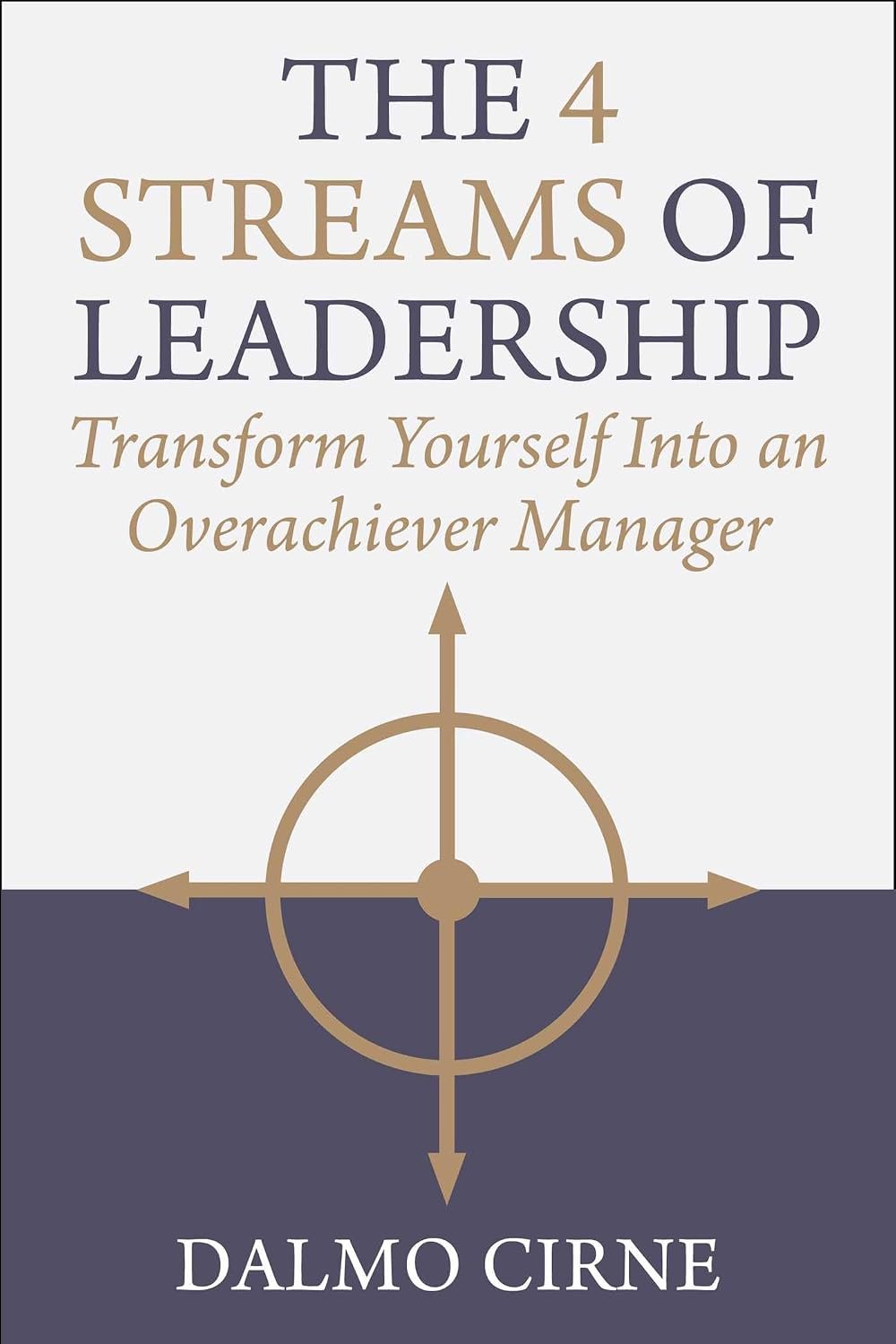
Promotion to management often rewards expertise by placing people in jobs for which that expertise is insufficient. Dalmo Cirne's The 4 Streams of Leadership begins from that uncomfortable mismatch. His framework divides a manager's work into Reservoir, Downstream, Upstream and Sidestream, insisting that effective leadership requires attention to oneself, the team and its work, senior stakeholders, and peers across the organization. It is a more useful starting point than the familiar portrait of the inspirational boss whose charisma supposedly fixes everything.
Why the four-way division is useful
A framework has to do more than name activities everyone already recognizes. Cirne's four streams turn the management job into a set of competing obligations that cannot all be reduced to the weekly team meeting. Someone may be excellent at coaching a colleague and still fail to secure a decision from stakeholders; another may keep senior management happy while neglecting the conditions of the team. Mapping these pressures separately gives a new manager a vocabulary for diagnosing the work they are not doing. That analytical distinction is the book's clearest promise.
The reservoir is not a wellness slogan
Cirne calls the first stream the Reservoir: a manager's own capacities, judgment and decision-making. This should not be confused with the fashionable demand that every professional constantly optimize the self. A manager's attention is finite, and decisions are made under incomplete information. A strong treatment of the Reservoir would therefore ask what habits support consistency, how to recognize one's limits and when to seek correction. Preparation becomes less about displaying certainty and more about making judgments that colleagues can understand and question.
Downstream is where rhetoric meets operations
The downstream stream covers teams, projects and operations. That grouping matters because people management is sometimes treated as independent of the systems through which work actually reaches customers. A caring leader can preside over unnecessary meetings and unstable delivery; a technically efficient operation can exhaust the people expected to sustain it. Cirne's organization suggests these dimensions must be managed together. The evidence of good leadership is not only whether the manager appears supportive but whether the team can repeatedly achieve worthwhile results without relying on constant emergency effort.
Upstream and the politics of clarity
Managing stakeholders is not simply flattering executives. It involves seeking approvals, explaining progress and aligning priorities when the people affected by decisions have unequal authority. New managers often underestimate how much of their team's frustration comes from unresolved decisions above them. The upstream stream foregrounds the need to communicate without hiding behind vague optimism. It offers a corrective to leadership advice that focuses exclusively on the direct-report relationship, although the book's actual guidance should be assessed for how honestly it handles conflicting incentives.
Sidestream and the invisible organization
Colleagues in adjacent functions have their own pressures, definitions of success and limits of authority. A manager can be competent inside one department and still fail by making promises that depend on someone else's capacity. Cirne's sidestream category treats cross-functional coordination as core work rather than a nuisance. The framework's value is especially clear in organizations where product, engineering, sales and support all have to collaborate. Cooperation requires negotiation about boundaries and shared measures; it cannot be summoned by an inspirational poster.
Reproducible lessons as a claim to examine
The author's website emphasizes repeatable lessons rather than feel-good business stories. That is a productive standard, but readers should still ask how repeatability is demonstrated. A practice that helped one team during an intense growth period may not transfer unchanged to a nonprofit, a school or a workplace without comparable resources. The book's framework is best treated as a set of hypotheses for disciplined adaptation, not a scientific guarantee of promotion or performance. A manager benefits from testing it against actual constraints and examining unintended effects.
What preparedness can and cannot do
Preparation does not abolish power imbalances, budget cuts or institutional contradictions. It can, however, make a manager less surprised by them. Cirne's project is strongest where it teaches a professional to anticipate which conversations, decisions and routines are necessary before failure becomes visible. The risk of any comprehensive model is that four memorable names begin to seem like complete explanations. Their value must remain practical: helping the manager notice what is missing, rather than offering a universal theory of human motivation.
The book as a desk instrument
Cirne repeatedly describes wanting a reference that managers reach for during a working day rather than a volume displayed on a shelf. That design ambition creates a testable editorial standard. Can a reader locate a relevant principle when a meeting goes badly, a stakeholder changes the requirements or a team member needs clarity? If the framework is truly practical, it should translate from memorable labels into decisions. A beautiful diagram is not enough; a working instrument must also help its user recognize when the model does not apply.
A map that makes omissions visible
The four streams could be most useful in diagnostic meetings. A struggling project may look like a productivity problem when the actual difficulty is conflicting upstream priorities, or a peer-team dependency that nobody owns. Sorting symptoms by stream gives an overburdened manager a method for locating neglected responsibilities. Yet there is a risk that the categories become rigid silos, when in real institutions one conversation often spans several. The framework earns its place if it sharpens practical attention rather than discouraging complex thinking.
Who will value this book
The 4 Streams of Leadership is particularly well aimed at experienced individual contributors becoming managers, recently promoted team leaders and people who recognize that operational competence differs from personal expertise. Its structure and the publisher's detailed outline provide a substantial basis for critical appreciation. An assessment of the examples and exercises in the complete book would still be needed before judging its effectiveness as a training manual.
Scope of this assessment
This is a research-based editorial review drawn from identified bibliographic, author and publisher sources. It considers the work’s documented premise and the critical questions it invites, without claiming a complete firsthand reading. No unverified scene, character action or ending is asserted.
About the book.
An evidence-bounded critical introduction to practical management and leadership nonfiction. Published descriptions support the stated premise; interpretations are identified as editorial analysis, not confirmed plot details.
This is an unsponsored, research-based editorial review, not a claim to firsthand reading of the complete book.
Found a book worth opening?
Books worth discovering. Authors worth knowing.
Return to the Journal →