
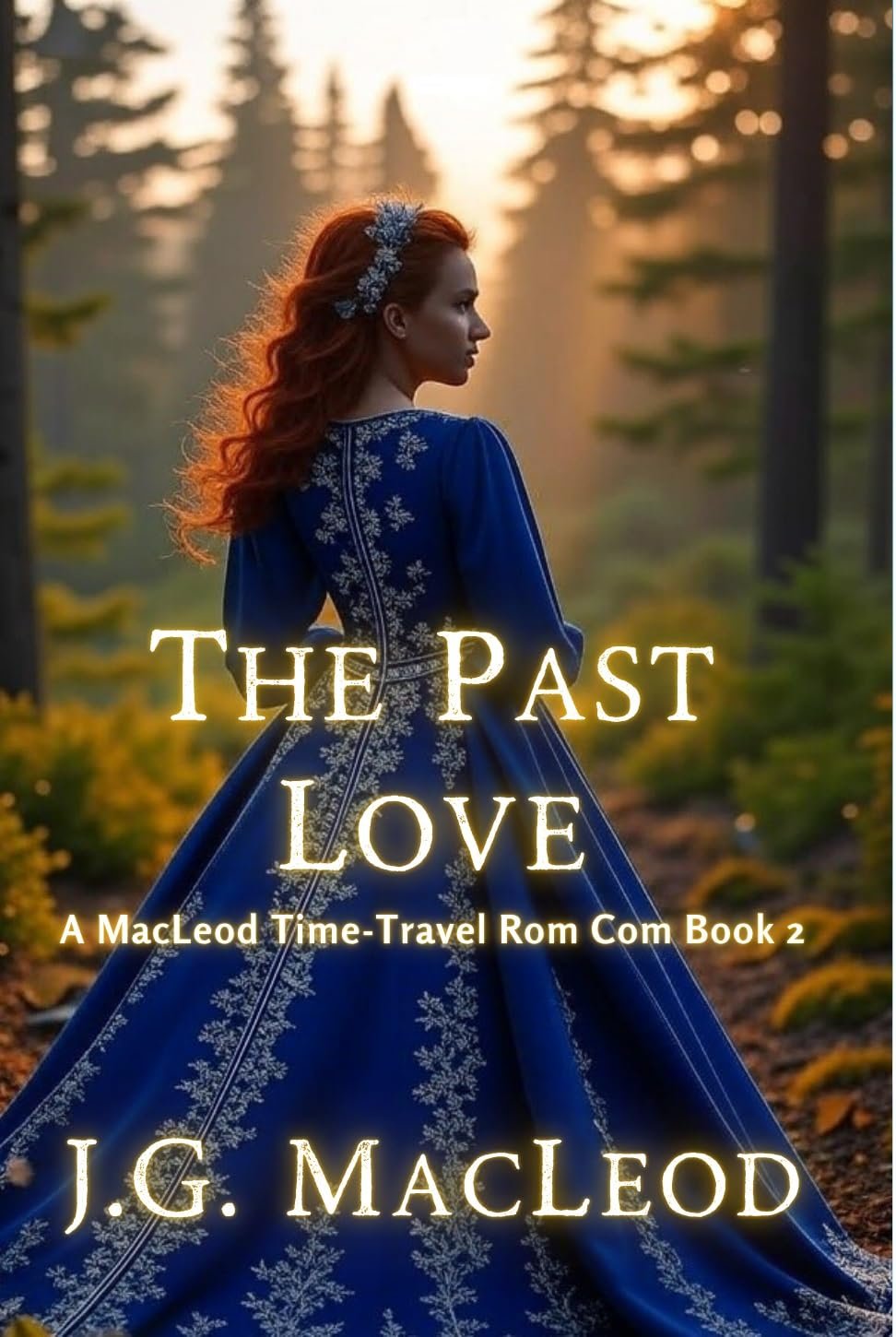
The Past Love
A time-traveling heroine encounters a past that refuses to repeat.
Books worth discovering. Authors worth knowing.
J.G.
An original critical assessment, grounded in verified public book descriptions.
J.G.
Time travel without a clean reset
J.G. MacLeod’s The Past Love is the second novel in a Scottish time-travel romantic comedy sequence, and its synopsis immediately changes the usual rules of a sequel. Brigid MacDonald, a coffee barista with a black belt, has moved from 2019 into fifteenth-century Glasgow. Yet the world she reaches is displaced relative to her previous adventure: familiar people stand at earlier points in their lives, and events she has already experienced are not settled facts. The book openly questions whether the future is determined or shaped by choice. That gives the romantic comedy a sharper narrative problem than a heroine merely learning to survive in unfamiliar clothes. Brigid’s very knowledge of an earlier possible history becomes uncertain equipment for her present decisions.
The comedy of misplaced confidence
Time-travel fiction often gives a modern protagonist an apparent advantage. Knowledge of later history, social norms and technology can become a form of power. MacLeod’s premise frustrates that easy confidence: when events do not repeat on schedule, the heroine cannot rely on remembering what should happen next. Her martial-arts training is a tangible counterweight to uncertainty, but being skilled in one form of conflict does not confer mastery over clan rivalries, relationships or the pressures of medieval life. Comedy can grow from that mismatch without abandoning emotional seriousness. The synopsis’s warning about corsets and disruptive gin signals a book comfortable with playful anachronistic contrast, while the emphasis on broken hearts indicates that jokes are not expected to dissolve every consequence.
Romance under revised conditions
The central romantic question is unusually rich: if two people encounter one another under different circumstances, is their connection the same relationship? A second-chance romance normally assumes a shared past, even when the pair disagree about its meaning. Here the past may itself be in dispute. Brigid’s choices might create a future that feels emotionally right while contradicting events once considered fixed. The synopsis describes characters working together or against one another to address feuds and wounded attachments, suggesting an ensemble larger than a simple pair of lovers. A reader’s pleasure may come from watching the story balance destiny and improvisation without making the heroine’s agency meaningless. That balance is the essential critical test, even if the available preview cannot establish how successfully it is achieved.
A sequel with a genuine entry cost
The book includes returning characters and explicit references to occurrences in The Future Bride, the series opener. A reader who starts here may be able to follow the major premise, but the significance of particular reversals will likely deepen with familiarity with the earlier novel. This is not a reason to dismiss a sequel; it is a useful expectation to set. MacLeod is offering both continuity and variation. The revised time line promises the pleasure of recognizing a person or event and then noticing that the familiar route no longer works. The hazard is that explanations of the temporal scheme could overwhelm movement and humor. A close review would have to measure that interplay rather than simply admire the cleverness of the premise.
Readers prepared for a playful paradox
This is a sensible choice for fans of time-slip romance, Scottish historical settings, gradual attraction and comic adventure who enjoy some suspense mixed into the humor. Readers seeking strict historical realism or a romance unencumbered by chronology may find the premise deliberately unruly. The strongest documented distinction is that the second installment does not just add another obstacle to an old plot: it revises the conditions under which relationships and consequences can exist. That is a promising ambition for a series novel. A full assessment of dialogue, period detail and emotional payoff still requires the text, but the premise offers a specific reason to keep following Brigid’s travels.
The fragility of a heroic memory
One of the most intriguing features of an altered chronology is that an accomplishment can become something that has not happened yet. A character may remember courage that nobody else recognizes, or regret an event that the new world has not experienced. The synopsis explicitly identifies such mismatches among returning figures, making memory itself a source of estrangement. That is a strong complication for a light romantic adventure because it raises the stakes of otherwise comic confusion. Brigid may know whom she trusted before, yet discover that those bonds have to be rebuilt on different terms. The reader’s enjoyment need not depend on complex theoretical explanations of time. It can come from a simple, poignant fact: knowing a person in one life gives no guarantee that they will know you in another.
The historical setting under pressure
A modern woman transported into medieval Scotland immediately encounters differences in clothing, status and social authority, and the published description signals a willingness to make comedy from those contrasts. Such humor can be lively, but it asks the author to be attentive to the fact that history was not merely an inconvenient set of manners. Clan loyalties, violence and gendered restrictions create real constraints for characters. The romantic-comedy mode succeeds when it can acknowledge those dangers while preserving the energy of play. MacLeod’s synopsis promises both suspense and slow-burn attraction, an arrangement that should allow fear, desire and comic defiance to alternate. The strongest work in this niche treats a heroine’s modern perspective as one resource among others rather than an effortless passport to competence in every era.
The appeal of a world that resists the plan
Readers of time-travel romance often enjoy knowing more than the people in the story, anticipating when a historical rule or previous event will become important. MacLeod unsettles that satisfaction by allowing history to depart from the expected path. The alteration gives Brigid a less comfortable but more active role: she cannot merely apply a remembered solution. Romance then becomes a continuing choice rather than the inevitable confirmation of an earlier plot. For a sequel, that is an attractive way to refresh both the comedy and the emotional stakes. The conceptual ingenuity will matter most if the characters remain more memorable than the mechanics required to move them through time.
About the book.
This review examines the documented premise and its critical implications; literary execution cannot be completely assessed without a full text.
Sponsored book review, identified according to the MarketAnyBook queue. Based on publicly accessible descriptions and bibliographic evidence; it is not a claim of full-book firsthand reading. Assessments of unverified interior craft are withheld.
Found a book worth opening?
Books worth discovering. Authors worth knowing.
Return to the Journal →