
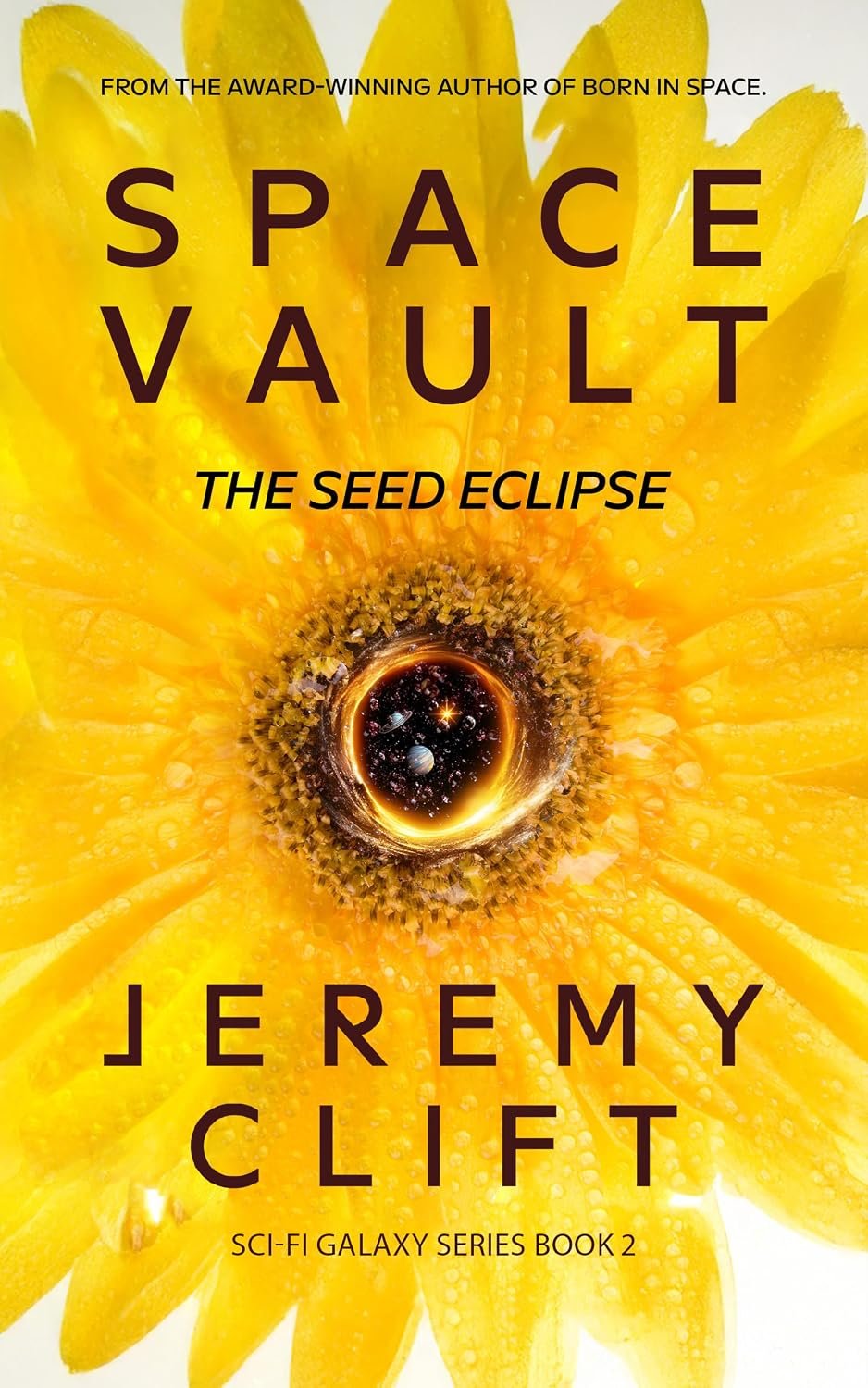
Space Vault: The Seed Eclipse
Teagan Ward’s struggle to protect her daughter converges with a lunar genetic vault and a fight over the future of life.
Books worth discovering. Authors worth knowing.
Teagan Ward’s struggle to protect her daughter converges with a lunar genetic vault and a fight over the future of life.
Original editorial perspective, grounded in the identified book and edition.
The future of a civilisation is a large thing to hide beneath the surface of the Moon. In Jeremy Clift’s Space Vault: The Seed Eclipse, a lunar repository of genetic material becomes the object of competing human and nonhuman interests. The published synopsis places the story on a damaged Earth and beyond it, where climate stress, corporate ambition and biotechnology intersect with a mother’s determination to protect her daughter. Teagan Ward’s child, Diana, was genetically engineered for life in deep space; powerful groups see her as an asset they should control. In that combination of a family relationship and a struggle over life’s underlying codes, the novel finds a precise question for its expansive science-fiction setting: who gets to decide what the next generation will become?
The vault as both rescue plan and prize
A seed vault is typically imagined as a safeguard against loss, a way of preserving possibilities when ordinary systems fail. Clift’s fictional lunar storehouse takes that protective idea into a political arena. The publisher’s description says the facility holds vital genetic codes for crops and food supplies, and potentially information relating to human futures. Resources preserved for collective survival can also become instruments of power when access is unequal. The novel’s advertised conflict grows out of that contradiction. A thing designed to keep life possible attracts those who want to own the terms on which life continues.
The Moon setting sharpens the issue. Distance may promise physical security from a struggling Earth, but it also places an essential resource far from ordinary public oversight. Readers can ask whether an off-world archive changes the ethics of possession: should whoever controls its doors determine who receives its contents? The accessible materials support the existence and importance of the vault, not the detailed rules governing it. The critical interest is in the premise’s logic, which makes the politics of preservation inseparable from the politics of ownership.
Diana and the problem of being designed
Diana is described as a genetically altered child made to survive the conditions of deep space, and rival powers covet her capabilities. This is more than a convenient way to introduce unusual technology. It converts a familiar science-fiction question about human enhancement into a direct question of personal freedom. If someone’s body was shaped to serve a purpose chosen by others, does that purpose give those others a legitimate claim over the person? The synopsis positions the Consortium as a force trying to reclaim Diana, and Teagan as determined to resist.
Care is needed when discussing genetic engineering in fiction. The novel’s speculative procedures and results are not evidence about real biotechnology. The point for literary analysis is the way design can become an excuse for treating a person as property. A reader may feel the distance between a laboratory’s intended function and an individual’s right to decide how to live. The premise gains emotional force precisely because Diana is not only a scientific development or a political symbol. She is someone whose future belongs at the centre of the story’s moral stakes.
Teagan Ward makes the stakes intimate
The public description presents Teagan as a mother with a history of captivity and genetic experimentation on the Moon. Her daughter’s creation links that traumatic past to the present conflict. This gives the book a meaningful human scale. It is possible to imagine a galactic struggle in terms of fleets, resources and institutions, but the mother’s position asks for another measure of success: whether one child can grow beyond the intentions imposed upon her. The reported events are enough to establish the relationship; this feature does not invent private conversations, rescue scenes or the eventual outcome.
Parental devotion can simplify adventure fiction when it is treated as an automatic moral answer. Here, the premise has room for harder questions. Protecting a child may require challenging systems whose resources are indispensable to many people. The reader can ask how Teagan weighs immediate loyalty against larger consequences, or how the novel grants Diana her own agency. Those questions matter because a story about ownership of life would lose some of its force if it ignored the person whose life is most visibly being contested.
Corporate power at the edge of survival
Clift’s synopsis describes a damaged Earth confronting scarcity, while corporate and other forces battle over genetic blueprints. Scarcity is an effective pressure point in speculative fiction because ordinary ethical commitments become harder to defend when survival itself is uncertain. A group may insist that extraordinary control is justified by emergency. Another may argue that the emergency was produced or intensified by the concentration of power. The book’s advertised situation permits those competing arguments without establishing that one fictional institution maps neatly onto any particular real-world company.
Scientific knowledge is often most useful when widely tested and understood, but fictional worlds can turn knowledge into a secret asset. The consequences are dramatic: information that might protect many lives can become a bargaining chip. Readers drawn to socially engaged science fiction may find this tension especially compelling. It is not only a question of who has the most advanced technology. It is a question of what kind of society can be built if the foundations of living systems are treated as exclusive property.
Alien alliances and another view of humanity
The description introduces the Tritans as an endangered alien species with whom Teagan seeks refuge. That detail broadens the conflict beyond human corporate rivalry. An endangered community has its own vulnerability, interests and understanding of survival. The encounter creates the possibility that a desperate human character may need solidarity with people whose needs differ from hers. It also complicates the easy language of saving humanity. If several species are caught in overlapping crises, whose survival counts, and who gets to define the terms of a successful future?
The book’s author has written publicly about multiple alien factions and contrasting responses to Diana, but available summaries do not justify a complete account of their cultures or motivations. It would be easy to invent such material and make the story sound more fully mapped than the evidence permits. The grounded observation is simpler and stronger: alien presence shifts the novel’s ethics beyond one species, testing whether the language of freedom and stewardship can survive when the circle of concern becomes much wider.
Artificial intelligence and authority
The publisher also foregrounds the politics of AI-controlled ecosystems. This is a particularly contemporary kind of speculative premise because it connects decisions about living environments to systems that may operate beyond straightforward human understanding. The novel’s promotional discussion asks who should have the authority to shape life when corporate strategies, artificial intelligence and personal relationships pull in different directions. Such questions should not be mistaken for factual claims about current AI systems. They are narrative ways of imagining what happens when consequential decisions migrate away from clearly accountable individuals.
An interesting way to read this is to distinguish capability from legitimacy. A fictional system may be able to manage complex resources or predict outcomes; that does not necessarily give it the right to decide what people must become. Similarly, a corporation’s investment in technology does not settle the ethics of imposing its plans on a child. The novel’s ingredients create the opportunity for a drama about consent and governance as much as a thriller about pursuit. Whether the book realises that opportunity is a question for close reading, not for promotional claims alone.
What a second book asks of its audience
Space Vault is identified as the second volume in the Sci-Fi Galaxy series, following Born in Space. Readers who enter here will encounter a heroine with a consequential past and connections already established elsewhere. The public description supplies enough to outline the essential stakes, but the first volume may give relationships and earlier events additional force. Clift’s own explanation allows the second book to function as both continuation and a fresh invitation. That is an authorial intention rather than proof that every newcomer will experience the story in exactly that way.
The shift between series continuity and a new central struggle can make an ambitious sequel exciting. Established characters do not have to be reintroduced from nothing, leaving room to explore how their earlier experiences shape the present. At the same time, the new premise needs its own moral and narrative momentum. The vault provides an intelligible focus, and the threatened child gives the political conflict personal urgency. Readers can look for how those threads are made to reinforce one another as the story develops.
Who may want to read it
Readers who enjoy high-stakes science fiction involving genetic engineering, alien alliances, ecological danger and contested power may find this a strong candidate. The novel appears especially suited to those interested in a speculative idea with a human relationship at its centre: a mother trying to preserve her daughter’s freedom while institutions argue over the resources necessary for survival. Because it is a second series instalment, some readers will prefer to begin with Born in Space. Others may be drawn by the new seed-vault conflict and the accessible published synopsis. Prospective readers should expect fictional extrapolation, not a scientific prediction or policy guide.
Jeremy Clift is credited as author; published bibliographic information identifies ElleWon Press as publisher of the 2025 book. His own site discusses the novel’s themes of genetic ownership and familial loyalty. Those records substantiate the premise but not a firsthand verdict on the complete book. The question that makes Space Vault worth considering remains sharply human even when the stage is interstellar: what kind of future is being saved if the people who must live in it have no say?
About the book.
Teagan Ward’s struggle to protect her daughter converges with a lunar genetic vault and a fight over the future of life. The original queue purchase URL points to the intended edition.
Independent editorial feature: this is an original research-based introduction, not a firsthand review of the complete book. The supplied purchase URL is preserved, while the WordPress cover image will be supplied later by the owner’s publisher. Details unavailable in the cited sources have not been invented.
Found a book worth opening?
Books worth discovering. Authors worth knowing.
Return to the Journal →