
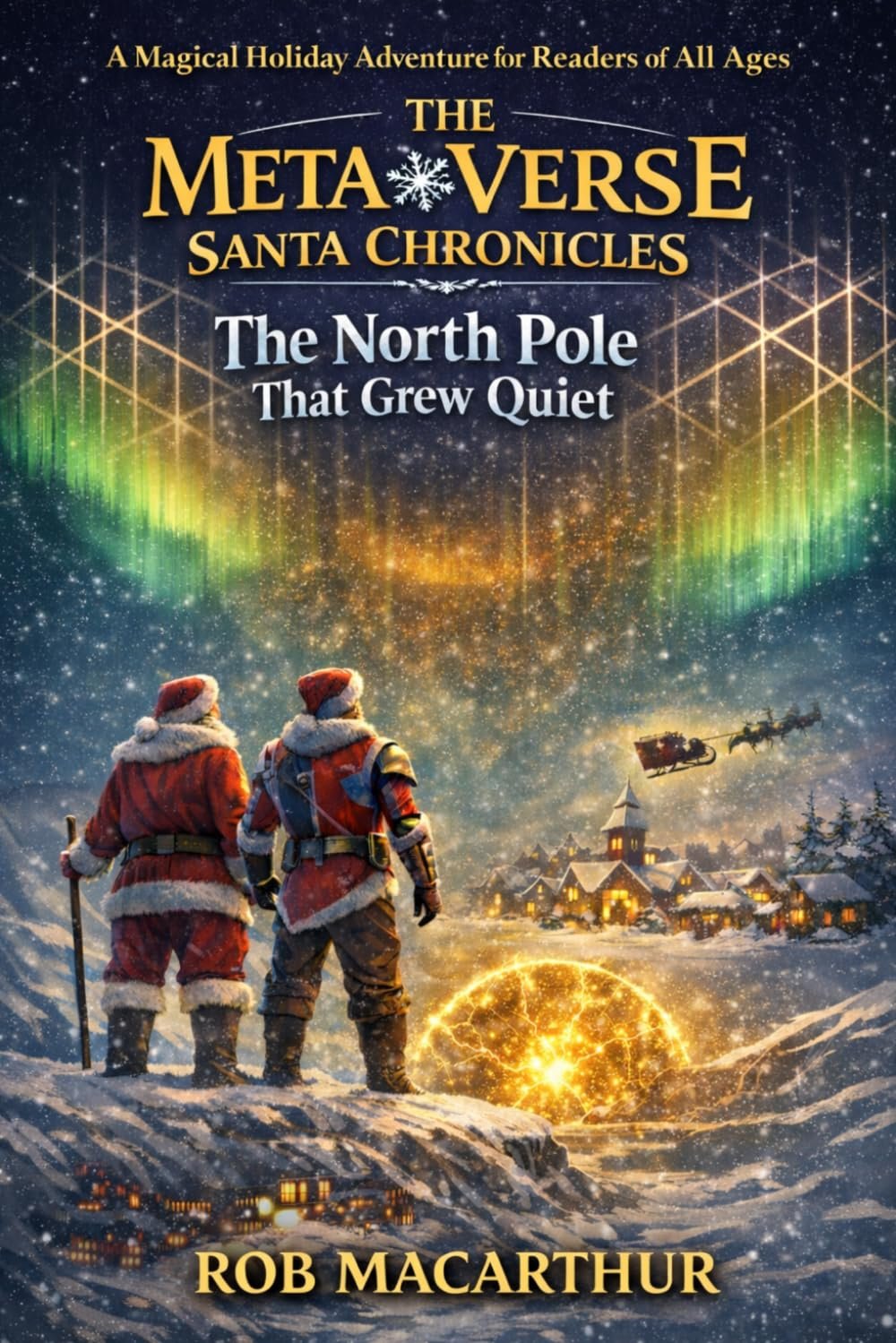
The MetaVerse Santa Chronicles – Book One – The North Pole
The MetaVerse Santa Chronicles opens with an evocative anomaly: a North Pole that has grown quiet. Rob MacArthur labels this the first book in a sequence, and the title suggests a collision between…
Books worth discovering. Authors worth knowing.
The MetaVerse Santa Chronicles opens with an evocative anomaly: a North Pole that has grown quiet. Rob MacArthur labels this the first book in a sequence, and the title suggests a collision between the old machinery of Christmas wonder and a technological world where virtual experience can seem to displace physical presence. That premise is suggestive…
Considered reviews, grounded in the book’s documented promise.
The MetaVerse Santa Chronicles opens with an evocative anomaly: a North Pole that has grown quiet. Rob MacArthur labels this the first book in a sequence, and the title suggests a collision between the old machinery of Christmas wonder and a technological world where virtual experience can seem to displace physical presence. That premise is suggestive without being fully documented. Silence at the North Pole might be a mystery, a political failure, a fading belief or an interruption of ordinary work; the accessible listing does not explain which. A responsible review begins with the evocative question and refuses to invent the answer.
A familiar myth made uncertain
Santa's world is built around repetition: the season returns, preparations begin and a promise is renewed. To imagine that world falling quiet is to interrupt a ritual so familiar that its absence becomes frightening. The title therefore has real literary force before any plot is described. Familiar folklore can sustain reinvention because readers already possess emotional expectations. The test for a new holiday fantasy is whether it uses those expectations as the basis for an unfamiliar human question rather than merely changing the appearance of elves and machinery.
The digital promise and its cost
The word MetaVerse invites readers to consider virtual identity, simulation and technological mediation, but it does not by itself prove that the novel criticizes screens or platforms. A useful critical question would be how digital presence changes our sense of community. Does a simulated gathering preserve connection or replace the labor of meeting? Does technology enlarge imagination or reduce wonder to something owned and optimized? These are contextual possibilities, not claims about scenes that have not been independently verified.
What holiday stories owe children and adults
Seasonal stories have to accommodate very different emotional histories. For some readers, Christmas evokes shared delight; for others it can intensify loneliness and absence. The image of a quiet North Pole could hold both. The most durable holiday fiction usually leaves room for loss without allowing it to erase generosity. A critic should therefore look for tonal flexibility: humor can coexist with melancholy, and spectacle can grow from care rather than overwhelm it. The public materials do not yet establish the intended age range or the book's narrative voice.
The first-book challenge
A book labeled one in a chronicle should offer both immediate satisfaction and an invitation to continue. Holiday mythology provides a recognizable framework but can also encourage excessive world-building. Readers need a protagonist with an intelligible want, an atmosphere that sustains the title and consequences more specific than a vague threat to Christmas. Until an extended synopsis or excerpt becomes available, any judgment about those features would be conjecture.
The honest attraction of a title
The book deserves a place on the discovery list because the collision of Metaverse and North Pole is an unusual cultural prompt. It may turn out to be comic, wistful, dystopian or adventurous; the supplied listing alone does not settle the matter. Its critical promise lies in asking what survives when familiar forms of togetherness stop functioning. The completed text must be consulted before that promise can be pronounced fulfilled.
Who will value this book
For curious readers of holiday fantasy and speculative stories about digital culture. This is a limited-source commentary on the verified title and series designation; no character names, plot events or age suitability are asserted. A real synopsis or sample is essential before publication.
Scope of this assessment
This is a research-based editorial review drawn from identified bibliographic, author and publisher sources. It considers the work’s documented premise and the critical questions it invites, without claiming a complete firsthand reading. No unverified scene, character action or ending is asserted.
About the book.
An evidence-bounded critical introduction to holiday fantasy and digital-age allegory. Published descriptions support the stated premise; interpretations are identified as editorial analysis, not confirmed plot details.
This is an unsponsored, research-based editorial review, not a claim to firsthand reading of the complete book. Only title/author and basic bibliographic listing verified. The Metaverse interpretation is explicitly an editorial hypothesis, not confirmed plot. Requires substantial source research.
Found a book worth opening?
Books worth discovering. Authors worth knowing.
Return to the Journal →