
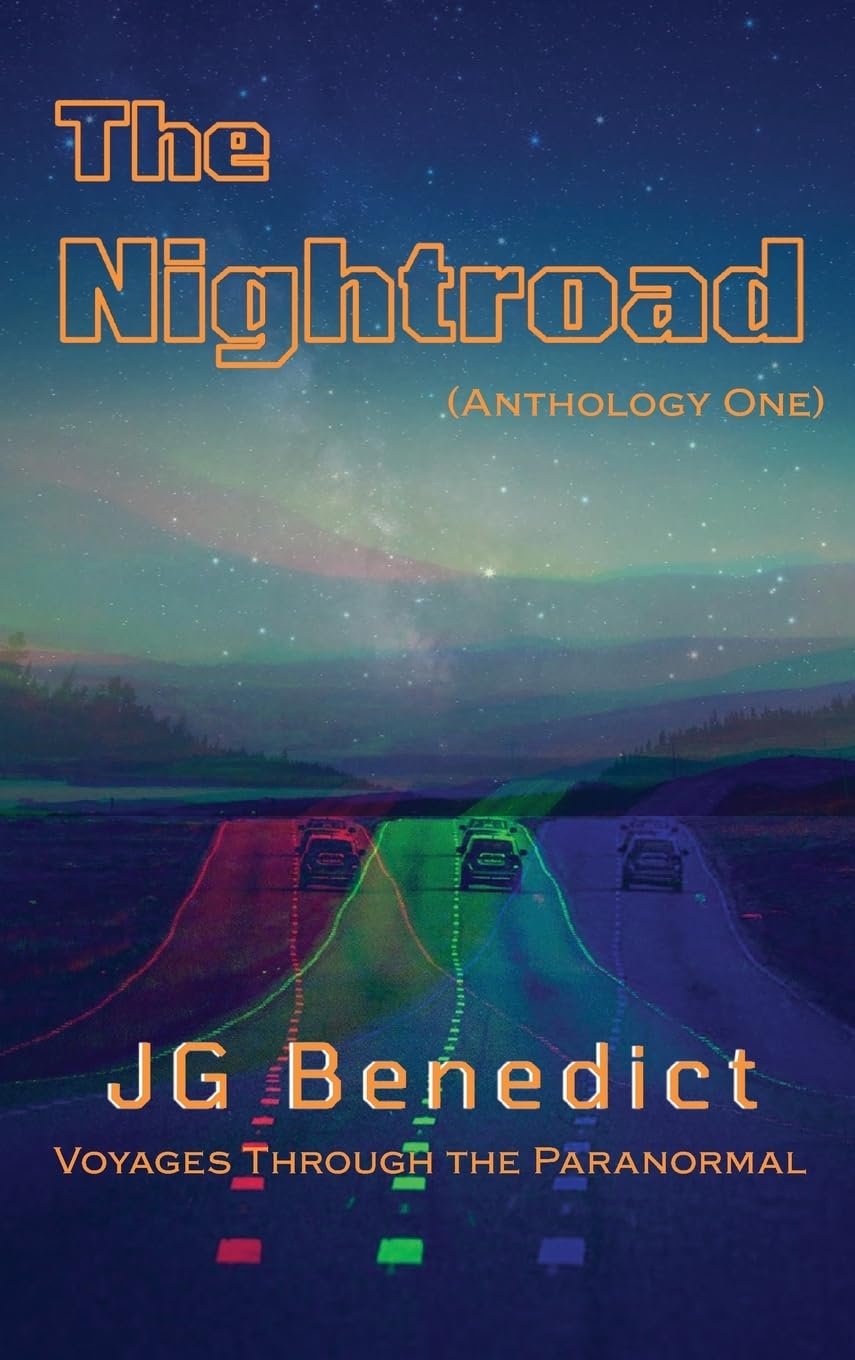
The Nightroad, Anthology One
A hidden haunted route connects frightening places and paranormal encounters in JG Benedict’s linked collection of dark journeys.
Books worth discovering. Authors worth knowing.
A hidden haunted route connects frightening places and paranormal encounters in JG Benedict’s linked collection of dark journeys.
Original editorial introduction, grounded in the verified book edition and public descriptions.
The most unsettling roads are not always marked on maps. JG Benedict's The Nightroad, Anthology One imagines a route appearing at the edges of familiar places, where ordinary roads become entrances to a darker network. On the author's official site, the Nightroad is described as a hidden course linking strange, haunted locations, used by travelers whose purposes range from exploration to something much less benign. The premise gives this anthology a distinctive unifying image: a road that can carry separate supernatural encounters while hinting that the different stories belong to one dangerous territory.
The road as more than a setting
A haunted house usually stands in one place. A mysterious road can lead anywhere, carrying danger between communities and making the ordinary act of travel unexpectedly consequential. Benedict's description places the Nightroad around dead ends, rarely used roads, and exits where familiar geography begins to fail. The effect is not simply that a character reaches a frightening destination. The path itself becomes part of the menace. A driver may be unsure whether the route is an escape or the thing from which escape is needed. That reading follows the author's stated premise without supplying imaginary stops or encounters.
Road stories also create a useful form of suspense: movement is continuous, but arrival is uncertain. The traveler can choose to go forward, turn back, wait, or follow a companion, yet every decision depends on incomplete knowledge. In paranormal fiction, that uncertainty can be more important than a single revealed creature. Benedict's world suggests a geography that refuses to be fully mastered by the people entering it. Readers can ask how an ordinary map, once trusted, stops being enough. The book's official description establishes the eerie network, but it leaves the detailed rules of access and escape for the stories themselves to explain.
An anthology held together by mystery
The title identifies this as Anthology One, and the author calls it the beginning of a journey through paranormal fiction. A published table of contents lists several individual pieces, including The Final Case of Marion Hollister, Joyride, The 6th Wall, The Pale House, Mountain Song, and Ancient Memory. It also includes sections of Rook's Story distributed through the volume. These bibliographic details offer a more concrete sense of architecture than the generic term anthology. The interleaving of a framing story suggests that readers may find connective material between otherwise separate encounters, though its complete narrative significance cannot be established from titles alone.
This arrangement may satisfy two different reading appetites. One reader can enjoy the freshness that a new setting or supernatural problem provides; another can look for accumulating hints about the larger world. The word 'One' implies room for further voyages without proving that a later volume resolves particular mysteries. The attractive feature of a shared haunted route is that it can make scattered horrors feel connected without requiring every story to follow the same protagonist. A responsible spotlight should not assign a monster, ending, or moral to a story merely because its title is suggestive. The verified structural details are enough to explain why the collection's form is part of its attraction.
The border between the suburban and the wild
The author describes the western New York landscape around Batavia as an influence on his fiction, particularly the meeting place between ordinary development and persistent swamp or wilderness. His official biography identifies the fictional county of Hueta as a backdrop to many stories. This context helps explain the Nightroad's appeal as a literary idea: the supernatural does not have to replace everyday life completely. It can intrude at a road junction, beyond a familiar neighborhood, or where a settled place ends. The comfort of knowing one's surroundings is precisely what makes a small violation disturbing.
This landscape should not be confused with a claim that every story takes place at a particular real location. Author biography provides creative context, not a scene-by-scene atlas. What readers can notice is the potential conflict between human order and the parts of a place that resist easy naming. A suburban road implies destinations and routines. A haunted exit suggests that those assumptions may conceal something older or stranger. Even a single unexpected turn can change how a person understands the world they thought they inhabited. The collection's premise makes that disruption foundational rather than exceptional.
Different reasons to travel into darkness
Benedict's publisher-facing description distinguishes people who brave the Nightroad to explore from others with more sinister purposes. The road therefore appears to offer more than accidental victims. Some travelers may seek knowledge, power, or experiences that ordinary life cannot provide. Others may follow curiosity into danger. That moral variety could allow the collection to move beyond the simple formula of an innocent person encountering an inexplicable threat. The official source does not give an inventory of travelers or their individual motives, so a feature should keep the distinction at the thematic level.
The difference between danger that arrives uninvited and danger that someone actively pursues is important. An explorer may believe a mystery can be studied; a malicious traveler might regard other people as part of the terrain to exploit. Both attitudes can be tested by a world that does not obey human rules. This is one way to read the Nightroad as a shared setting for stories with differing ethical perspectives. The road connects them spatially, but the decisions of the people entering it may create the emotional differences between tales.
Who should take this journey?
The Nightroad, Anthology One is an inviting prospect for readers of paranormal short fiction, atmospheric horror, uncanny geography, and linked story collections. Its author-supported premise points to haunted routes and a hidden supernatural frontier rather than a single conventional haunted building. Readers who enjoy recurring framing mysteries may appreciate the documented Rook interludes, while readers who prefer a self-contained experience can explore the individual tale structure. The exact intensity of violence, horror, and other potentially sensitive elements cannot be responsibly specified from the official synopsis and contents alone. The clearly supported recommendation is for audiences who enjoy the idea that the everyday world contains passages to something frighteningly unfamiliar.
The promise of an open door
A path between places can symbolize freedom, but Benedict's Nightroad turns passage into a question about what we are willing to encounter. The official description leaves room for stories about recklessness, discovery, exploitation, and survival; the contents confirm a varied collection assembled within that frame. No claim of firsthand reading or an invented ending is necessary to see why the project is distinctive. The central image is strong enough: a road that belongs to the outskirts, appears where the familiar world should be secure, and carries travelers into stories they cannot fully control. The reader's journey begins with wondering what waits beyond the next unremarkable turn.
About the book.
A hidden haunted route connects frightening places and paranormal encounters in JG Benedict’s linked collection of dark journeys. Public bibliographic details have been distinguished from editorial interpretation.
Independent editorial feature: this is a source-based introduction, not a firsthand review of the complete book. Bibliographic descriptions and author or publisher statements are interpreted with clear source limits. The original purchase URL remains unchanged; WordPress cover media is added later by the owner’s publisher.
Found a book worth opening?
Books worth discovering. Authors worth knowing.
Return to the Journal →