
What the Sky Carries
A wartime meeting, a scarf patterned with airplanes and a pilot’s later travels shape Ginette Guy Mayer’s story of enduring memory.
Books worth discovering. Authors worth knowing.
A wartime meeting, a scarf patterned with airplanes and a pilot’s later travels shape Ginette Guy Mayer’s story of enduring memory.
Original editorial introduction, grounded in the verified book edition and public descriptions.
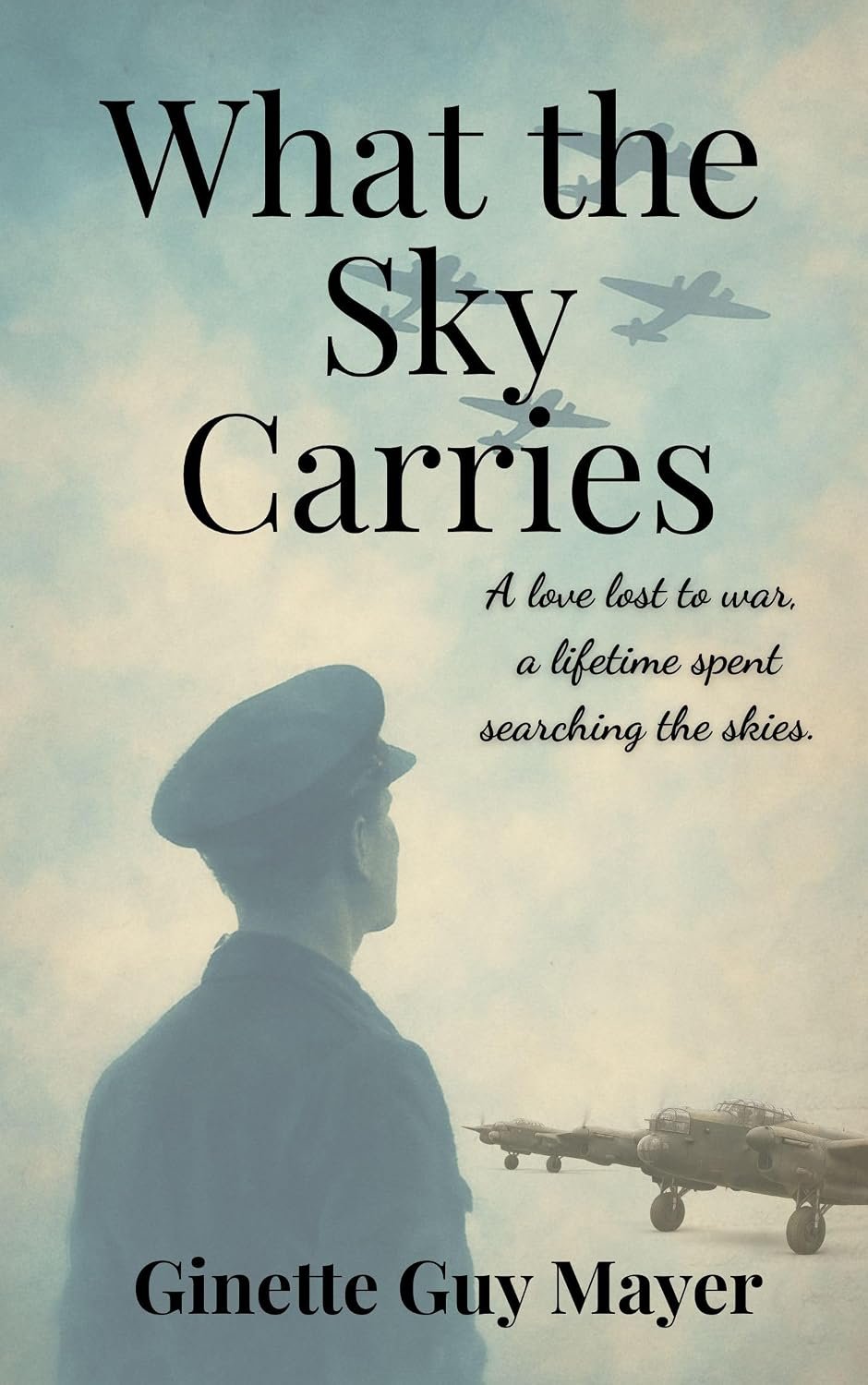
A keepsake can be almost weightless and still travel through decades: a scarf with tiny blue airplanes, given as an intimate token before war and separation turn a brief meeting into a lasting memory. In Ginette Guy Mayer's What the Sky Carries, the publisher's description identifies a Canadian airman, a nurse he meets in England, and a wartime connection that follows him into his later life as a commercial pilot. The premise brings historical romance into conversation with memory, time, and the uncertain distance between keeping a promise and having the opportunity to fulfill it.
Robbie Connors takes to the air
According to published book information, Robbie Connors joins the Royal Canadian Air Force during the Second World War. He is portrayed as steady and quiet, moved by a desire to serve and perhaps to find meaning in the sky. This introduction is important because it establishes flight as more than occupational detail. It becomes the physical environment in which he makes a wartime commitment, meets someone he remembers, and later spends his career. The available synopsis does not say which missions he flies or how his training proceeds, and those historical particulars must not be invented to intensify the article.
The wartime setting inevitably gives the romantic encounter a different sense of time. During a period when travel, danger, and orders can separate people abruptly, even a short meeting may acquire exceptional significance. This does not mean that every wartime romance is predetermined to be tragic. It means ordinary expectations about meeting again become unstable. Mayer's premise uses that instability directly: Robbie meets a nurse whose warmth leaves a lasting impression, and the two exchange a promise and a scarf before circumstances divide them. The details are simple enough to allow imagination while remaining anchored in the book's described opening.
A scarf as a portable sky
The printed description specifies the scarf decorated with tiny blue airplanes. That concrete object gives the premise much of its emotional character. Unlike an abstract vow, a keepsake can be folded, stored, carried, misplaced, and rediscovered; it links memory to touch and sight. The little airplanes also echo Robbie's work, making the gift specific to his journey rather than a generic emblem of romance. Readers may look for how the text uses material objects to keep absent people present, though any later appearance of the scarf must be left for the novel itself to confirm.
A keepsake may preserve an event but not explain it. Robbie's memory of one meeting can remain vivid even while his knowledge of the woman he met stays incomplete. That difference between memory and understanding offers a subtle source of tension. A person can cherish an encounter without knowing what the other person's life became. The reader may therefore ask what fidelity means when practical information is scarce and years are passing. Is remembrance a form of commitment, a refuge from new possibilities, or something that changes meaning as the person remembering grows older? The synopsis supports these questions without disclosing the answer.
The long journey after the war
The public description follows Robbie into a career flying commercial aircraft for KLM. That shift from wartime service to civilian travel widens the novel's time horizon. A pilot may cross oceans and cities while carrying a private story that remains geographically and emotionally unfinished. The recurring movement is suggestive: someone whose profession makes travel possible may still be unable to reach one particular person. In this way, the sky functions as both a route and a reminder. The available materials do not establish the details of Robbie's later relationships or the precise ending, and a responsible feature should leave those developments intact for the reader.
Historical fiction also creates a double obligation. A novelist may imagine personal experiences while situating them amid real institutions and events. The Royal Canadian Air Force and KLM are real-world references, but the fictional character's participation is part of the story, not a historical fact needing retrospective confirmation. Readers who enjoy period detail may appreciate the book's aviation setting while recognizing that the factual accuracy of each scene would require comparison with the complete text. This feature uses the sourced premise as the basis for interpretation, not as proof of every circumstance that its characters might face.
How a painting became a story
Mayer has described the novel's creative origin in her own essay. A painting of a pilot by an artist in the Thousand Islands region prompted a short story about Robbie and Helen, and an encouraging public reading helped her expand the work into a novel. This author-reported context is unusually valuable: it demonstrates how an image can become a question about the life just outside its frame. What happened before the painted moment? What absence or aspiration might a face or uniform suggest? The development from visual prompt to extended narrative is part of the project's documented background, distinct from the imagined events inside the book.
That origin also explains why the novel's central image feels so important. Painting captures a single instant; storytelling tests how that instant echoes over time. The title's suggestion of the sky carrying something unseen can apply both to airplanes in motion and to the emotional burden of unfinished recollection. These are literary interpretations, not quotations from the author. The relationship between a captured image and an unfolding life gives readers a way to approach a romance whose central emotional force depends on the passage of years.
Who might be moved by this story?
What the Sky Carries may be a good choice for readers who enjoy historical romance with a Second World War backdrop, aviation settings, and stories of lasting emotional memory. The documented synopsis emphasizes a quiet airman, an English nurse, a brief bond, a keepsake, and later years of travel rather than battlefield action. Readers expecting an operational history of the air force should look for a different kind of book; here historical circumstances frame an imagined personal relationship. Readers sensitive to themes of separation and wartime uncertainty should know they shape the promotional premise, although the exact emotional outcome is not established by the sources cited here. Its clearest appeal is a romance interested in what a single meeting can mean across an entire life.
The question the skies cannot answer
Travel can shorten distance, but it cannot turn memory into present knowledge on demand. This tension makes the book's described story more compelling than a simple promise of reunion. Robbie's career keeps him in motion while the scarf and the remembered nurse keep a moment of his past emotionally near. Mayer's own account of the painting that inspired the novel adds another layer: art has carried a fleeting image into a narrative about time. The source-grounded invitation to readers is to follow how the novel handles love that has been interrupted, without assuming it offers a particular resolution. That choice belongs to the pages beyond the synopsis.
About the book.
A wartime meeting, a scarf patterned with airplanes and a pilot’s later travels shape Ginette Guy Mayer’s story of enduring memory. Public bibliographic details have been distinguished from editorial interpretation.
Independent editorial feature: this is a source-based introduction, not a firsthand review of the complete book. Bibliographic descriptions and author or publisher statements are interpreted with clear source limits. The original purchase URL remains unchanged; WordPress cover media is added later by the owner’s publisher.
Found a book worth opening?
Books worth discovering. Authors worth knowing.
Return to the Journal →