
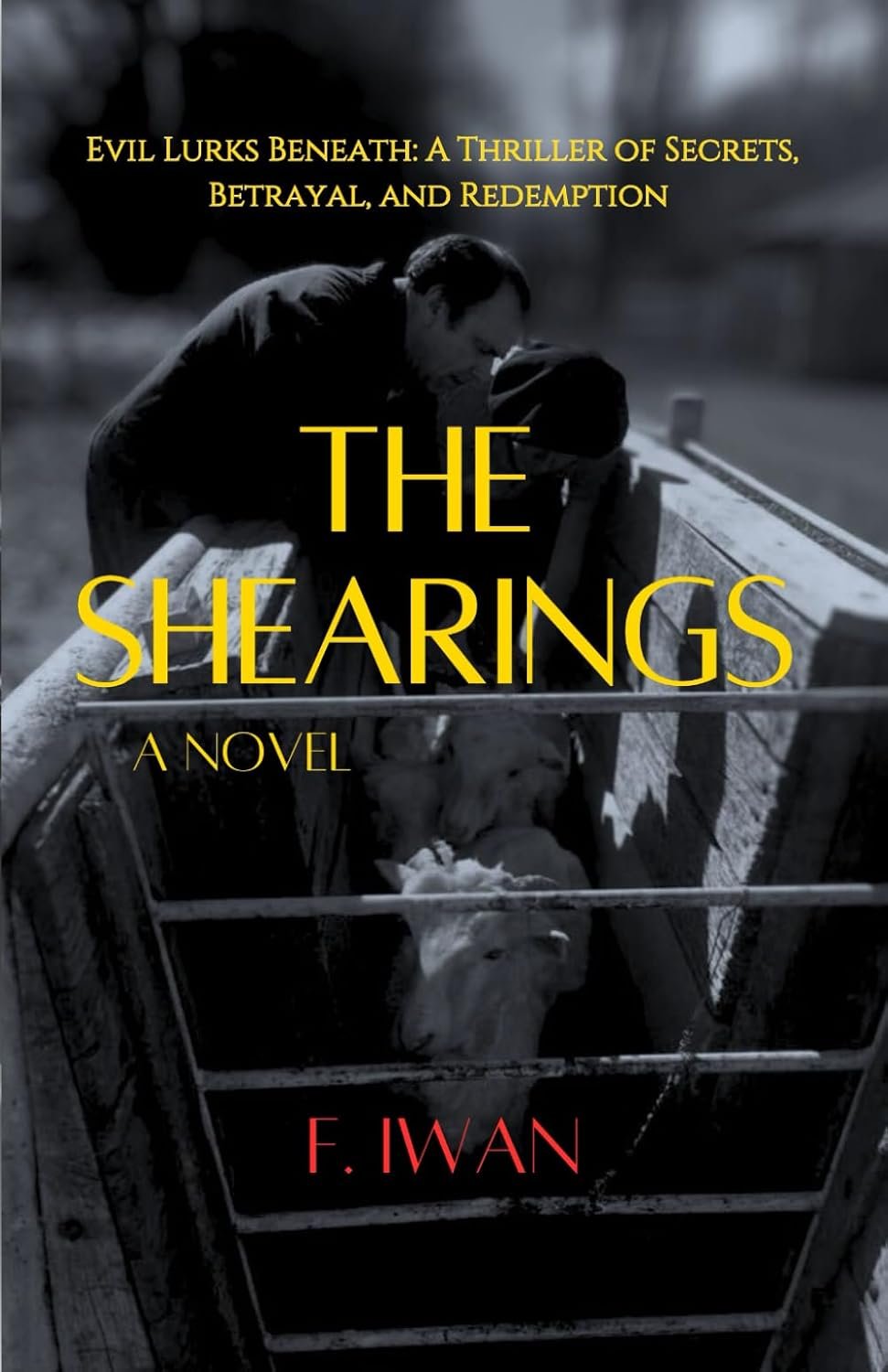
The Shearings
Attorney Charlotte investigates a modern kidnapping case whose roots reach back to her traumatic childhood and a Welsh-American family history.
Books worth discovering. Authors worth knowing.
Attorney Charlotte investigates a modern kidnapping case whose roots reach back to her traumatic childhood and a Welsh-American family history.
Federico Iwan’s The Shearings begins from the tension between a modern pursuit of justice and a childhood catastrophe that refuses to remain buried.
A Crime With Roots in the Past
Federico Iwan’s The Shearings begins from the tension between a modern pursuit of justice and a childhood catastrophe that refuses to remain buried. The author’s official synopsis introduces Charlotte, a United States attorney working in Washington, D.C., whose investigation of abduction and murder leads toward people and places linked to her own past. Independent review coverage fills in part of that premise: as a teenager in western Virginia, Charlotte survived a violent kidnapping that claimed her younger sister. Decades later, a prosecution draws her toward connections she could scarcely have expected. The story therefore has two forms of suspense. One asks whether the people responsible for current harm can be exposed. The other asks what it means for a professional investigator to discover that her private history is entangled with the evidence. That layering moves the novel beyond a procedural puzzle into territory where truth has emotional as well as legal consequences.
Charlotte’s Professional Duty and Personal Fear
Charlotte’s job requires a disciplined approach to testimony, proof and legal process. Her own memories, however, bring grief and unfinished questions into the case. This contrast is central to the novel’s advertised appeal. A prosecutor must not substitute certainty for evidence, while a survivor may carry a powerful sense that justice has been delayed. Iwan’s plot places these concerns in the same character without giving the reader a simple formula for resolving them. The modern investigation is not described as identical to Charlotte’s childhood experience; it becomes troubling precisely because seemingly separate histories begin to overlap. A reader can follow the professional questions—what can be demonstrated, who can be trusted, which leads remain alive—while recognizing the psychological difficulty of reopening an old wound. The book’s tension arises from the possibility that solving the case may demand as much from Charlotte personally as it does from her legal skills.
The Land Behind the Story
The author connects The Shearings to his family history as a descendant of Welsh settlers in Patagonia, Argentina. He describes the hardships of his ancestors, the agricultural communities they established and the role of Indigenous knowledge in their survival. That background informs his interest in Welsh-descended communities elsewhere, including Virginia, where the novel’s historical strands connect to the Monacan people. The creative inspiration is more specific than a generic interest in old family secrets. It joins the history of settlement, land use and cross-cultural relationships to a fictional modern crime. Such material requires care because a novelist’s imaginative reconstruction should not be mistaken for a definitive history of Indigenous communities or migration. Readers may nonetheless appreciate how an author’s heritage can provide a textured framework for suspense. The landscape is not merely scenery; family attachments to place become part of the circumstances that shape loyalty, silence and a long search for answers.
The Crime Beneath Familiar Relationships
The book’s extended description refers to trafficking and corruption, with Charlotte learning that dangerous connections may reach into her own community and family networks. This makes familiarity itself a source of unease. In many thrillers, an outsider arrives to disrupt a safe town; here the most unsettling possibility is that people who seem to belong within a trusted circle may have knowledge they have never disclosed. The suspense turns on access: who knows the history, who controls the records, and whose interpretation of the past has been accepted without sufficient scrutiny? Iwan’s narrative signals that Charlotte has to revisit relationships she once thought she understood. That should not be read as a license to speculate about the guilt of every named person in the book. The feature preserves the distinction between a published premise and a resolved mystery. Readers deserve to encounter the book’s discoveries and reversals in the order the author chose to reveal them.
Welsh Heritage and the Idea of Inheritance
The title The Shearings calls attention to an agricultural context, and the author’s family history includes cattle and sheep ranching. The relationship between land and family becomes an especially fruitful lens when a crime story moves across generations. An inheritance may consist of a home, property or a profession, but it may also be a set of half-understood obligations and remembered grievances. Iwan’s account of his ancestors’ journey adds another layer: migration changes where a family lives without erasing the stories it carries. A thriller built around such legacies can ask whether loyalty helps preserve truth or encourages silence when a painful fact threatens a cherished identity. The published summaries confirm historical and family elements, but they do not establish every symbolic role played by farming in the actual narrative. Here, the meaning of inheritance is an editorial question to bring to the text, not a claim about an unverified plot revelation.
A Thriller With Difficult Material
The source descriptions include kidnapping, abuse and trafficking involving children. These are serious subjects, and an article should neither hide them entirely nor turn them into sensational spectacle. The book’s premise places suffering within a pursuit of accountability, but readers sensitive to these topics may want to consider the content before beginning. It is also worth separating the realism of a legal setting from any assertion that the events happened as portrayed. The Shearings is a work of fiction shaped by historical interests and professional knowledge. Iwan’s legal career may contribute to the procedural atmosphere, while his family research provides cultural depth. Neither background converts the plot into documentary evidence about a real individual or group. An attentive approach recognizes the harm represented in the narrative while allowing the author’s mystery to unfold without exploiting the vulnerability of its characters for easy dramatic effect.
Federico Iwan’s Personal Connection
Iwan’s official book site is unusually helpful because it gives a direct account of his creative motivation. He describes growing up with Welsh culture in Patagonia and later connecting those experiences to his fascination with legal thrillers, crime narratives and questions of historical justice. Such context can enrich a reading without prescribing exactly what readers must think. A novelist draws selectively from biography, combines locations and invents events that no single family chronicle would contain. The resulting fiction may invite independent curiosity about Welsh settlement in Argentina or about the Monacan people, but the book should not be used as the sole source for researching either history. The more reliable insight is about storytelling: a writer can use personal inheritance to give a crime narrative stakes that extend beyond the immediate investigation. In The Shearings, the announced collision of family memory and legal accountability gives that creative choice a concrete form.
Truth as a Dangerous Responsibility
Readers drawn to multilayered crime fiction may find The Shearings appealing for its combination of a determined attorney, a long-unsolved trauma and threats linked to powerful relationships. The historical dimension distinguishes it from a stand-alone courtroom drama; the procedural dimension keeps the family themes from becoming purely retrospective. This research-based feature identifies the published setup and author background without claiming a firsthand reading of all chapters or revealing the mystery’s answer. The central question remains compelling even without the resolution: what happens when the truth a person is professionally obliged to pursue endangers the story she has told herself about home? Charlotte’s predicament suggests that justice is not only an abstract institution but a demand carried by people whose pasts may be at stake. Whether the novel delivers a satisfying resolution is for readers to decide, but its documented premise offers plenty of reason to turn the opening page.
About the book.
Legal suspense, crime thriller and intergenerational historical fiction. Attorney Charlotte investigates a modern kidnapping case whose roots reach back to her traumatic childhood and a Welsh-American family history.
Sponsored book feature. Independent research-based commentary based on publicly available book details; not a claim of first-hand full-text review. The designated cover placeholder will be resolved by the owner’s publishing automation.
Found a book worth opening?
Books worth discovering. Authors worth knowing.
Return to the Journal →