
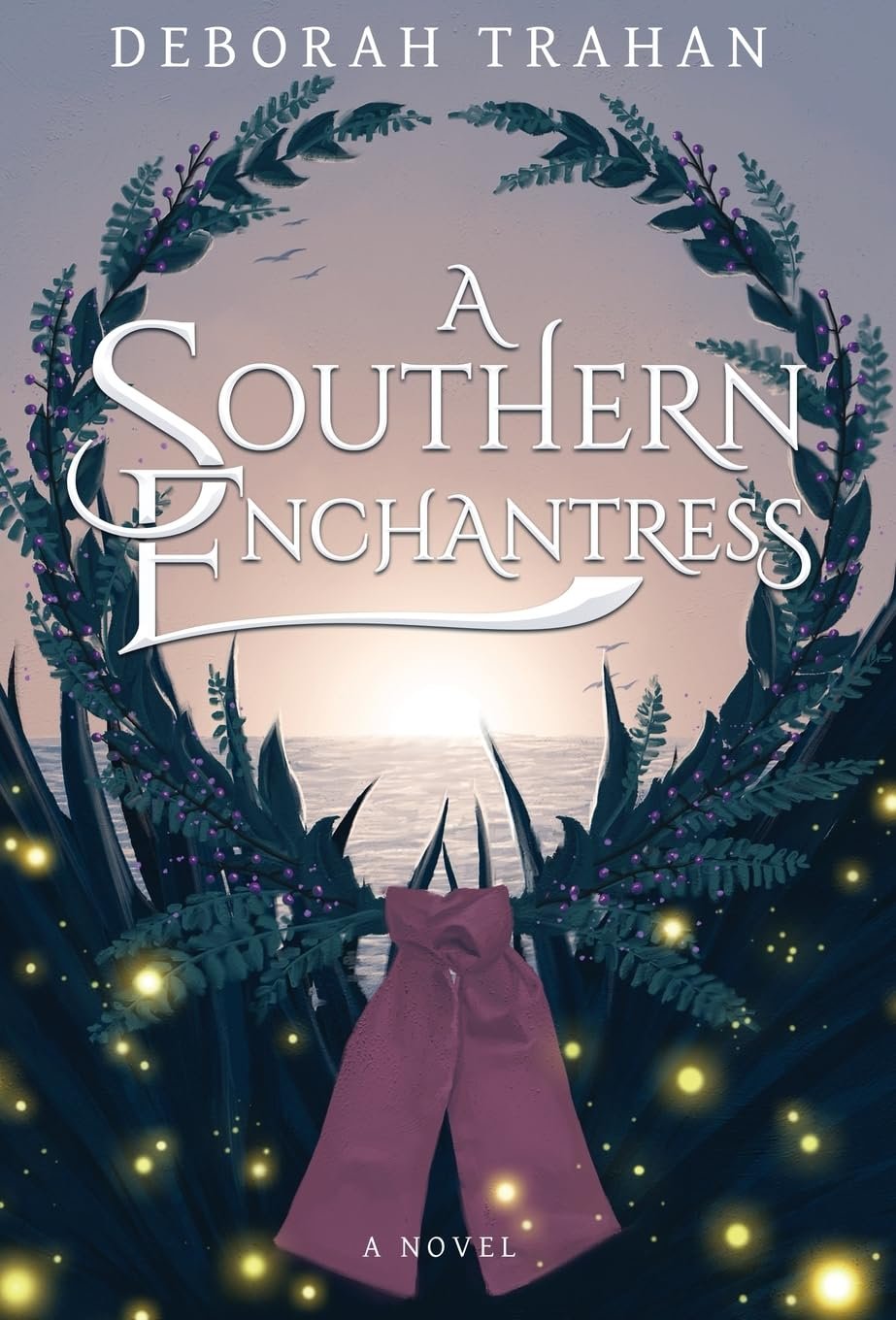
A Southern Enchantress
In New Orleans, Suzanne’s romance with Max coincides with vengeful hauntings that pull her toward a magical family inheritance.
Books worth discovering. Authors worth knowing.
In New Orleans, Suzanne’s romance with Max coincides with vengeful hauntings that pull her toward a magical family inheritance.
Deborah Trahan’s A Southern Enchantress introduces Suzanne, a woman whose unexpected meeting with Max at a New Orleans Garden District gathering arrives just as the supernatural begins pressing more insistently into her life.
A Haunting Begins at a Garden District Party
Deborah Trahan’s A Southern Enchantress introduces Suzanne, a woman whose unexpected meeting with Max at a New Orleans Garden District gathering arrives just as the supernatural begins pressing more insistently into her life. The publisher’s synopsis describes Suzanne as clairsentient, someone unusually receptive to impressions beyond ordinary perception. Her attraction to Max gives the book a romantic current, but the hauntings soon demand attention to old wrongs. The encounters are not presented as random decorative scares. They appear to carry unfinished claims from the past, forcing Suzanne to examine the inheritance she has tried to keep at a distance. This setup draws on the atmosphere of New Orleans and the Mississippi Gulf Coast while linking personal desire to family history. The story’s appeal lies in that conjunction: a potential new relationship cannot be considered apart from the memories, obligations and unsettled lives that seem to crowd around it.
The Magic Suzanne Tried to Leave Behind
The official description reveals that Suzanne was raised by a mother who practiced hoodoo and expected her daughter to take up folk magic. Suzanne rejected that path, but her new encounters make avoidance increasingly difficult. This family conflict gives the supernatural narrative an emotional foundation. A daughter may love the people who raised her while resisting the roles they imagine for her adult life. Suzanne’s hesitation is therefore not merely disbelief in magic; the advertised history suggests a disagreement over identity and inherited responsibility. The novel’s magical traditions should be treated as part of the author’s fictional world rather than reduced to exotic decoration. Hoodoo has real cultural histories that deserve independent research and care, even as an individual novel uses its own imaginative terms. Readers can follow Suzanne’s fictional struggle without assuming the story defines an entire living tradition or that every paranormal effect described has a real-world counterpart.
Max and the Pressure of the Present
The introduction of Max provides an important counterweight to the story’s preoccupation with generations past. Suzanne is not simply receiving messages from ghosts in isolation; she is also navigating desire and the uncertain possibilities of an intimate relationship. The publisher calls Max an alluring rogue, a description that signals attraction without explaining whether trust will be easy. A romance becomes more interesting when the protagonist cannot compartmentalize it from her other challenges. Suzanne’s attempts to understand the hauntings may affect what she shares, what she conceals and how she decides whom to rely upon. The public synopsis establishes the developing relationship, not its outcome, so it would be misleading to forecast a happy ending or invent betrayals. Its function within the premise is nevertheless clear: ordinary questions of vulnerability and trust continue even when the demands of the unseen world become impossible to ignore.
The Phantom Connected to Another Era
The publisher identifies a beloved specter trapped since the 1940s as an important presence, and the author’s interview describes a character named Addy as a phantom wife. These details establish a bridge between two periods without disclosing every secret the story contains. A dual-timeline novel can make the past feel active rather than finished; an event in one decade may alter the meaning of a relationship in another. For Suzanne, the encounter with a ghost suggests that understanding herself may require attention to lives and choices she did not personally witness. The challenge for the reader is to keep distinct what the public premise confirms and what remains hidden within the chapters. It is legitimate to expect mysteries of memory, retribution and attachment. It is not legitimate to invent the specific harm Addy suffered or announce who, if anyone, is finally punished. Those discoveries belong to Trahan’s own storytelling.
A Landscape With Its Own Memory
New Orleans and the Mississippi Gulf Coast are named in the publisher description, and Trahan has spoken about the coastal landscape where she lives. Such settings offer more than atmospheric detail for a paranormal novel. Cities and shorelines contain layers of migration, architecture, family history and local storytelling. A writer working in a dual timeline can place present experience beside earlier eras in ways that make familiar streets feel newly complicated. The title’s southern emphasis and the Garden District opening invite attention to how place shapes Suzanne’s sense of obligation. Still, evocative scenery should not be mistaken for an exhaustive representation of the region. Trahan writes a particular fictional story, not a cultural encyclopedia. The most rewarding reading may be to notice what she selects: a gathering where romance begins, Gulf Coast spaces associated with memory, and the crossing of everyday locations by supernatural demands. Those details let the setting participate in the mystery rather than merely surround it.
Vengeance, Protection and Generational Love
A central phrase in the book’s description is the demand to avenge an old wrong. Revenge can provide a clear dramatic engine, but it also raises difficult ethical questions. Who has the authority to seek repayment for injuries from another time? Can present people be responsible for consequences they never chose? Suzanne’s family legacy and the specter’s unresolved experience make these concerns more than abstract debates. Trahan’s publisher frames the novel as celebrating the lasting love of women across generations. That gives a different emphasis to the haunting: beyond fear, it may involve protection, recognition and the wish for a forgotten person to be heard. The feature does not turn that possibility into a verified ending. Instead, it identifies a tension already present in the synopsis between settling accounts and sustaining relationships. Readers can explore how the author balances those impulses as Suzanne moves closer to the magical identity she once resisted.
The Author’s Journey Into Fiction
Trahan’s own background adds a useful context for this novel. Her website and publisher interview describe decades of reading, writing and teaching English, including years in secondary education. She has said the working title was The Phantom Wife before revisions led to A Southern Enchantress. That change is revealing because it shifts attention from one ghostly figure to Suzanne as the central character and to a genre that blends paranormal, fantasy and historical strands. A title can influence the reader’s expectations long before the story begins, and Trahan’s explanation makes the creative decision unusually visible. Her stated intention was to write the kind of novel she herself wanted to read. Readers do not need to know that biography to enjoy the book, but it clarifies why the finished premise combines romantic energy, haunted memory and the persistent claims of family history.
When the Past Refuses to Stay Quiet
A Southern Enchantress is likely to attract readers who enjoy supernatural fiction with strong regional atmosphere, romantic complications and mysteries extending across generations. The verified premise contains enough distinctive elements to orient a reader: Suzanne’s estrangement from an inherited magical role, her attraction to Max, haunted encounters demanding redress and a ghost connected to the 1940s. This article is a research-grounded feature, not a claim to have independently assessed the whole novel’s prose or its resolution. What makes the setup compelling is the suggestion that refusing a family inheritance does not necessarily free someone from its consequences. Suzanne may have to decide which parts of that inheritance she can claim on her own terms. The dual timelines and Gulf Coast setting offer a stage for that decision, while the ghost’s unfinished story promises to complicate easy distinctions between love, duty and justice. The final meaning remains in the pages themselves.
About the book.
Southern Gothic, paranormal romance and dual-timeline family fiction. In New Orleans, Suzanne’s romance with Max coincides with vengeful hauntings that pull her toward a magical family inheritance.
Editorial book feature, not paid sponsorship. Independent research-based commentary based on publicly available book details; not a claim of first-hand full-text review. The designated cover placeholder will be resolved by the owner’s publishing automation.
Found a book worth opening?
Books worth discovering. Authors worth knowing.
Return to the Journal →