
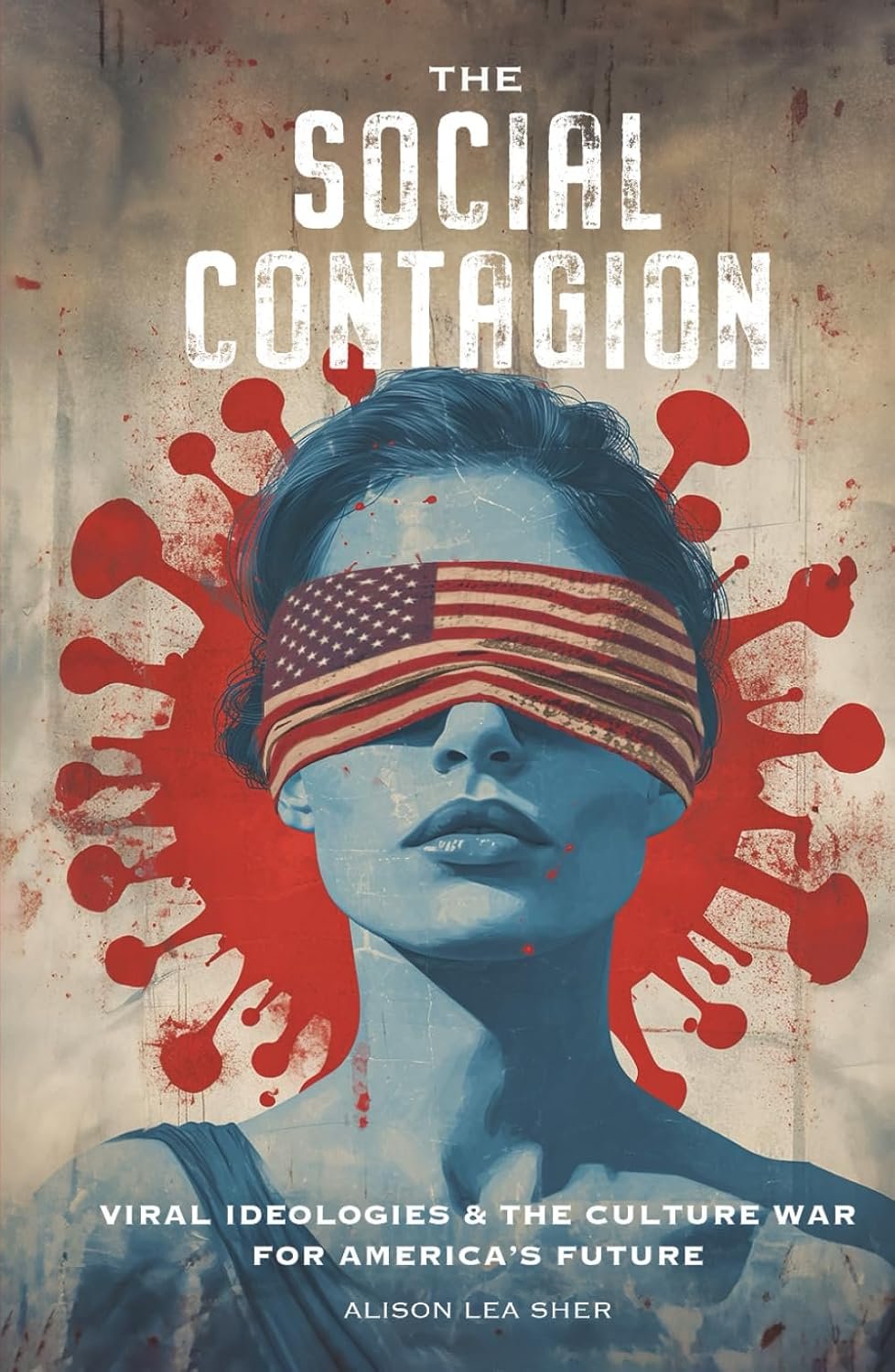
The Social Contagion
Alison Lea Sher examines how digital tribalism, pandemic-era arguments and competing ideas about belonging shape public life.
Books worth discovering. Authors worth knowing.
Alison Lea Sher examines how digital tribalism, pandemic-era arguments and competing ideas about belonging shape public life.
Alison Lea Sher’s The Social Contagion begins from a recognizable public experience: arguments that seem to move from one phone to another faster than anyone can examine their assumptions.
Ideas That Travel Faster Than Conversations
Alison Lea Sher’s The Social Contagion begins from a recognizable public experience: arguments that seem to move from one phone to another faster than anyone can examine their assumptions. The author’s description positions this book at the junction of cultural commentary, personal reflection and media analysis. It considers the ideological upheaval associated with the pandemic period and its aftermath, when public-health disputes, racial justice activism, electoral conflict and arguments over language became intertwined with people’s senses of belonging. Sher calls attention to disinformation, digital tribalism and the competing expectations people bring to shared civic life. Those are her stated subjects, not proof that any single political movement has a unique monopoly on manipulation. The premise is best approached as an invitation to interrogate how opinions spread and harden rather than as a substitute for independent verification of every political claim it discusses. That distinction lets an intellectually curious reader enter a contentious subject with questions instead of a predetermined verdict.
The Difference Between Sharing and Understanding
The word contagion suggests an idea transmitted by contact, a memorable metaphor for a culture in which a forwarded clip can arrive long before its context. The metaphor is not a diagnosis and should not be used to imply that holding an unpopular belief is a medical condition. As an editorial lens, however, it raises a useful question: how does an assertion acquire the social momentum that makes disagreement feel dangerous? Online attention systems favor brevity, emotional urgency and immediate reactions, while genuinely testing a claim often demands time. Readers may recognize a similar problem in ordinary conversation. A headline becomes an identity marker; an argument becomes a loyalty test; an objection is interpreted as evidence about someone’s character. Sher’s published framing invites scrutiny of those habits in many political communities. The most useful reading posture may be to compare interpretations, ask what evidence is missing and resist treating a compelling account of polarization as itself beyond challenge.
Pandemic Arguments and Changing Identities
Sher identifies COVID-19 as one of the upheavals around which her examination is organized. The pandemic altered routines and exposed conflicts over authority, risk, expertise and individual obligations. People who previously shared workplaces or friendships sometimes found that their assumptions about institutions differed sharply. None of those divisions can responsibly be reduced to a universal explanation: experiences varied by age, job, geography, vulnerability and political outlook. A book examining the period can still be valuable because it asks what happens after a temporary emergency leaves durable labels attached to people. When a disagreement becomes a story about who is enlightened, gullible, selfish or dangerous, the relationship between evidence and identity changes. Sher’s cultural diagnosis is one interpretive approach to that shift. A reader can engage it seriously while examining primary sources and alternative analyses of pandemic decisions rather than mistaking any memoir-informed interpretation for a comprehensive historical record.
Political Language and the Pressure to Belong
The author’s overview also names Black Lives Matter, Trumpism, social media and what she calls woke orthodoxy. These expressions describe contested and heterogeneous political realities, not interchangeable phenomena. Their inclusion signals a broad ambition: to understand how public arguments produce moral communities as well as policies. People may take part in movements because of lived experience, perceived injustice, loyalty, fear, hope or a combination of motives. Treating every participant as merely swept up in contagion would obscure the complexity the topic requires. A stronger way to read Sher’s project is to ask how groups communicate internally, how slogans compress diverse commitments and where those shortcuts limit dialogue. Readers will likely disagree about which institutions or factions deserve criticism. Such disagreement need not disqualify the book as a stimulus to reflection. The important question is whether an account makes room for verifiable distinctions and recognizes disagreement without automatically interpreting opponents as enemies.
Media Analysis Meets Personal Witness
Sher’s description promises both media analysis and personal experience, an intersection that creates opportunity and responsibility. Personal memory can illuminate the feeling of living through political change: surprise, isolation, fatigue and the search for a vocabulary adequate to events. Media analysis asks a different set of questions about framing, sourcing, incentives and audience response. Neither method should be expected to do the other’s work. An anecdote can be vivid without being representative; a measurable media pattern can be meaningful without explaining an individual’s motive. The combination can nevertheless make abstract debates feel human. As a reader, it is worth noticing when the author shifts from an account of something personally witnessed to a general theory about American culture. That shift is where interpretation begins. Recognizing it helps readers appreciate the craft of reflective nonfiction while preserving their own responsibility to evaluate evidence and counterarguments.
Fear, Authority and the Search for Certainty
The published synopsis highlights fear, authority and belonging as forces that may be exploited in turbulent moments. Each deserves a separate conversation. Fear can sharpen attention to danger, but it can also narrow a person’s willingness to consider unexpected facts. Authority may help coordinate responses to complex problems, but credibility depends on transparent methods and accountability. Belonging is not inherently manipulative; it can support mutual aid, trust and civic participation. Problems emerge when those forces become inseparable from unquestioning allegiance. Sher’s central provocation encourages the reader to consider situations in which the emotional relief of certainty has displaced patient reasoning. This is not a lesson aimed at only one party or demographic. Anyone who participates in collective arguments can become overly confident, select convenient evidence or mistake a strongly shared feeling for an established fact. A thoughtful response begins by applying the same standard to one’s preferred narrative.
From Conflict to Conversation
The author’s stated aim includes clarity, coexistence and a kind of collective healing, language that makes the book more than a catalogue of grievances. Repairing communication does not require pretending serious disagreements are trivial. A society can disagree over laws, rights and public resources while still preserving habits that enable correction. Those habits include accurately summarizing an opposing position, distinguishing empirical claims from value judgments and admitting when one’s own information is incomplete. A reader interested in practical applications might bring those questions to a discussion group or simply to conversations with people who follow different news sources. The book should not be treated as guaranteeing reconciliation or resolving structural disputes by itself. Its potential contribution is more modest and, perhaps, more durable: reminding people that how an argument is conducted affects what participants can discover. The title’s urgency makes sense in a climate where attention is plentiful but trust is scarce.
A Book for Readers Willing to Question Themselves
The Social Contagion is most directly relevant to readers of cultural criticism, media literacy and personal essays about American public life. Sher’s website clearly identifies the subjects and her interpretive ambitions, but a feature cannot substitute for evaluating the book’s complete reasoning and citations. This article therefore does not endorse every claim or attribute to the author arguments not present in her public description. The more challenging possibility opened by the premise is that ideological habits are easiest to see from outside one’s own group. If an account of polarization simply confirms everything its reader already believes, it may have missed its most useful opportunity. A generous but critical reading would test the author’s examples, consider missing perspectives and ask which principles could be applied consistently. The book’s value to such a reader lies in the questions it provokes about evidence, empathy and the conditions that make public conversation possible across profound differences.
About the book.
Cultural commentary, media analysis and reflective nonfiction. Alison Lea Sher examines how digital tribalism, pandemic-era arguments and competing ideas about belonging shape public life.
Sponsored book feature. Independent research-based commentary based on publicly available book details; not a claim of first-hand full-text review. The designated cover placeholder will be resolved by the owner’s publishing automation.
Found a book worth opening?
Books worth discovering. Authors worth knowing.
Return to the Journal →