
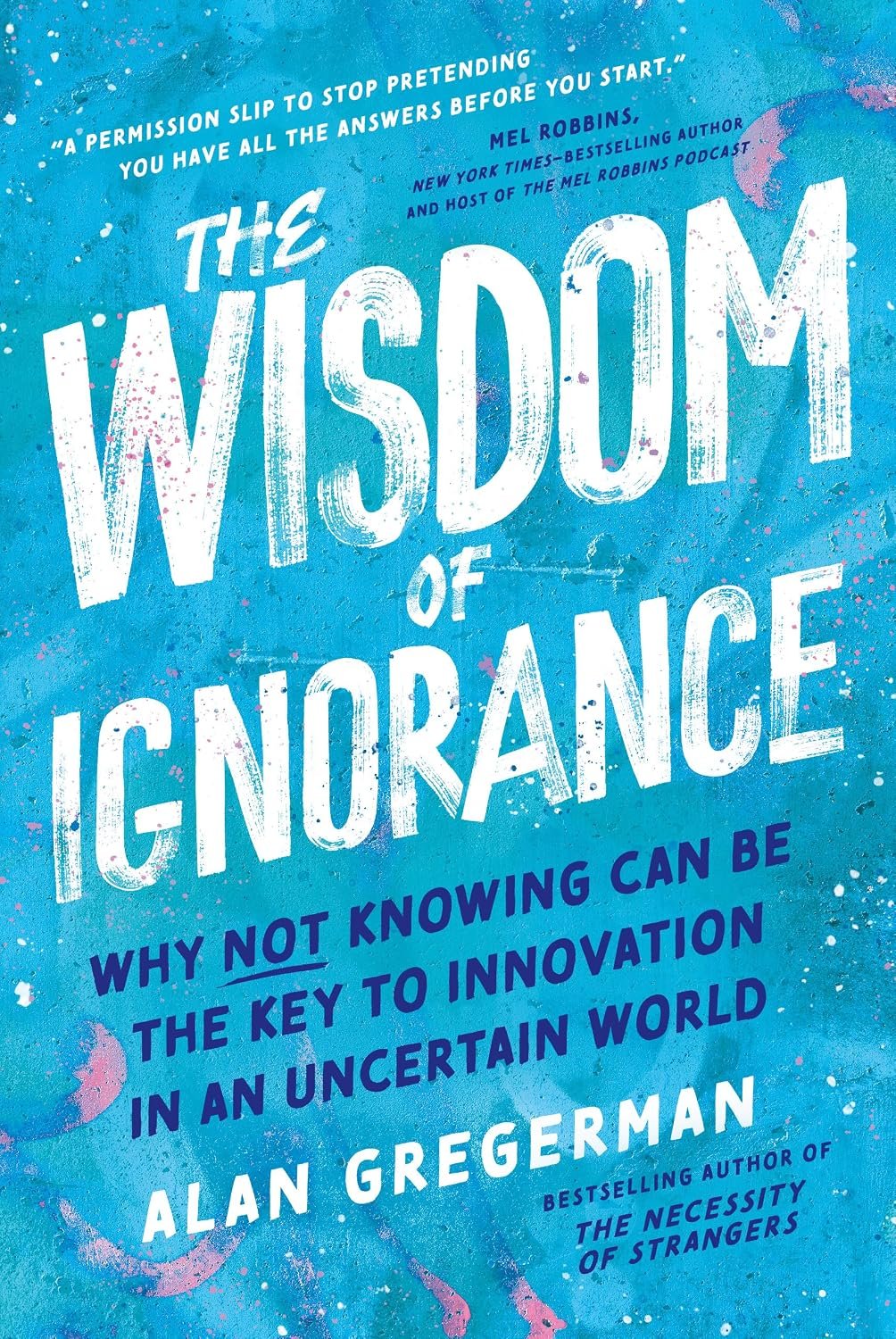
The Wisdom of Ignorance
Alan Gregerman argues that purposeful curiosity and humility about what we do not know can unlock better ideas than expertise alone.
Books worth discovering. Authors worth knowing.
Alan Gregerman argues that purposeful curiosity and humility about what we do not know can unlock better ideas than expertise alone.
A.
Why an Expert Might Need to Admit a Gap
In The Wisdom of Ignorance, business writer Alan Gregerman challenges a familiar assumption: the most qualified person in the room must also possess the best new idea. Expertise is indispensable for executing difficult work, yet it can make once-successful methods seem inevitable. Gregerman argues that innovation often starts when people recognize the limits of their knowledge and look beyond conventional solutions. He calls this stance enlightened ignorance. It is not an endorsement of careless decision-making; it is an invitation to learn deliberately where confidence has hardened into habit.
The problem he identifies is visible in many organizations. A team can become remarkably skilled at producing a familiar result while losing curiosity about whether the result still matters. A leader can protect established procedures because those procedures once brought success. Meanwhile, customers, technology or social expectations change. Gregerman’s thesis asks a practical question: how does an organization become competent at discovering what it does not yet understand? That makes the title less paradoxical than it first appears. The wisdom is not in ignorance itself, but in the response it inspires.
Purpose Comes Before Experimentation
Gregerman describes six essential capabilities for responding to uncertainty. His interviews begin with purposefulness: the discipline of committing to work that matters enough to justify sustained attention. Curiosity without direction can scatter effort across distractions. Purpose does not eliminate risk, but it gives a team a standard for deciding which opportunities deserve investigation. An organization trying to improve services for an overlooked community, for example, might begin by listening to the people it hopes to serve before designing another efficient version of its existing offering.
That example illustrates the approach; it is not presented as a documented case study from the book. The broader point is that innovation requires both ambition and humility. Without a meaningful objective, novelty becomes its own reward. Without humility, the objective becomes an excuse for declaring victory too soon. Gregerman’s message can therefore speak to nonprofit leaders, business owners, teachers and individuals facing professional change. In each setting, the most productive question may be less about defending what one already knows and more about asking what needs to become possible next.
Curiosity and Respect Are Working Skills
The second capability, curiosity, encourages searching for inspiration outside familiar professional boundaries. Gregerman’s previous work on strangers, childhood creativity and unlikely sources of genius provides a foundation for this argument. New ideas often arrive through contact with someone whose experience is too different to fit existing categories. But contact alone is insufficient. Curiosity becomes useful when it is paired with active listening, the willingness to test an assumption and enough patience to understand why an unfamiliar approach works in its original context.
Respect is another of the six skills. In innovation, respect is not only good manners; it affects which voices are allowed to shape a decision. Junior employees, customers or outsiders may notice problems that senior specialists have learned to ignore. Treating their observations as meaningful does not mean accepting every suggestion. It means creating conditions in which insights can be examined rather than dismissed by status. Readers may find this especially relevant in workplaces where expertise is organized into strict hierarchies. A group can maintain rigorous standards while still acknowledging that understanding is distributed unevenly.
Humility Without Abdicating Responsibility
Humility is perhaps the most easily misunderstood quality in the framework. Some leaders hear it as weakness: an admission that they are not qualified to decide. Gregerman instead positions it as a way to become more capable. Saying that a problem has not been solved is different from surrendering responsibility for solving it. The person who can acknowledge uncertainty has room to seek evidence, recruit complementary experience and revise an ineffective plan. The person determined to appear all-knowing may quietly create conditions for a much larger failure.
There is an important distinction between humility and indecision. A team can accept uncertainty while setting deadlines and criteria for action. It can choose a small experiment, track results and decide what to change. Gregerman’s public interviews emphasize practical progress rather than abstract admiration for doubt. The editorial value here is the shift from defending one’s original answer to testing whether the answer continues to serve its purpose. That shift can be uncomfortable because it separates professional identity from the need to be right every time.
Look Forward and Stay Alert
The final two habits bring a productive tension into the book. Future focus asks people to notice what is emerging rather than relying exclusively on yesterday’s successful practices. Gregerman also uses the deliberately provocative term paranoia for an awareness that new competitors, technologies and social changes may make existing strengths less valuable. He is not asking people to cultivate clinical paranoia. His point is strategic vigilance: remaining alert to signs that an apparently secure position is changing beneath one’s feet.
These habits can appear to conflict with the earlier invitation to curiosity. Constant anxiety can prevent experimentation, while unguarded optimism can conceal risk. The framework works best when future awareness creates questions rather than panic. What would make our service unnecessary? Which assumption would we revisit if we were starting today? Whose unmet need has our familiarity allowed us to overlook? They are constructive questions because they connect discomfort to specific inquiry. Their purpose is not to predict every disruption, but to keep the organization from mistaking inertia for stability.
The Author’s Wider Argument
Gregerman has written The Necessity of Strangers, Surrounded by Geniuses and Lessons from the Sandbox. His official biography describes years of consulting and speaking on innovation. In a published interview he connects his interest in exploration to an early fascination with other places and cultures. This helps situate his new book within a long-standing concern: meaningful discoveries often come from sources we were not trained to regard as authoritative. His latest work takes that principle into a period marked by rapid technological change and heightened expectations of expertise.
The book is marketed as a practical guide with six skills, not as a claim that specialists should discard their training. Readers in medicine, engineering or finance should continue to respect professional evidence and regulatory duties. The invitation is to notice when a genuine unknown lies outside the proven technique. Responsible innovation needs both the safety of tested knowledge and the courage to ask whether something important has been missed. That balance makes the argument more useful than a simple celebration of outsiders against experts.
A Different Kind of Competitive Advantage
The Wisdom of Ignorance will speak most directly to leaders, creative teams and professionals whose reliable methods are beginning to feel insufficient. Its provocative title might also interest anyone reluctant to ask an elementary question for fear of looking unprepared. Gregerman reframes that embarrassment as a lost learning opportunity. The most valuable person in a meeting may sometimes be the one who can identify a question everybody else has stopped asking. That contribution still needs to be followed by disciplined work, but it can open an entirely new direction.
The book’s central promise is not that uncertainty will disappear. It is that uncertainty can become workable when people unite purpose, curiosity, humility, respect and attention to the future. A culture prepared to say it does not know yet is also a culture capable of finding out. In a fast-changing world, such a habit may be more durable than one individual’s command of the last successful answer.
About the book.
Gregerman calls for enlightened ignorance: discovering opportunities by questioning assumptions and practicing six habits—purpose, curiosity, humility, respect, future focus and constructive vigilance.
Sponsored book feature. Independent research-based commentary using publicly available descriptions and author material, not a claim of first-hand full-text review. The cover placeholder will be resolved by the owner’s publishing automation.
Found a book worth opening?
Books worth discovering. Authors worth knowing.
Return to the Journal →