
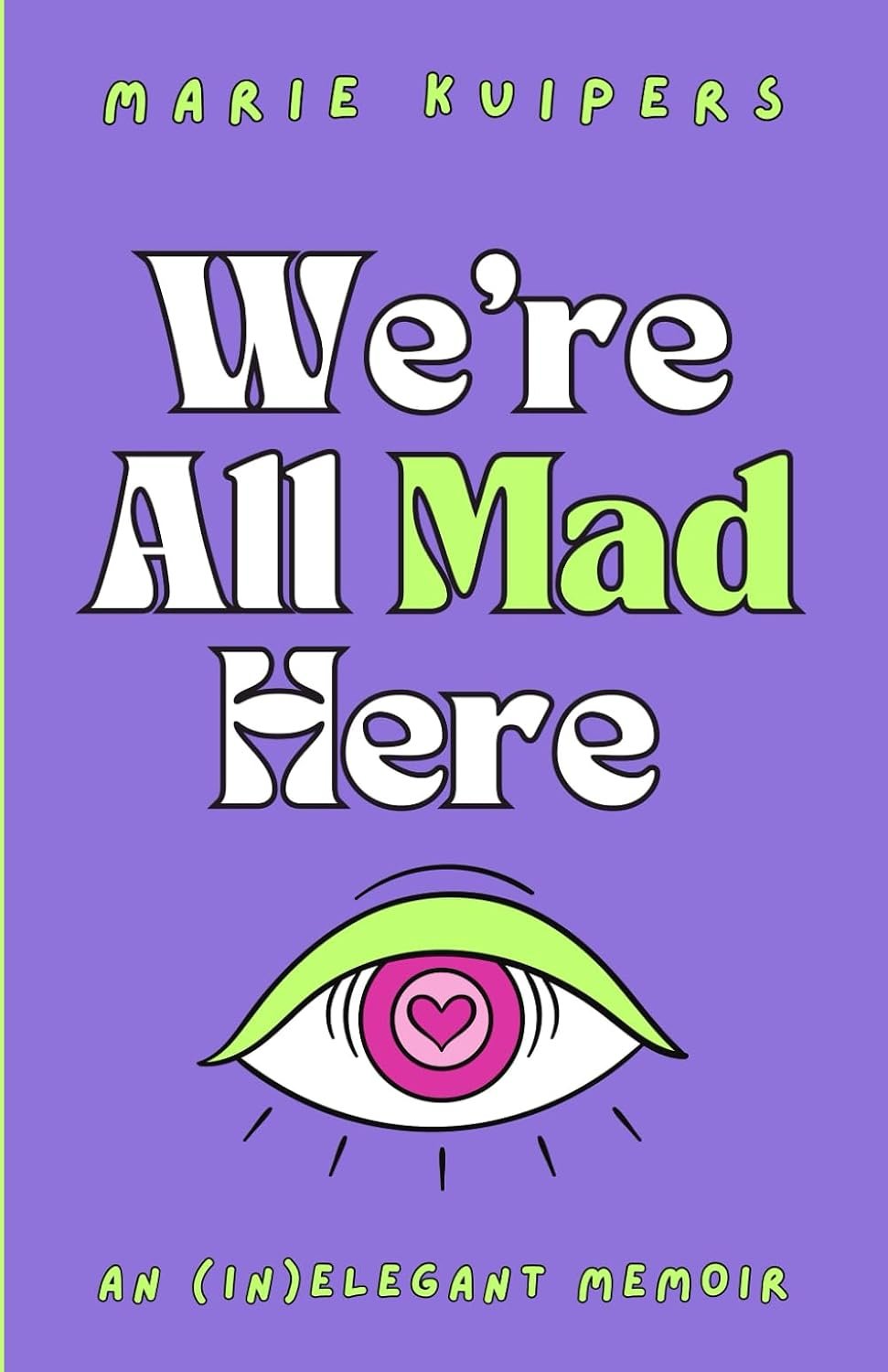
We’re All Mad Here
Marie Kuipers brings raucous humor and unsettling family memory into a collection of irreverent autobiographical sketches.
Books worth discovering. Authors worth knowing.
Marie Kuipers brings raucous humor and unsettling family memory into a collection of irreverent autobiographical sketches.
M.
An Unruly Memoir with a Deliberate Title
Marie Kuipers gives her collection the title We’re All Mad Here: an (in)elegant memoir, and the contradiction in that subtitle is an effective introduction. Elegance suggests graceful hindsight and carefully ordered lessons. The parenthetical interruption suggests the opposite: experience as something messy, awkward and sometimes impossible to explain without laughter. On her official website, Kuipers describes a collection of autobiographical sketches that moves between dark humor, personal hurt and the possibility of forgiveness. The book’s appeal begins with that refusal to make difficult family history tidy simply because it is being narrated afterward.
The site also calls attention to the narrator’s place as an outlier within a family shaped by generational trauma. That is a substantial framing choice. Many memoirs are organized by the ideal of reconciliation, but people living inside complicated family patterns rarely know where reconciliation begins. The public description instead offers an unruly mixture of absurd observations and serious memory. Humor becomes a way to confront the experiences that polished language might make too distant, while the word memoir reminds readers that an actual person’s life is at stake beneath the comic voice.
What Small Incidents Reveal
Kuipers’s official list of episodes includes Bucky, a mischievous rescue dog, an apparent vendetta against umbrellas and a dislike of Steely Dan. It also mentions a rooster spared through a moment of insight involving a homeowners association dispute. Each example sounds slightly improbable when placed beside family trauma and heartbreak. That contrast is the point of the book’s public presentation. People do not experience loss and joy in separate, cleanly labeled compartments. An ordinary annoyance may occur on the same afternoon as a serious conversation; a ridiculous pet can become part of the routine that makes enduring difficulty possible.
An essay collection made from such incidents has a different rhythm from a memoir driven by a single geographic journey. Each sketch can isolate an encounter or irritation and give it its own emotional scale. A reader does not need to regard every event as monumental. Instead, the accumulation may reveal recurring habits of thought: how someone handles embarrassment, what they refuse to tolerate and where tenderness unexpectedly surfaces. The source descriptions do not provide a chapter-by-chapter table of contents, so it would be misleading to invent the sequence of these stories. Their public framing nonetheless establishes a recognizable method: build the larger portrait through particular moments.
Humor That Refuses to Behave
The author places the collection at an intersection of the dark, the irreverent and the raucously funny. That combination signals a style potentially less comforting than familiar inspirational memoir. Comedy can be a means of establishing distance from painful material. It can also be an invitation to admit that one’s own reactions have been contradictory. Someone may be both angry and amused by a family ritual, irritated by a neighbor and grateful to a pet, embarrassed by a mistake and unwilling to apologize for surviving it. An honest comic voice makes room for those tensions.
There is an ethical dimension to memoir humor too. When the material involves real people, the writer must decide which memories to preserve and whose privacy to protect. Readers should not mistake a sharp joke for an independently verified judgment on everyone involved. Kuipers’s perspective is necessarily personal; it is the truth as arranged and understood by its narrator. That does not diminish its literary significance. Rather, it encourages attention to how the author uses tone to create connection even when the subject is uncomfortable.
The Pressure of Being an Outlier
The term outlier appears prominently in Kuipers’s book presentation. To live as an outlier may mean being the relative who asks forbidden questions, the person whose needs cannot be fitted into established routines or simply someone whose sense of humor has never matched the room. The author connects that position with generational trauma, suggesting that inherited expectations have consequences long after their origins become difficult to trace. Such a frame supports a central memoir question: what happens when the rules for belonging are the very rules a person needs to resist?
A reader need not share the author’s exact family experience to recognize the friction between authenticity and acceptance. Some families reward composure, others practical achievement, and still others silence. Humorous self-description can challenge those codes by making the supposed misfit the storyteller rather than the problem to be solved. This is a critical lens drawn from the book’s stated themes, not a claim that Kuipers narrates any particular confrontation. The episodes themselves are best left for readers to encounter on their own terms.
Grief, Forgiveness and the Work Between
The author’s description promises heartbreak and, eventually, forgiveness. That does not mean the final chapters deliver a universal prescription to reconcile with anyone who caused harm. Forgiveness is a personal and often contested word. In a memoir, it might describe emotional release, improved boundaries, or a change in the story the narrator tells herself. Without access to the whole text, assigning a precise definition to Kuipers would be unwarranted. What can be said is that the public description situates forgiveness at the far end of a journey through noise and difficulty rather than at its beginning.
The book therefore asks for readers who can tolerate tonal shifts. Laughter after an account of trauma may feel bracing rather than soothing; a vulnerable scene after comic exaggeration may make the joke retrospectively different. Those transitions are part of the narrative challenge. Kuipers appears to favor emotional range over uniform decorum. The parenthetical subtitle warns the reader not to expect a polished sequence of lessons that always arrives at the correct response. Life as she describes it has more loose ends than that.
The Rescue Dog and the Ordinary World
Bucky, the rescue dog named in the author’s description, is not only an opportunity for comic animal stories. In nonfiction, the presence of a pet often changes the scale of attention. A dog needs food and care no matter how intellectually complicated a family history becomes. The routines of animal companionship can pull the narrator back into the immediate world of weather, errands and affectionate exasperation. Nothing publicly available justifies declaring that Bucky heals a particular wound in the story. Yet his prominence in the official description suggests that shared domestic life supplies some of the collection’s texture.
The rooster, umbrellas and unlikely cultural grievances work similarly. They keep the memoir from becoming entirely abstract, showing the writer’s sense of self through objects and small irritations. A useful test of comic nonfiction is whether the specifics are memorable because they reveal a person, not merely because they are strange. Kuipers’s chosen examples hint at a willingness to let personality emerge unfiltered. The strategy may divide readers: one person’s delightful irreverence is another person’s uncomfortable excess. That distinctive response is preferable to pretending the book is designed for everybody.
Who Will Welcome This Kind of Disorder
We’re All Mad Here is for readers who appreciate autobiographical essays that mix sharp observation with family complexity. Someone looking for a gentle, linear recovery guide may find its irreverence surprising. Someone who enjoys darkly comic personal writing may appreciate the refusal to present emotional growth as a serene march from struggle to wisdom. The publicly confirmed elements are sufficiently specific to suggest an authorial voice: Bucky, the rooster, the outlier identity and the generational history give the collection a recognizable shape.
The most intriguing question is whether comedy can allow difficult experiences to remain complicated without becoming unbearable. Kuipers’s own description suggests she is prepared to test that possibility. Her title does not promise a perfectly reasonable world; it promises a voice willing to speak from within an unreasonable one. For readers who value memoir as personality, conflict and unfinished self-understanding rather than simply a lesson delivered, that may be a persuasive invitation.
About the book.
The author describes stories involving a rescue dog Bucky, a neighborhood rooster, a homeowners association, generational trauma, social expectations and unexpected forgiveness.
Editorial book feature, not paid sponsorship. Independent research-based commentary using publicly available descriptions and author material, not a claim of first-hand full-text review. The cover placeholder will be resolved by the owner’s publishing automation.
Found a book worth opening?
Books worth discovering. Authors worth knowing.
Return to the Journal →