
To Shoot a Sinner
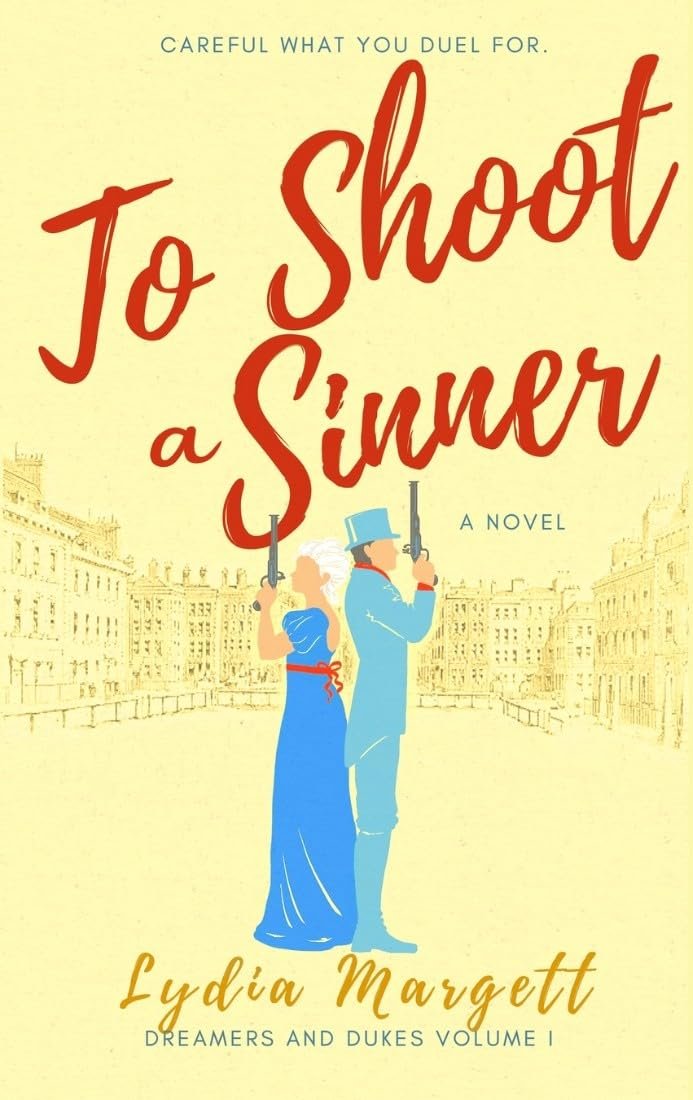
Lady Charlotte Aston finds herself facing Benjamin Scarsdale, a dangerous man connected to London’s underworld, in a dawn duel she was never trained to fight. His shot wounds Charlotte rather than her…
Books worth discovering. Authors worth knowing.
Lady Charlotte Aston finds herself facing Benjamin Scarsdale, a dangerous man connected to London’s underworld, in a dawn duel she was never trained to fight. His shot wounds Charlotte rather than her brother, and a startling proposal keeps their lives entangled. Margett identifies this as the opening Dreamers and Dukes novel and frames it as a romance…
Carefully sourced literary criticism and book-specific interpretation.
Lady Charlotte Aston finds herself facing Benjamin Scarsdale, a dangerous man connected to London’s underworld, in a dawn duel she was never trained to fight. His shot wounds Charlotte rather than her brother, and a startling proposal keeps their lives entangled. Margett identifies this as the opening Dreamers and Dukes novel and frames it as a romance across widely divided social worlds.
A duel as the courtship problem
A duel makes an unusually honest introduction to a love story about unequal power: it places bodily risk and the rules of an honour culture in front of desire. Charlotte’s presence in a scene ordinarily associated with masculine privilege hints at the gender question inside the book’s premise. She is endangered by conventions she did not design but must navigate all the same.
Danger, agency and accountability
Benjamin’s underworld power may be thrilling, but romantic danger needs to be interrogated, not simply admired. The real tension is whether attraction allows Charlotte the capacity to refuse and act, or whether his reputation becomes a substitute for depth. The author calls the series feminist; an independent judgment would require examining Charlotte’s actual decisions and the treatment of the consequences of violence.
Regency convention meets the underworld
Margett’s hook works by placing the etiquette of the Regency romance beside criminal networks, then allowing both to reveal their coercive rules. Courtship becomes a negotiation between public honour and private risk. The story promises a familiar opposition-attract pattern, but its specific catalyst—a failed confrontation with a gun—may make forgiveness and accountability harder to brush aside than in a purely drawing-room romance.
The likely reader
Readers drawn to intense historical romance, dangerous heroes and heroines whose choices challenge the limits of their social setting may enjoy this premise. Readers looking for a gentle courtship should know that violence is present from the outset. This is a listing-based review, not a claim to have verified the novel’s entire portrayal of agency or its romantic resolution.
Consent in a world of inherited rules
The Regency setting carries an elaborate apparatus of permissions, reputations and consequences. A woman’s public standing may depend on a code that offers her limited influence over the terms by which she is judged. Charlotte’s appearance at a duel immediately unsettles those expectations: she is standing where a woman would not conventionally be expected, exposed to the physical stakes of a masculine ritual. But entering such a scene is not automatically liberation. It can also demonstrate how a supposedly honourable system creates danger for those who lack the power to enforce its rules. That distinction makes the premise more provocative than a simple heroine-does-something-scandalous device.
Benjamin’s social position complicates matters further. If he operates within an underworld where violence is ordinary, then Charlotte’s society and his might share more than their manners initially suggest. Both can make dissent costly. Both may rely upon private arrangements protected by public myth. The central romance has an opportunity to expose the moral hypocrisies on either side of the divide. Whether it does so is a matter for reading, not something a promotional hook can establish. What is already clear is that the author has chosen a scenario in which attraction cannot be separated from practical questions of safety and authority.
The wounded body and the romantic imagination
A gunshot injury is an uncomfortable foundation for desire, as it should be. Romance readers may be prepared to accept dangerous circumstances as the prelude to tenderness, yet the physical fact of Charlotte’s wound ought not to vanish merely because an emotionally compelling hero is involved. If Benjamin feels responsible, responsibility must involve more than protective possessiveness. A relationship that becomes convincing would require him to encounter Charlotte as someone with a judgment of her own, not as a living reminder of his mistake. The published premise suggests this confrontation but does not document the extent to which the book sustains it.
The genre’s pleasures are not diminished by asking such questions. Indeed, they become richer. A hero capable of altering his conduct is more interesting than one who needs only to reveal a hidden softness; a heroine who can assess a proposal rather than simply be overwhelmed by it has more room to develop a romantic self. The word “sinner” in the title also points toward the problem of judgment. The challenge is to decide who is condemning whom, and whether a code of respectability can be trusted to distinguish wrongdoing from social disobedience.
A series beginning with argument, not just attraction
As a first installment, this novel has to do two kinds of work. It must persuade readers to invest in Charlotte and Benjamin’s particular relationship while establishing a world capacious enough to contain later stories. The underworld setting offers continuity; the Regency social structure offers recurring pressures. But a romantic series is most persuasive when later couples need not repeat the same moral question under new names. The central duel is distinctive enough to give this opening book a problem of its own, provided its consequences are carried beyond the initial shock.
There is value in treating the author’s own description of the series as feminist as a critical proposition rather than a certificate of merit. The measure is how agency is distributed, whose risks are acknowledged and how the story imagines a satisfying union without pretending that structural inequalities dissolve through passion. On the verified description alone, To Shoot a Sinner looks capable of an energetic combination of courtship, danger and social critique. A final recommendation should follow examination of the actual narrative choices that give that combination substance.
The review’s scope
This assessment is based on the identified bibliographic records and available author, publisher and bookseller descriptions. The interpretive claims above are editorial judgments about the documented premise and genre choices, not testimony to having read every chapter or inspected every illustration. The published text may answer, complicate or contradict the critical questions raised here. A finished review would assess the language, structure and ending directly.
About the book.
The title, author/contributor record, source URL and matching cover file ID come from the current MarketAnyBook Journal Queue and its Drive asset folder. The review considers Regency historical romance through verified available descriptions rather than firsthand full-book reading.
Unsponsored editorial book review based on publicly available bibliographic and descriptive evidence, with critical interpretation distinguished from verified book details.
Found a book worth opening?
Books worth discovering. Authors worth knowing.
Return to the Journal →