
Today My Brain Is a Dinosaur
A child imagines his overwhelmed thoughts as a dinosaur while learning about feelings, family support, and asking for help.
Books worth discovering. Authors worth knowing.
A child imagines his overwhelmed thoughts as a dinosaur while learning about feelings, family support, and asking for help.
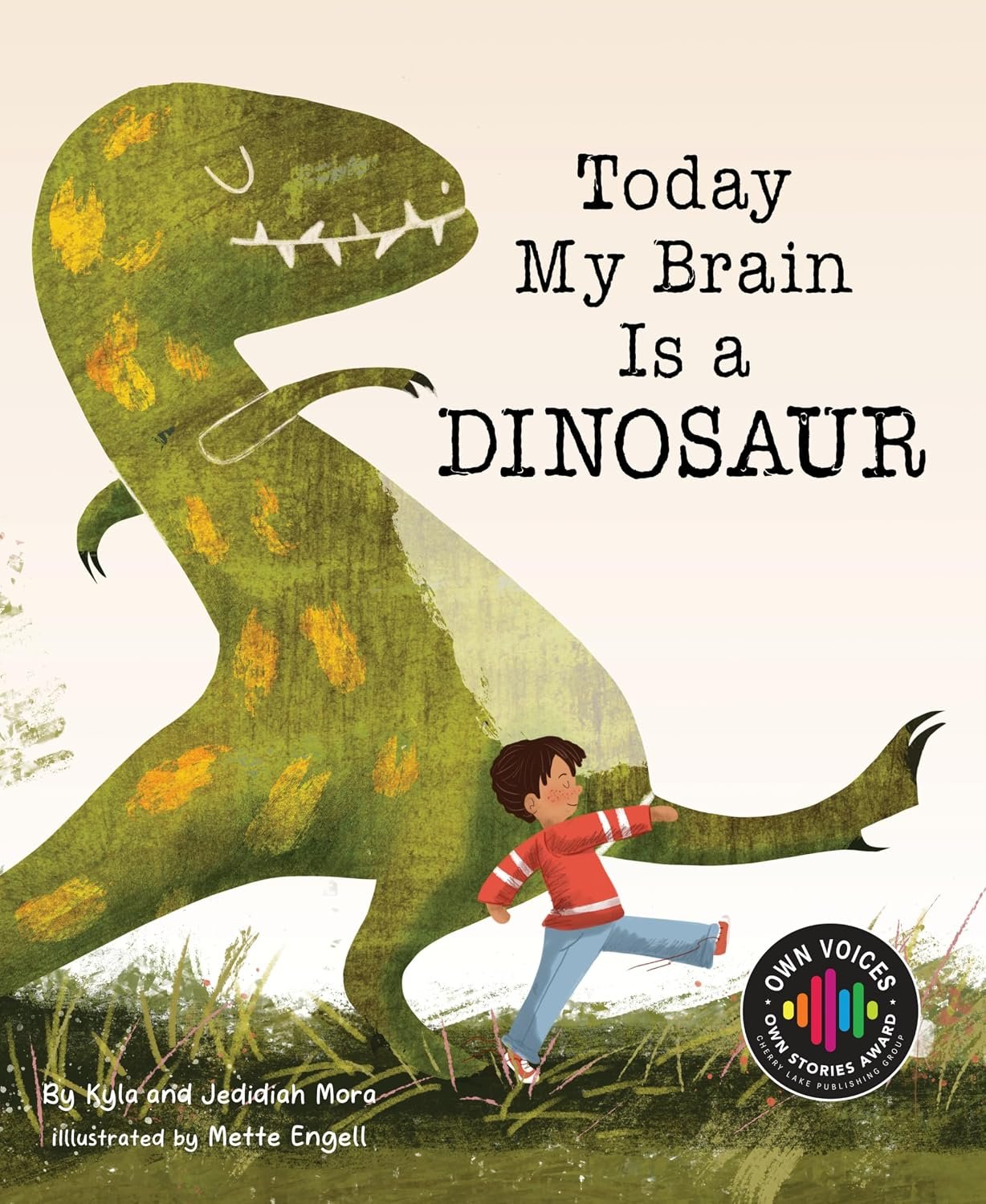
Today My Brain Is a Dinosaur by Kyla Mora and Jedidiah Mora, illustrated by Mette Engell, offers a child’s-eye way of describing the experience of a brain that will not behave as others expect.
A mind that feels enormous
Today My Brain Is a Dinosaur by Kyla Mora and Jedidiah Mora, illustrated by Mette Engell, offers a child’s-eye way of describing the experience of a brain that will not behave as others expect. The publisher introduces a boy who tries to meet demands around him but experiences his thoughts and emotions as creatures and forces that overwhelm ordinary routines. Some days the mind feels like a dinosaur; at other moments the images become a raging bull or a hurricane. These comparisons are not medical labels, nor do they turn neurodiversity into a single animal-like personality. They are metaphors the story uses to communicate intensity, unpredictability, and effort. For a young reader who is frequently told to settle down, an exaggerated picture can make an invisible struggle easier to discuss. The book’s own synopsis emphasizes the importance of family support and learning to work with one’s strengths. The story therefore appears oriented toward recognition rather than punishment. Its central promise is that having a difficult day does not make a child a bad person.
Why metaphor matters for young readers
Adults often describe attention and emotional regulation in abstract terms: control your impulses, focus, or manage frustration. Such instructions can be hard for a young child to translate into felt experience. An image of a dinosaur bursting through one’s thoughts offers a different starting point. A roaring creature communicates loudness and urgency without requiring a technical vocabulary. The public synopsis gives this imaginative approach a specific shape, and independent review discussion notes several changing metaphors for the boy’s experiences. The comparisons invite conversation, but they should not be mistaken for precise definitions of autism or ADHD. Both encompass varied experiences, and no single picture book can summarize them. Instead, the story gives children and adults a shared language to ask what a difficult moment feels like. If a caregiver uses that opening to listen, the metaphor can be helpful. It becomes less useful when imposed on a child who describes their own mind differently. Good picture-book conversation leaves room for the young reader’s own words.
The cost of trying hard to be easy
The publisher describes the protagonist as trying to do what is expected of him while his mind resists. That detail matters because behavior observed by others can hide considerable effort. A child who interrupts, moves, or seems distracted may already be working very hard to cope. The book’s premise asks readers to notice the gap between outward conduct and inward strain. It also avoids framing every moment as charming chaos. The official description says that the boy becomes deeply upset when his world feels unmanageable, which acknowledges the distress that can accompany repeated frustration. In a family or classroom setting, such recognition should prompt curiosity rather than a rush to judgment. Adults can ask what support is needed, whether a task could be approached differently, or whether the environment has become overwhelming. These are possible discussion directions, not guaranteed lessons written out in the story. Understanding a child’s effort does not mean there are no boundaries; it means boundaries can coexist with empathy and practical help.
Support without trying to erase difference
The publisher’s summary emphasizes a family who helps the boy return to calmer ground. It also describes the boy learning to use distinctive ways of thinking advantageously, remain flexible, and ask for help. These elements make the book more than a catalogue of hard moments. Asking for help becomes an act of self-understanding, not defeat. The story’s approach is compatible with a strengths-based conversation, though it must not be treated as a clinical protocol. A reader might consider what the family does to convey steadiness and how adults in real settings can make a child feel safe enough to name distress. The safest interpretation avoids a promise that an affirming attitude solves every challenge. Some children need accommodations, specialist support, changes to routines, or simply adults who take their experience seriously. A picture book can begin that conversation, but the actual support must be tailored to the person. The boy’s journey appears designed to make difference visible while leaving intact the dignity of someone whose mind works in unexpected ways.
Pictures, sound, and the work of a picture book
Mette Engell is credited as illustrator, and the book is listed as a 32-page picture book in the Own Voices, Own Stories series. The visual role matters because metaphors about a dinosaur or storm depend on imagery as well as written language. An illustration can show what a child’s emotional scale feels like even when external events appear small. Kirkus comments specifically on the art’s depiction of thoughts whirling around the boy, independent evidence that the book uses visuals to embody his perspective. That does not justify inventing a page-by-page description or assuming every image shares the same style. It does, however, make clear why this is a picture-book concept rather than a straightforward information pamphlet. Young children often encounter a story first through its pictures, then through repeated reading and questions. Adults may use the illustrations to invite discussion without demanding that the child identify with every scene. The material is a starting point for empathy, not an assessment tool.
A useful book with room for critical thought
Independent reviews, including Kirkus, recognize the importance of the book’s message while not praising every element of its execution. That distinction can be useful to adult buyers. A story may raise a worthwhile issue while prompting different responses to its rhymes, pace, or tone. Responsible editorial writing should not flatten all evaluation into universal acclaim. The stronger point is that children with attention or regulation differences deserve representation that neither mocks them nor denies their challenges. The book’s marketing describes an authentic view of neurodiversity, but readers should remember how varied individual experiences can be. Adults can consider whether the language resonates with a particular child, whether the imagery feels reassuring, and whether it opens space to talk about support. If it does not fit one child, that is not a failure of the child or proof that the book’s general message is worthless. There are many ways to represent minds, and choice in reading matters.
Who should read Today My Brain Is a Dinosaur
This picture book may be particularly useful for families and educators seeking a child-friendly opening to conversations about big emotions, attention, flexible thinking, and asking for help. The publisher positions it for young readers and highlights neurodiverse experiences, making it especially relevant where children feel misunderstood by expectations around behavior. Children who love dramatic animals and lively metaphors may enjoy the imaginative frame even without identifying with the central struggle. Adults should read with curiosity rather than treat the story as a diagnostic checklist. Readers seeking a clinical guide to ADHD or autism should use authoritative professional resources instead. The book’s value lies in helping listeners imagine what an ordinary task can feel like from inside another person’s mind.
About the creators
Kyla Mora and Jedidiah Mora are credited as authors of Today My Brain Is a Dinosaur, with Mette Engell as illustrator. Publisher information identifies the work as part of the Own Voices, Own Stories series, and its themes include neurodiversity, emotions, and family support. This article draws from that published synopsis and a separate professional review. It does not claim that reading the book produces specified therapeutic or educational outcomes.
About the book.
Illustrated children’s picture book; neurodiversity and emotions. A child imagines his overwhelmed thoughts as a dinosaur while learning about feelings, family support, and asking for help.
Sponsored book feature. Original research-based commentary, not firsthand complete-book reading. The owner’s Python automation will resolve the cover placeholder.
Found a book worth opening?
Books worth discovering. Authors worth knowing.
Return to the Journal →