
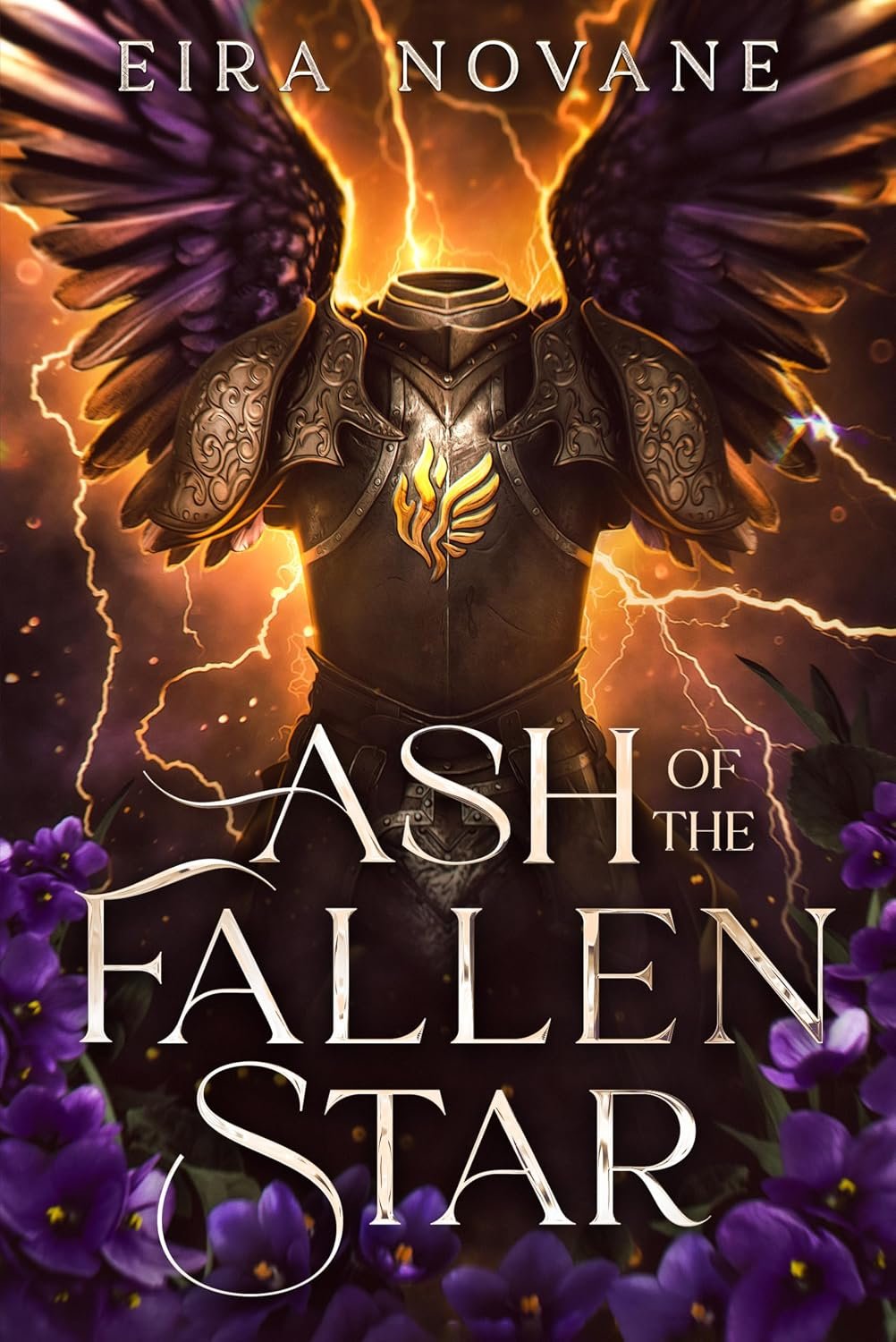
Ash of the Fallen Star
A restorer haunted by lost memories and a revenant guardian challenge a cosmic order that seeks to erase their love.
Books worth discovering. Authors worth knowing.
A restorer haunted by lost memories and a revenant guardian challenge a cosmic order that seeks to erase their love.
Eira Novane’s Ash of the Fallen Star begins from a romance shaped by absence.
A love someone was made to forget
Eira Novane’s Ash of the Fallen Star begins from a romance shaped by absence. The author’s synopsis says that Caelin, a restorer working among the ruins of Elowen’s Fall, experiences dreams of violet wings and a lost love she cannot consciously remember. Lucan, a guardian returned from death, is bound to her by a connection that has survived centuries. The tension is immediate: he remembers a bond she does not, and his continued existence is precarious. This is not merely a lovers-reunited premise. Caelin must determine whether what calls to her from the past has a place in the person she is now. The book’s setting gives that question a material form. She repairs fragments of a ruined city while confronting fragments of a vanished identity. The author’s descriptions emphasize memory, sacrifice, and divine power, which place the romance inside a larger mythology. The result is a fantasy in which the act of remembering may have personal and cosmic consequences. Those stakes are stated in official summaries and discussed in a professional review; this introduction does not invent later revelations.
A restorer surrounded by things that remember
The choice to make Caelin a restorer is central to the documented premise. A restorer works with objects damaged by time, handling traces that outlast their makers. At Elowen’s Fall, glyphs and artifacts hint at the city’s lost history, while Caelin’s dreams suggest her own past is similarly unfinished. That parallel gives the romantic fantasy a clear visual and emotional grammar. Recovering a missing piece can bring clarity, but it can also disturb a story a person has learned to live with. The independent Kirkus review describes Caelin’s interest in ancient symbols and the strange changes that accompany her growing awareness. It does not justify saying she solves every historical puzzle or instantly becomes whole. The better reading question is what restoration costs. Does recovering the past allow someone to choose freely, or does it create new pressure to become who others remember? This question matters particularly because Lucan’s memory and Caelin’s uncertainty are not symmetrical. Love across lifetimes can sound comforting, but it also asks whether the present person has a voice in an old promise.
Lucan and the vulnerability of resurrection
Lucan is described as a revenant who has risen because of a powerful soul bond. That supernatural condition makes him different from a conventional immortal hero. The author’s synopsis characterizes his existence as fragile, tied to the return of Caelin’s memory. His role in the romance therefore contains both longing and dependence. A reader can feel sympathy for someone who has waited across death without assuming that waiting entitles him to a particular choice from Caelin. In the strongest versions of this kind of romance, devotion is meaningful because it exists alongside another person’s autonomy. The public premise makes that tension possible, though this feature does not claim the novel resolves it in any specified way. The idea of a revenant also links the love plot with the city’s ruined architecture. Something considered lost has returned, but its return may be incomplete and unstable. The bond has survived, yet survival is not the same as simple happiness. That uncertainty keeps the romantic stakes intertwined with the fantasy’s rules of memory and mortality.
Cosmic law and the fear of uncontrolled love
The official synopsis introduces Nerien, Caelin’s divine sibling, and the Order of Preservation, forces committed to containing what they perceive as the chaotic danger of love. This conflict turns private attachment into a challenge to an established order. Preserving stability can sound morally defensible, but a system that treats affection as a threat may restrict the people it claims to protect. Readers might think about the difference between care and control. Who is allowed to define safety, and what happens when a divine rule erases memories or identities to enforce it? The author’s description places an ancient attempt to erase Caelin at the heart of the danger. It does not disclose the complete history or final outcome, and that uncertainty deserves to remain intact. The antagonistic force is compelling because it operates through an idea as well as power. If love is considered disorder, the lovers must do more than survive pursuit: they must confront a worldview that says their bond should never have existed. Romantic stakes become philosophical without losing their intimate center.
Fantasy romance with a distinct emotional register
Ash of the Fallen Star is advertised as emotionally intense fantasy romance with magic, a slow-building bond, and a ruined world. The author specifies a medium heat level; readers can use that description as orientation rather than a universal rating of explicitness. Kirkus also frames the book as a romantic fantasy and highlights its atmosphere and characters. This is useful independent evidence of its genre placement, but it does not make a research-based article a firsthand review. Its distinctive appeal lies in the relationship between longing and lost knowledge. Caelin cannot simply consult a complete record of her former self; the surviving pieces arrive through dreams, symbols, and Lucan’s presence. Readers who enjoy gradual discovery may find that setup more compelling than immediate explanation. Those who prefer quick resolutions and minimal supernatural mythology might feel differently. The novel’s speculative system gives questions of fate and free will a visible form: powers awaken, ancient rules operate, and the heroine must decide what to accept as her own truth.
Consent, choice, and the return of memory
Stories about reincarnation or eternal bonds can tempt a simplistic conclusion that a past commitment must govern the present. Novane’s premise offers a reason to ask a more nuanced question. A person who has lost memories does not become merely the property of those who remember them. The possibility of rediscovery is exciting precisely because there is still a decision to be made. This interpretation follows the author’s emphasis on memory and choice, not any invented scene of confrontation or consent. A reader can watch how Caelin’s own understanding changes and whether the novel treats her current judgment as seriously as Lucan’s devotion. Similarly, the divine conflict tests whether inherited order should outweigh lived feeling. Romantic fantasy can offer sweeping declarations while still respecting individuality. The story’s central uncertainty—whether love from another life can survive the truth of the present one—allows such questions without requiring the article to spoil the answer. The risk of disappearance makes every act of recognition feel consequential.
Who should read Ash of the Fallen Star
This book is a fit for readers who want romantic fantasy with restored ruins, divine opposition, soul bonds, and a love story shaped by missing memories. It particularly suits those who enjoy atmospheric world-building alongside questions about agency and sacrifice. Readers seeking action with little emotional interiority or romance without any fantasy mythology should expect a different balance. The official description’s medium-heat orientation may help readers choose according to their comfort with intimate material. Begin it for the mystery of who Caelin was, stay attentive to who she chooses to become, and let the connection between restoration and identity guide the reading without requiring a promised ending the synopsis keeps hidden.
About the author
Eira Novane describes her work as epic fantasy romance concerned with fate, magic, ancient vows, and complicated love. Her official book page and an independent Kirkus review provide grounded information about Caelin, Lucan, and the city of Elowen’s Fall. This feature introduces those documented elements while avoiding fabricated dialogue, scenes, or plot resolutions. Anne-Marie Rutella is preserved in the source metadata as the editor named in the queue.
About the book.
Romantic fantasy; soul-bond and memory. A restorer haunted by lost memories and a revenant guardian challenge a cosmic order that seeks to erase their love.
Editorial book feature, not paid sponsorship. Original research-based commentary, not firsthand complete-book reading. The owner’s Python automation will resolve the cover placeholder.
Found a book worth opening?
Books worth discovering. Authors worth knowing.
Return to the Journal →