
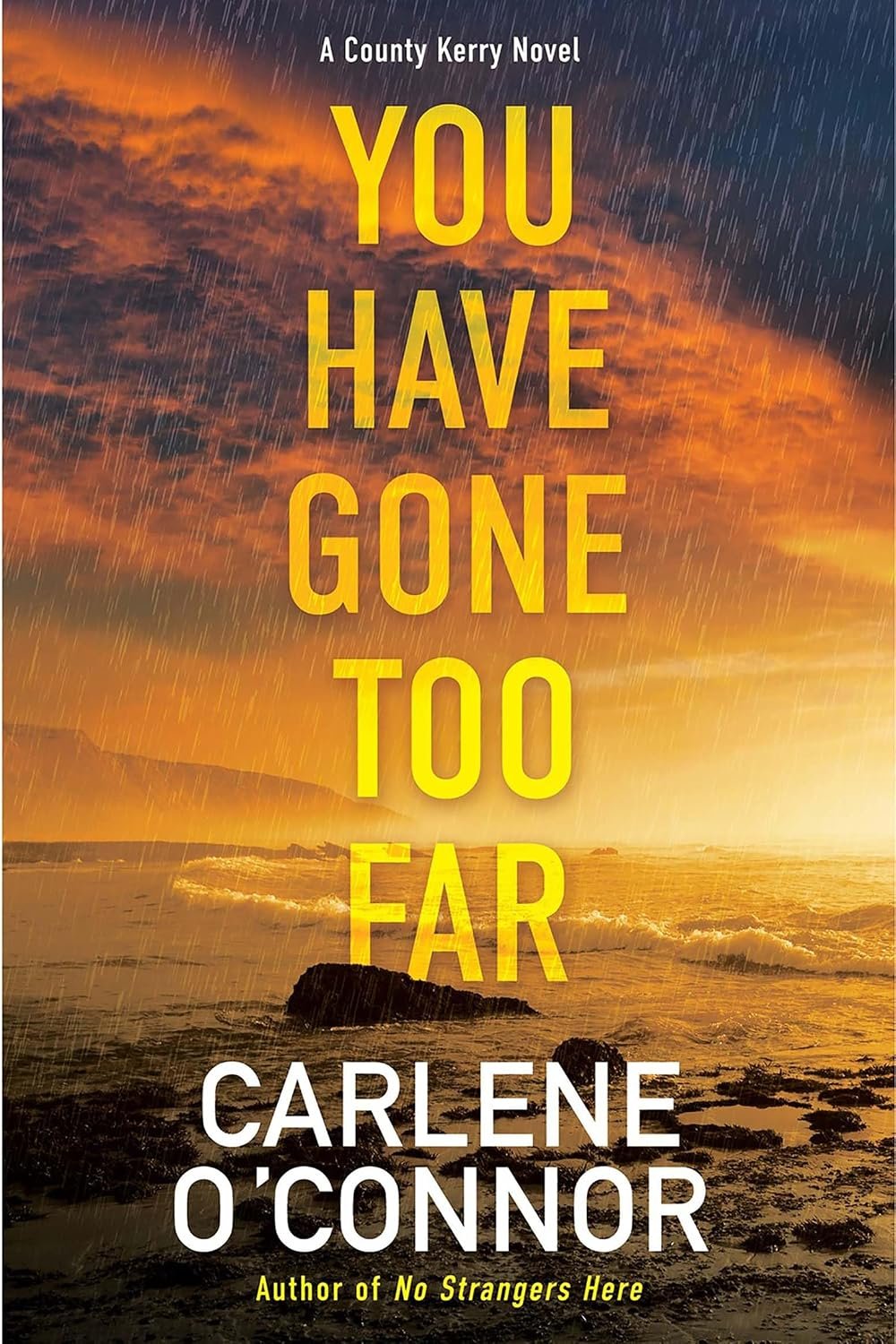
You Have Gone Too Far
In a dark County Kerry mystery, ominous messages and disappearances draw veterinarian Dimpna Wilde toward a dangerous history.
Books worth discovering. Authors worth knowing.
In a dark County Kerry mystery, ominous messages and disappearances draw veterinarian Dimpna Wilde toward a dangerous history.
In Dingle, warnings to two pregnant women, disappearances and older suspicions form the latest Dimpna Wilde mystery.
A warning that comes before the disappearance
Carlene O’Connor’s *You Have Gone Too Far* returns to County Kerry for a dark mystery built around a chilling pattern. According to its publisher, two pregnant women in Dingle receive anonymous warnings that they are in danger. Their attempt to understand the connection between them opens into an investigation involving the region’s past. The story also follows veterinarian Dimpna Wilde, whose practical responsibilities coexist with a growing sense of threat. The title belongs to the third book in O’Connor’s County Kerry series, and its premise is notably less cozy than a picturesque Irish village might suggest. The landscape matters not because it makes danger attractive, but because familiar roads and neighbors can suddenly become uncertain. The official synopsis identifies a missing pregnant woman named Shauna, a boy caught up in the danger and a figure referred to as the Moth Man. It also places Dimpna close to the disappearance of a ten-year-old boy named Dylan, who ventures toward a bog on a dare. These details establish parallel crises with a shared pressure of time. A reader enters the novel knowing that more than one person is vulnerable, but not how the mysteries connect or what the final answers will be. That is enough to introduce the novel without disclosing developments beyond its public setup.
Why the County Kerry setting works
Rural settings make unusual demands on crime fiction. Their physical openness can contrast with social intimacy: a valley or bog may look boundless while everyday life is shaped by long memories and close relationships. Publisher descriptions emphasize windswept roads, beaches and cliffs along Ireland’s southwest coast. O’Connor uses that region as the context for a darker investigation, rather than as scenery detached from the case. The disappearance of people from a community where identities and histories overlap creates a special kind of unease. Questions about what neighbors know become as urgent as questions about where someone might be. The bog itself carries narrative potential, because such places suggest both natural difficulty and buried history. It would be wrong to assert that the book employs a particular symbol in a particular chapter without having read it. What the verified synopsis does show is a convergence of a child’s excursion, the discovery of danger and older episodes that haunt the present case. The setting invites readers to pay attention to the ways landscape stores memory—through stories, traditions, fears and places people avoid. That makes atmosphere central to the book’s promise, not an embellishment around an interchangeable plot.
Dimpna Wilde and the obligations of care
A veterinarian is a compelling protagonist for a mystery because the profession usually demands patient observation, practical intervention and attention to the vulnerable. Dimpna’s obligations are not limited to solving a puzzle. Public descriptions mention lambing season, concern for her father and the arrival of help from a local child. Those responsibilities create an ordinary social world that the disappearances threaten to fracture. It is not necessary to invent a detective technique for her to see why she might become emotionally involved. Her capacity to care is already part of the story’s established frame. The professional identity also creates a contrast with formal policing. Dimpna brings an intimate knowledge of animals, families and routines, while Detective Inspector Cormac O’Brien works within the structure of a criminal investigation. The available source material establishes both characters within the series, though it does not disclose every step of their collaboration in this volume. A reader might reasonably anticipate tension between local knowledge and official procedure. The interesting question is not whether one form of knowledge automatically wins, but how a community responds when immediate concern exceeds any one person’s authority.
The dangers of a convenient explanation
The official pitch raises the possibility of a mysterious cult connected to past disappearances and violence. In fiction, such a possibility can sharpen fear while also testing the investigators’ judgment. A compelling mystery asks the reader to distinguish evidence from rumor, memory from proof and collective anxiety from a reliable account of what occurred. The synopsis does not establish the ultimate truth of that theory; treating it as confirmed would spoil the core uncertainty and misrepresent the book. The better introduction is that the specter of a cult changes what characters fear and what readers are primed to suspect. Pregnancy and a child’s disappearance lend the premise particular urgency, but those stakes deserve care in description. The threatened characters are not merely devices used to make the plot more frightening. Their vulnerability raises questions about bodily autonomy, family bonds and how communities judge who is believed or protected. Readers who prefer gentle crime fiction should note the darker content. O’Connor’s County Kerry series has a reputation for a more ominous atmosphere than her lighter village mysteries, a distinction that helps a new reader choose appropriately without resorting to invented shock or sensational promises.
Reading the third volume as part of a series
Because this is book three, prior relationships and histories may deepen the experience even if a new reader can follow the central mystery. The publisher lists *No Strangers Here* and *Some of Us Are Looking* as earlier County Kerry novels. Readers who enjoy watching recurring characters develop may prefer publication order; others may be drawn first by the particular premise of this installment. The available sources do not justify a guarantee that every backstory is fully recapped. Series continuity is part of the buying decision, not a flaw or advantage in the abstract. A mystery’s atmosphere can be as decisive as its solution. Here the public material promises questions that are personal as well as forensic: what does a warning mean, who remembers the past, and what can be done when someone disappears? The novel seems designed for readers willing to sit with worry while separate strands gradually intersect. Those expectations are clearer and fairer than an unverified claim that every revelation is unpredictable or that the ending will satisfy all tastes. The strongest editorial claim available is that the book combines a supported high-stakes setup with an established returning heroine and a specific coastal setting.
Suspense with competing forms of vulnerability
The missing child and pregnant women also change the rhythm of expectation. A detective may seek a neat sequence of leads, but families confronted by a disappearance experience uncertainty as an immediate emotional crisis. The tension between methodical investigation and personal urgency can give a mystery its pulse. Dimpna’s concern is not simply an intellectual interest in what happened; the community faces the prospect of irreversible harm while information remains incomplete. The publisher synopsis makes that urgency explicit without supplying all subsequent events, leaving a reader to discover whether the characters’ obligations can be reconciled with the pace of the investigation.
Who should read You Have Gone Too Far
This is a strong candidate for fans of atmospheric crime fiction set in a recognizable community, especially readers drawn to recurring investigators, historic secrets and urgent missing-person cases. It may also appeal to readers who enjoy procedurals in which local life and personal attachments complicate an inquiry. It is not the ideal starting point for someone wanting only a lighthearted village puzzle, and its threats involving pregnant women and a child may be uncomfortable for some. For readers open to darker material, the verified premise offers multiple intersecting pressures without requiring a feature to reveal the murderer, the explanation for the warnings or the fate of those missing.
About Carlene O’Connor
Carlene O’Connor writes the County Kerry novels alongside other Ireland-set mystery series. Kensington’s publication information confirms this title as the third County Kerry installment and lists multiple print and ebook editions. Its series placement and original title are preserved here; no claim of a firsthand reading or unpublished plot knowledge is intended.
About the book.
Irish crime mystery / suspense, County Kerry series book 3. In Dingle, warnings to two pregnant women, disappearances and older suspicions form the latest Dimpna Wilde mystery. Research-based editorial feature, not a firsthand review.
Independent editorial book feature. Research-based commentary using verifiable published sources, not a claim of a complete firsthand reading. Cover placeholders await the owner’s Python automation.
Found a book worth opening?
Books worth discovering. Authors worth knowing.
Return to the Journal →