
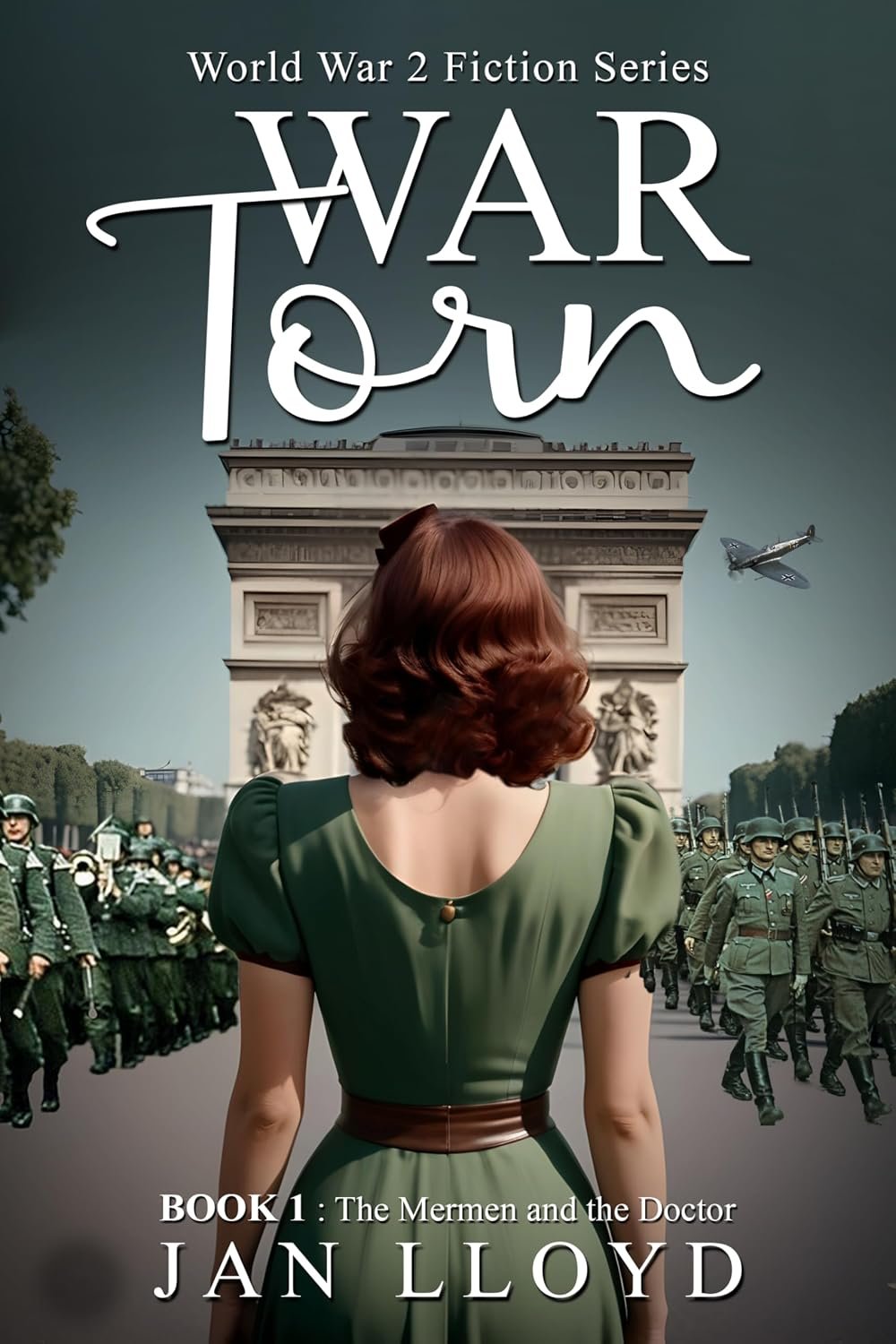
War Torn Book 1: A WW2 fiction series. A story of betrayal, love, and survival. (English Edition)
In occupied France, a violinist’s flight becomes a story of impossible refuge and divided loyalties.
Books worth discovering. Authors worth knowing.
War places ordinary words such as safety, duty and loyalty under extraordinary pressure. A journey intended to save a life may lead into a situation no one could reasonably call secure. Jan Lloyd's War Torn Book 1 begins with such a rupture: a musician attempts to escape Nazi-occupied France with her ill Jewish husband, suffers a shipwreck and is taken aboard a German submarine. The published synopsis connects that perilous setting with a forbidden attraction and a struggle for survival. This introduction considers those documented elements without treating the historical atrocities surrounding the story as mere romantic scenery.
An editorial introduction to the book and its published premise, not a full-book review.
October 1942 and a decision to flee The publisher description places the story in October 1942. Frances Meyer, described as a gifted violinist, is in occupied France and fears an SS officer obsessed with her. She attempts to leave with her ailing Jewish husband. Even before the voyage begins, the setup establishes multiple threats: occupation, antisemitic persecution, vulnerability within a household and the danger of escape. Those facts are conveyed in the public blurb, not inferred from an unverified historical scene. Readers should understand at the outset that the novel approaches World War II through an individual's danger and divided relationships.
Frances's identity as a violinist is a meaningful choice in the premise. Musical training implies discipline and sensitivity to order, while wartime flight takes place amid instability and coercion. We cannot know from the synopsis how extensively the narrative depicts performance or practice, but the contrast itself is evident. A protagonist associated with expressive art enters circumstances that threaten even the ability to make a free choice.
Rescue that is not a safe return The escape attempt turns disastrous when Frances is shipwrecked in the Atlantic. She is rescued by a German U-boat under Kapitan Kristian Mueller. A rescue normally promises a restoration of order; here it delivers Frances into an enemy military environment. The submarine is not neutral territory. The advertised description stresses the confined conditions and the difficulty of remaining safe among the crew. It also indicates that the vessel faces Allied pursuit. The dramatic pressure comes from a place that is simultaneously shelter from the sea and a new source of danger.
The submarine setting offers a strong spatial metaphor without requiring invented technical details. Confinement limits privacy and movement. A military hierarchy determines who has authority. Noise, closeness and the inability to leave all intensify personal encounters. The promotional material describes some of these discomforts directly, including the number of men aboard and the claustrophobic environment. A responsible feature should not extrapolate exact operations, battle maneuvers or ship specifications from this description.
An attraction with moral stakes The official synopsis acknowledges an unexpected connection between Frances and Mueller. That is also where the ethical difficulty of this historical romance becomes unavoidable. A German commander is not simply an inconvenient love interest placed across a neutral dividing line. His position exists within a wartime structure responsible for devastating violence. A novel can explore complicated attachments, but readers need not set aside the occupation's context to recognize them. The important question is how fiction balances an individual's complexity with the material consequences of the institutions around that person.
The description says that Frances is torn between loyalty, survival and feelings she did not anticipate. It does not say what those feelings justify or how the novel ultimately judges them. Treating the blurb's word 'love' as a complete moral answer would erase the uncertainty the book advertises. Equally, assuming a specific scene of confession or betrayal would manufacture material not in evidence.
The wider danger of the war This first installment is publicly positioned as historical fiction with romantic suspense, not as a documentary reconstruction of any one mission. The U-boat becomes a hunted target, according to the book description, increasing the cost of each personal decision. Frances's precarious position is therefore influenced by larger events as well as the people nearest to her. The novel's stated wartime setting makes readers conscious that a choice apparently intimate may have consequences across military and civilian lines. This is a thematic reading of the setup, not a claim about the book's ending.
Historical fiction carries a particular obligation for anyone writing about it. A synopsis may borrow real conditions to frame invented individuals and encounters. That does not give a feature writer permission to present the imagined narrative as historical evidence. Readers interested in the U-boat campaign, occupied France or the Holocaust should supplement fiction with specialist historical scholarship.
A series rather than a standalone event The title identifies this as Book One, and the author's website presents *War Torn* as a trilogy. That wider structure is useful context, since the first volume need not close every arc established by a large wartime canvas. We can say the story begins a series; we cannot promise a particular cliffhanger, reveal which characters return or supply events from later installments as though they occur in the first. Anyone deciding whether to begin the trilogy should be aware that its promise extends beyond the immediate voyage.
The author website also notes that Lloyd drafted the first installment many years before publication, and later returned to the manuscript with encouragement from her daughter. This background may intrigue readers of long-gestating novels. A story written in one era and released in another can carry traces of both the original imaginative impulse and later revision. The public biography does not establish every revision step, so claims about how the manuscript changed would be speculative. The verified fact is the long interval between initial writing and eventual publication.
What kind of reader might enter this story Readers drawn to intense historical romance, characters facing compromised choices and stories of survival may recognize the appeal of the premise. So might those interested in how a personal narrative can make a large conflict feel immediate. At the same time, the setting includes Nazi persecution and threats of violence. That is not incidental background for all readers. Sensitivity to the era and to the book's announced subject matter should be part of a thoughtful reading decision, especially for anyone looking for escapist romance rather than wartime distress.
Retailer descriptions list a paperback edition of roughly 328 pages, but formats and page counts can vary. More importantly, no listing alone establishes the execution of its historical research, emotional pacing or character development. Those judgments require reading. What the evidence does establish is a distinctive opening: a violinist attempting to protect herself and her husband ends up dependent on an enemy submarine, where the meanings of rescue and danger become entangled. That is a substantial enough premise to invite examination without revealing or inventing a conclusion.
About the book.
In October 1942 Frances Meyer flees occupied France with her ailing Jewish husband, is shipwrecked, and is taken aboard a German U-boat under Kapitan Kristian Mueller.
Non-sponsored Book Feature based on the queue record and cited public materials; this is not a full-book review. Interpretive observations are distinguished from the publicly documented synopsis. Verify all copy before publication. Source research: primary reference and second reference.
Found a book worth opening?
Books worth discovering. Authors worth knowing.
Return to the Journal →