
Whispering Rain
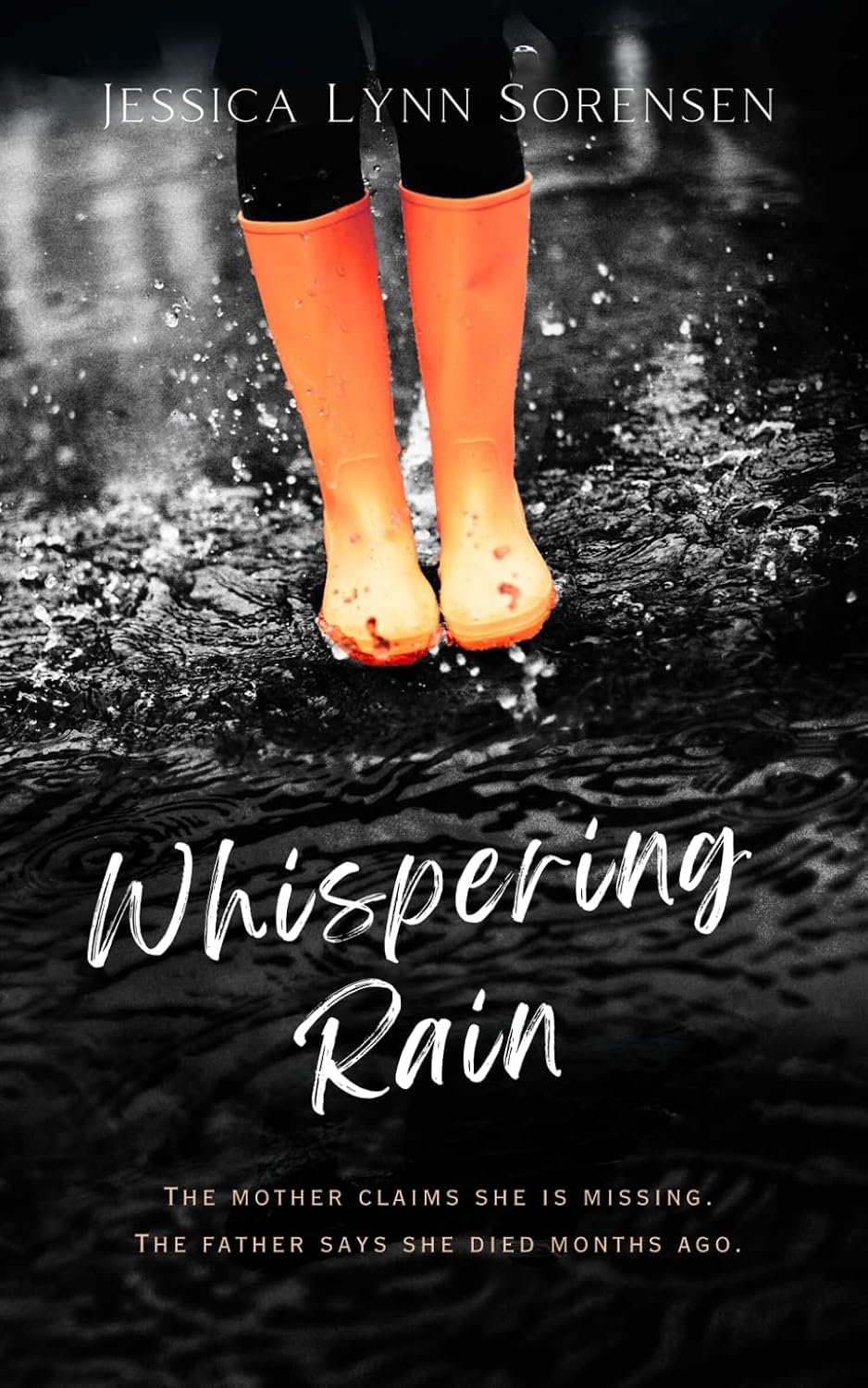
A missing child, two irreconcilable parental stories, and a detective forced to ask what really happened to Bailey Moore.
Books worth discovering. Authors worth knowing.
A missing child, two irreconcilable parental stories, and a detective forced to ask what really happened to Bailey Moore.
J.
A Case Built on Two Impossible Accounts
At the center of Jessica Lynn Sorensen’s *Whispering Rain* is a contradiction that should make any detective deeply uneasy. Four-year-old Bailey Moore is missing, according to her mother, who says the disappearance happened the previous night. Bailey’s father offers a different account: he says the child died months earlier in a car accident. The published synopsis establishes those incompatible statements without resolving them, placing Detective Caleb Reed in the position of investigating not only what happened but which version of reality he can even trust. This is a sharper premise than a conventional missing-person clock. When the basic question of whether a victim is alive becomes contested, every apparent clue demands a second look.
The story is listed as the second entry in Sorensen’s Detective Caleb Reed series, and its product description says it can be read as a standalone mystery. That combination matters. Returning readers may be familiar with Caleb’s investigative voice, while newcomers can enter through an immediately legible dilemma. The case provides a self-contained doorway: two parents, one daughter, and an account that cannot simultaneously be true in both versions. The uncertainty does not depend on an elaborate criminal network or an encyclopedic understanding of prior adventures. It grows from an ordinary setting made terrifying by conflicting testimony and the vulnerability of the child at its center.
What Does a Detective Believe?
Much of detective fiction depends on the assumption that careful observation will eventually reorganize chaos into a comprehensible pattern. Here, the published premise challenges the first stage of that process. Caleb cannot simply decide which parent seems more convincing. An emotionally persuasive story might still be false; a strange or halting statement might reflect trauma rather than deceit. Investigators often need timelines, records and independent corroboration precisely because human testimony is shaped by fear, guilt, memory and self-protection. The fictional tension comes from watching the apparent obviousness of a case dissolve. A missing-child report sounds urgent, but so does a claim that the reported missing child died long ago.
The distinction between knowing someone is lying and knowing who is lying is crucial. The synopsis asks which person could be concealing the truth and how far that concealment might go. But readers should not assume the problem has a simple either-or answer. Psychological mysteries work through misdirection, selective perspective and the possibility that a question has been framed incorrectly. We can discuss those storytelling possibilities without presenting any as a verified twist. The supplied book description deliberately withholds the resolution. A research-based feature should do the same, allowing the opening contradiction to retain the unsettling power that makes it a promising hook.
An Investigator With His Own Limits
Caleb is not introduced as an all-knowing machine. The promotional material uses a distinctly weary, exasperated voice to suggest a working detective irritated by the dysfunction he encounters. That tone is important to the book’s atmosphere. The darker the subject, the more an investigator’s very human impatience may sharpen the contrast between ordinary professional routine and the extraordinary behavior of the people involved. Police work, as imagined here, is not one uninterrupted display of brilliance. It is also exhausting, morally uncomfortable and full of conversations that leave more questions than answers. Caleb’s frustration may help make the absurdity of the parents’ stories feel immediate rather than abstract.
The series is described in sources as centered on middle-aged characters, using first-person narration and multiple perspectives. These are publisher-facing descriptors, not conclusions from a comprehensive reading. Even so, they explain something about the intended experience. First-person sections can place readers near a character’s immediate judgments, making uncertainty harder to escape. Multiple perspectives can widen the field while also raising doubts about what each narrator sees or chooses to reveal. The challenge for a reader is to keep track of what has been established and what belongs only to someone’s account. In a mystery founded on incompatible stories, that distinction is not a footnote; it is the heart of the tension.
Responsibility in a Darker Mystery
Because the case concerns a young child, it is sensible to note the content guidance printed with public listings. The synopsis references limited child-abuse material in recollection rather than the current story, and describes it as not highly graphic. This is useful information for readers who prefer to know where a thriller’s disturbing elements are likely to lie. Such a note should not be turned into a sensational promise. The emotional burden of a missing or deceased child is serious enough without exaggeration. Likewise, the fact that the story advertises little or no romantic heat makes it a different proposition from suspense that is primarily driven by a relationship subplot.
The most compelling aspect of the setup is that it forces everyone involved to confront their appetite for certainty. Readers may form an immediate theory based on their reactions to the mother and father. But a detective has to suspend precisely that reflex long enough to look for evidence. The contrast creates a useful reading experience: the desire to turn the page is linked to the desire to see one’s own assumptions tested. Mystery novels thrive when their central question can be stated clearly, then complicated responsibly. Here it can be stated in a few words: what happened to Bailey Moore? The challenge is that even the question’s premises may be unstable.
Where the Series Fits
Sorensen’s author website lists *Whispering Rain* between *A Stranger Within* and *Fading Secrets* in the Detective Caleb Reed sequence. A bibliographic listing places it in 2025. The series context offers readers two entry points. Anyone already acquainted with Caleb can see how a particularly strange investigation tests him; a newcomer can use the clear central mystery to decide whether Sorensen’s approach suits their tastes. Readers of psychological suspense who prefer moral unease, clashing accounts and an investigator under pressure will likely recognize the appeal from the publisher’s description alone. It is less useful to promise twists or a satisfying ending without having verified them.
Sorensen also makes an interesting choice by framing the case as potentially less high-profile than Caleb’s other work. Scale is not the same as difficulty. An investigation involving one family may be as psychologically intricate as a sprawling criminal conspiracy because the emotional relationships are so dense. Each contradiction can carry layers of grief, fear and obligation. The result, at least in the premise supplied by the author and bookseller sources, is a mystery built not around spectacle but around the fragility of what people report as fact.
A careful feature stops short of naming the person responsible or declaring what is ultimately true. Those are questions for the novel itself. What readers can know before opening *Whispering Rain* is that it begins with an unforgettable evidentiary conflict, pairs that conflict with an imperfect detective, and signals an unsettling but focused reading experience. The book’s greatest promise is its ability to make a familiar crime-fiction situation feel almost logically impossible. When the statements at the heart of a case cannot coexist, the investigation becomes an inquiry into truth, memory and the damage that concealment can leave behind.
For readers deciding whether to begin with this installment rather than the first book, the marketing’s standalone designation is useful but should not be overstated. It indicates that the central mystery can be approached without prior reading, not that every passing reference to Caleb’s history will have equal significance to a newcomer. Another sensible consideration is emotional tolerance for a child-centered investigation. The novel’s listed content guidance gives a practical starting point for that choice. Those details make the book easier to evaluate on its own terms: an abrasive, weary investigator, intimate psychological uncertainty, and a suspenseful premise whose unanswered question is deliberately kept intact.
About the book.
Detective Caleb Reed investigates the reported disappearance of four-year-old Bailey Moore; her mother says she disappeared last night, while her father says she died months earlier in a car accident.
Sponsored book feature. Independent research-based commentary using publicly available descriptions and author material, not a claim of first-hand full-text review. The cover placeholder will be resolved by the owner’s publishing automation.
Found a book worth opening?
Books worth discovering. Authors worth knowing.
Return to the Journal →