
A Glorifying Poetic Tale
A farm-day UFO encounter becomes an unusual rhymed adventure in which an angel interrupts an otherworldly threat.
Books worth discovering. Authors worth knowing.
A farm-day UFO encounter becomes an unusual rhymed adventure in which an angel interrupts an otherworldly threat.
S.
When the Ordinary Farm Day Turns Extraordinary
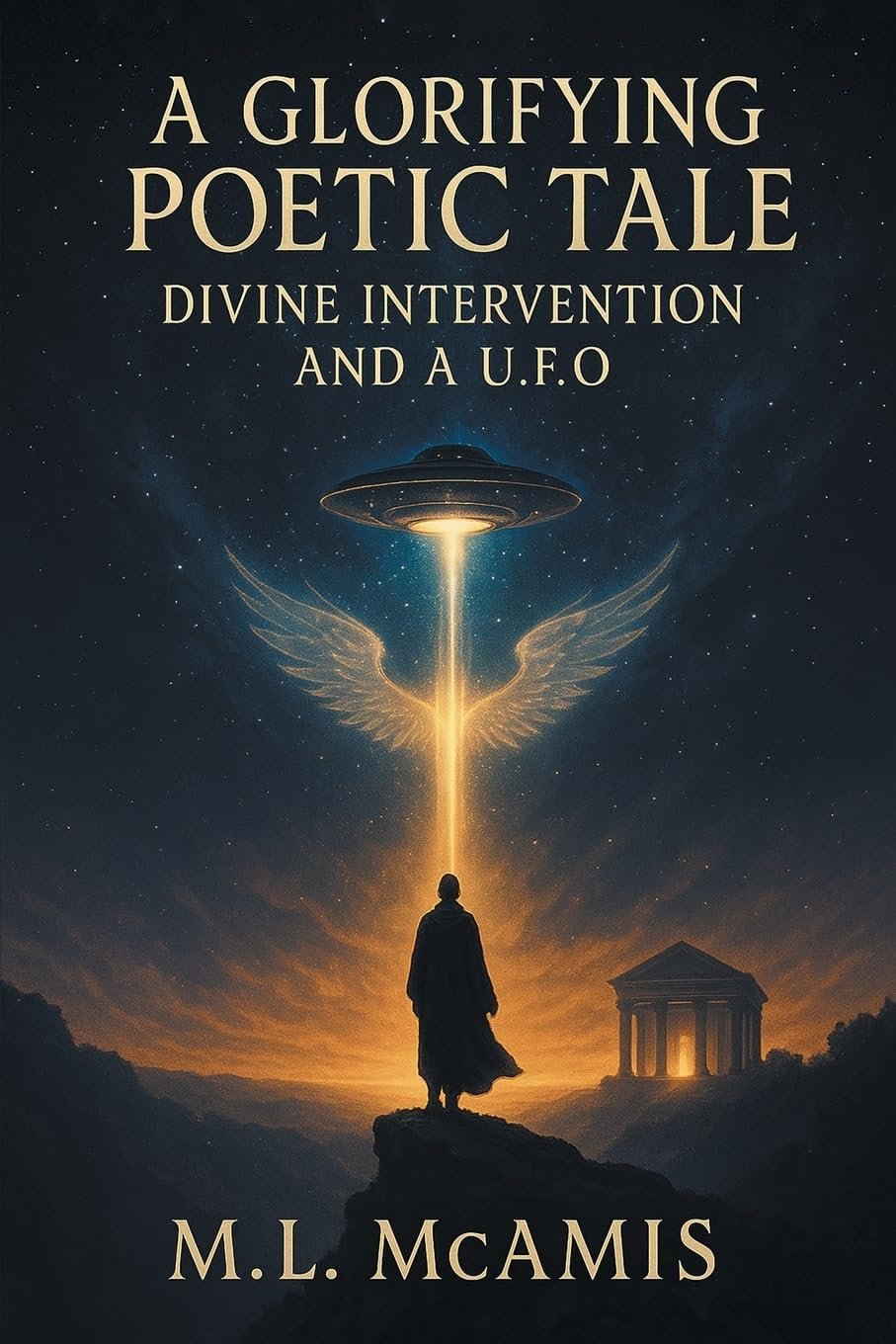
A quiet farm is the starting point of M. L. McAmis’s A Glorifying Poetic Tale: Divine Intervention and a U. F. O. Bookseller descriptions establish a surprisingly compact sequence: a UFO appears, a beam of light descends, and a heavenly angel steps into the disorder. An alien described as hostile is captured. These events belong to the publisher’s short summary, not to an independently reconstructed reading of every page. Even at this scale, the premise makes a distinctive promise. It places the familiar world of chores and open land beside the immense uncertainty of an encounter from the sky.
That juxtaposition gives the adventure its initial energy. Farms are often imagined as places where life follows seasonal patterns and a day’s work has a recognizable order. A hovering object interrupts that sense of continuity. The characters cannot simply solve the disturbance by turning to their usual routine. McAmis adds another disruption by introducing an angel. Instead of approaching the UFO only as science-fiction technology, the book frames the encounter through a language of providence, moral danger and unexpected help. Readers can decide how its combinations of faith and the fantastic work for them.
Why Tell an Encounter in Rhyme?
The published synopsis calls this a rhymed adventure, a crucial detail for understanding its intended experience. Rhyme changes the pace of a strange event. Where a prose thriller might linger over technical clues and fear, lines built around rhythm can make an impossible sight easier to repeat aloud and remember. That does not mean the situation has no tension. The summary speaks of chaos and an unfriendly alien. But verse creates a different kind of narrative container for those ideas, inviting a voice that can move between excitement, surprise and reassurance in a small number of pages.
At thirty-two pages in the Bookside Press paperback catalogues, the book is far shorter than a conventional science-fiction novel. That format matters. A feature on it should not invent a large cast, extended mythology or intricate technological explanation to make the story sound longer than it is. Instead, the interesting editorial questions concern economy: what does an author include when the core incident must be conveyed quickly? How much work can a single image, a repeated sound or a simple contrast between earthly fear and heavenly intervention perform? A short rhymed tale can aim for memorable impressions rather than exhaustive world-building.
Two Kinds of the Unknown
The UFO introduces one kind of unknown, associated in popular storytelling with distance, other worlds and human uncertainty. The angel introduces another, this time grounded in spiritual imagination. McAmis’s book sets these modes beside each other without asking the reader to approach the scenario as a documented encounter. It is a poetic narrative. What makes the combination striking is that neither element belongs to the everyday farm landscape. Both arrive with the power to change what the people within the story think is possible.
The result is an opportunity to discuss storytelling traditions without pretending to know additional scenes. Many fantastical adventures set up a struggle between threatening power and protective power. In McAmis’s public outline, the beam and the alien represent disruption; the angel brings intervention. The apparent contrast supplies a clear emotional path even if a reader is unfamiliar with science fiction or explicitly religious tales. It also suggests the sort of question the book might invite after a shared reading: what helps people feel safe when something unfamiliar appears, and why do some stories embody that help as a recognizable guardian?
A Threat Without a Technical Manual
A UFO is frequently the beginning of a mystery that demands explanations about where a visitor came from and what it wants. That is not what the existing synopsis primarily emphasizes. The published description instead identifies the visitor as mean and reports that the angel captures it. The simplicity is part of the text’s advertised identity. Calling the work a technological speculation would impose expectations that the available material does not support; framing it as a miraculous rhymed adventure keeps the focus on the story the publisher actually describes.
This distinction also affects the intended audience. The listing does not establish a precise reading age, and the presence of rhyme does not automatically make a book exclusively for young children. Adult readers who enjoy devotional verse, whimsical fantasy or improbable genre combinations may find the premise appealing. Families considering a read-aloud encounter should judge its appropriateness from the actual pages and individual readers’ comfort with religious imagery and extraterrestrial threats. Marketing language is a starting point for understanding tone, not a substitute for checking the edition firsthand.
The Meaning of Intervention
The word intervention in the subtitle does important narrative work. An intervention implies that the problem cannot be resolved by the threatened people alone. It also implies a turning point when outside help changes the direction of events. In the described scene, that help arrives in the form of a heavenly figure. The title makes the religious interpretation explicit rather than leaving the reader to infer it from symbolism. A reader seeking a neutral alien-contact mystery should know that the story’s moral and spiritual framing is central to its pitch.
The theme can be explored without treating the plot as theological proof. Fiction often gives concrete bodies to intangible concepts such as hope, protection and rescue. A storm becomes a challenge to perseverance; a guardian becomes an image of care. Here, the angel is simultaneously a character in the advertised adventure and a recognizable emblem of divine involvement. The different genres share a surprising point of contact: both science fiction and religious fantasy invite readers to imagine that everyday appearances do not exhaust the possibilities of the universe.
The Poet and the Small-Book Tradition
Bookseller biographies identify M. L. McAmis as a poet from Greeneville, Tennessee, with training through the Institute of Children’s Literature and Long Ridge Writer’s Group. Those details provide some grounding for the authorial approach. A writer working in poetry can be especially attentive to the way sound shapes anticipation, to the length of a pause before a surprise, and to images that remain in a listener’s mind. Such craft possibilities are interpretive observations about the form, not claims to have analyzed unprovided lines from this particular book.
The listing for the 2025 Bookside Press edition confirms a thirty-two-page paperback and the distinctive subtitle. That is useful for readers, who deserve to know whether they are approaching a short verse story or a novel-length science-fiction adventure. More elaborate claims about illustrations, precise stanza forms, the number of characters or the ending beyond the synopsis should await a verified complete copy. This restraint need not diminish the book. It respects the work’s actual scale and gives prospective readers an accurate picture of the encounter it proposes.
How to Read a Genre Collision
One way to enjoy such a premise is to accept its elements on their own imaginative terms. Ask why the author chose an everyday farm instead of a distant space station, why a UFO creates the disruption rather than a conventional earthly danger, and what effect the angel has on the emotional direction of the poem. The answers may sit in the actual language of the verse. A publisher’s paragraph cannot demonstrate the sound of those lines; only the book itself can. Readers attracted by the concept should approach it with curiosity rather than expecting a critical verdict based on unavailable text.
A second route is to consider the story as part of a long tradition of miniature adventures. Many brief tales rely on a stable place, a startling intrusion and a decisive act that restores meaning. McAmis’s combination of alien imagery and divine rescue adds an unusual signature to that familiar structure. The public materials do not establish whether the poem is playful, solemn or both from page to page. What they do establish is an explicit wish to tell a miraculous adventure in rhyme, and that is a clearer recommendation than an invented account of its stylistic subtleties.
A Short Encounter With a Long Shadow
A Glorifying Poetic Tale offers a concentrated curiosity for readers who enjoy faith-inflected fantasy, unexpected science-fiction motifs and stories meant to be heard as well as read. Its best introductory hook is not a claim of complex extraterrestrial lore. It is the improbable arrival of an angel amid a sudden UFO disturbance in a setting where nothing of the sort should be expected. That combination raises a question as old as storytelling: what happens when the everyday world seems briefly open to forces beyond ordinary explanation?
The most useful reader expectation is modest and specific. This is a short, publicly described rhymed adventure, not an independently verified report of supernatural events and not a book whose every detail is available in promotional summaries. Its premise is vivid enough to invite imaginative conversation without embellishment. In the end, the appeal of McAmis’s approach lies in bringing two expansive ideas—other worlds and divine care—down to the scale of one ordinary day on a farm, then allowing poetry to carry the meeting.
About the book.
A brief rhymed tale set on a farm, where a UFO appears, beams light downward and an angel intervenes to capture a hostile alien; the publisher lists a 32-page paperback.
Editorial book feature, not paid sponsorship. Research-based commentary from named public sources, not a first-hand complete-book review. The cover placeholder will be resolved by the owner’s publishing automation.
Found a book worth opening?
Books worth discovering. Authors worth knowing.
Return to the Journal →