
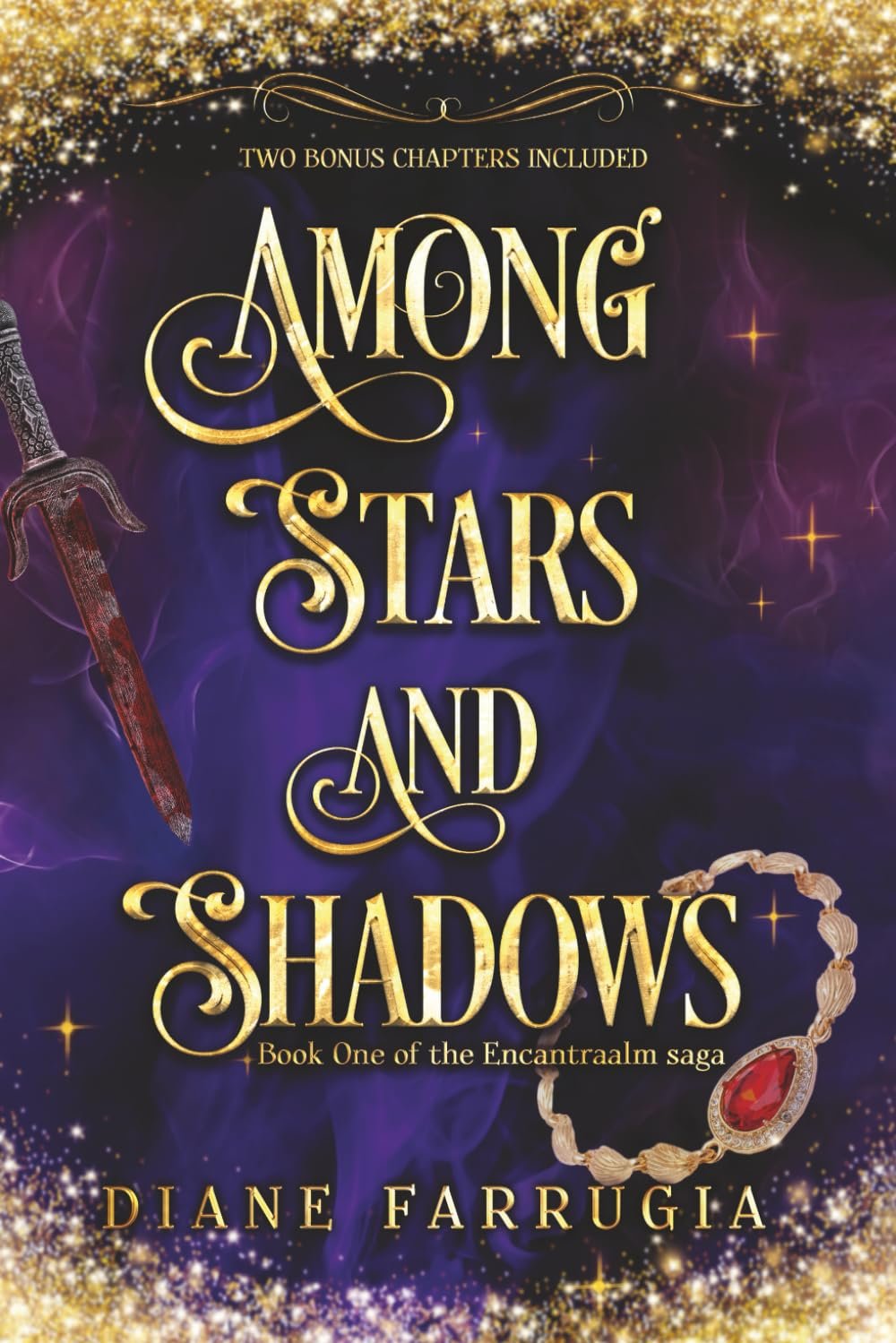
Among Stars and Shadows
Grieving student Kayla Winters crosses into a magical realm, where love, ancestry and an ambitious king turn escape into an impossible choice.
Books worth discovering. Authors worth knowing.
Grieving student Kayla Winters crosses into a magical realm, where love, ancestry and an ambitious king turn escape into an impossible choice.
S.
A Life Already Heavy Before the Magic Begins
Kayla Winters enters Diane Farrugia’s Among Stars and Shadows with burdens that do not disappear when the fantasy opens. Publisher catalogues describe a young woman struggling with chronic illness, university work that is slipping away from her, and guilt following her mother’s death. Those circumstances matter because they turn the familiar portal-fantasy premise inside out. She is not simply a restless visitor delighted to leave ordinary life behind. She needs to recover a sense of control, yet the unexpected passage into a world of living myths takes even more control away.
The result is a romantic fantasy with grief and vulnerability at its center. Kayla’s problems precede the elven prince, the magical kingdom and the threat to the human realm. The new landscape does not magically cure an old wound; it brings those wounds into a different arena. That difference helps distinguish the story from escapist tales in which crossing a threshold clears the emotional slate. For Kayla, escape and self-discovery are entangled. The reader has reason to watch how the outer danger meets someone already trying to decide what belonging should mean.
The Uncomfortable Promise of a New World
Farrugia’s public synopsis identifies the magical world as the hidden counterpart to the reality humans know. Discovering that another realm exists can be exhilarating in fantasy, but for a stranded outsider it also presents a problem of safety. What laws govern the new place? Which customs could an unprepared visitor misunderstand? What obligations might attach to an invitation that sounds generous? The descriptions emphasize Kayla’s wish to go home and her growing recognition that the world she has entered is not a harmless fairy tale.
This is where the book’s atmosphere earns the word shadows in the title. The magical realm contains beauty, attraction and mythic possibility, but its power structures are not benign. Kayla seeks refuge in a castle even as the monarch who rules it becomes a source of danger. Shelter can therefore mean dependence on someone who benefits from keeping her trapped. That contradiction is particularly effective for romance fantasy: a setting associated with elegance and protection becomes the site of hidden coercion. Readers can explore the difference between feeling welcomed and actually being free.
Declan and the Problem of Being Seen
Prince Declan is introduced as the figure who cuts through Kayla’s defenses. One publisher account says he can read her emotions, a gift with obvious romantic possibilities and an equally obvious unsettling side. Many romances build intimacy around the slow process of disclosure. Here, the possibility that someone can sense feelings before they are spoken changes the balance. Kayla’s attraction does not erase the need for boundaries; it sharpens the tension between wanting to be understood and wanting to control how one is understood.
The available descriptions do not justify inventing private conversations or promising exactly how Declan handles that ability. They do establish his role as a powerful romantic interest and the son of a dangerous ruler. The family relationship turns the love story into something politically fraught. Kayla cannot evaluate Declan only as an appealing individual, because the power of his father’s court reaches into her future. Romantic loyalty and familial obligation may point in conflicting directions. That gives readers something richer than the question of whether two attractive people will admit their feelings.
A King Who Wants More Than a Kingdom
The principal political threat comes from Declan’s father, a king whose power can control minds and whose ambition extends to the human world. The publisher’s 2024 and 2025 descriptions agree on his interest in crossing between realms and on the importance of Kayla’s ancestry. The later synopsis explicitly connects her bloodline to his plans. In a genre where heritage can confer secret privilege, Farrugia turns the revelation of ancestry into a danger. Discovering where one comes from may create vulnerability rather than instant empowerment.
The king’s interest also reframes the portal between worlds. A gateway that initially seems like an extraordinary escape from Kayla’s troubles becomes a potential route for conquest. Decisions inside the magical realm may affect people who have no idea it exists. This raises the scale without requiring the feature to claim a particular battle or ending. The published setup is enough: a grieving student, a royal family divided by desire and ambition, and an inheritance whose meaning is contested. The pressure is both intimate and geopolitical, a combination that defines much contemporary romantic fantasy.
The Winter Solstice as a Deadline
One edition’s synopsis describes a deadline at the next Winter Solstice, by which Kayla’s true lineage and fate must be determined. That seasonal marker gives the story a sense of tightening time. A fantasy romance can luxuriate in atmosphere, court rituals and slow-building attraction, but a deadline prevents its characters from remaining in emotional suspension forever. Kayla must decide what to trust under conditions that continually narrow her choices. The public summary does not tell us how the deadline is resolved, and avoiding that speculation preserves the central suspense.
A solstice also brings symbolic possibilities: a turning point in the balance of darkness and light, a pause between one season and another, a moment when waiting can no longer continue. Those associations are useful as interpretive reading questions, not proof of a specific ritual depicted in the text. The title’s contrast between stars and shadows makes such imagery feel relevant. Readers may find it rewarding to notice how much of Kayla’s struggle concerns things she can observe directly and how much depends on what others conceal from her.
Grief, Illness and the Cost of a Fresh Start
Kayla’s background deserves attention independent of the love triangle between freedom, Prince Declan and the king’s demands. A protagonist managing illness and bereavement may interpret risk very differently from someone entering a fantasy world without personal loss. Returning home can signify comfort but also the burden of facing unfinished grief. Remaining in the new place can promise transformation but also an increasing dependence on forces beyond her control. Farrugia’s premise allows these choices to feel genuinely difficult rather than simply decorative.
The medical references in the synopsis describe a fictional character; they are not grounds for presenting the novel as an account of any particular diagnosis or treatment. The same restraint applies to bereavement. Grief can influence a character’s need for connection without explaining every decision she makes. A careful reader can appreciate Kayla as a person whose emotional needs complicate her choices. Her romance has weight precisely because it happens when she has reasons to protect herself, seek stability and doubt what promises of safety actually mean.
An Elven Love Story With a Political Spine
The romance is the most obvious point of entry for readers attracted to the Encantraalm saga, but the story’s public architecture includes a political thriller embedded in the fantasy. Mind control is not merely an impressive magical talent; it is a threat to consent and collective freedom. Bloodline is not only personal history; it may become a tool of state ambition. A castle is not only a romantic setting; it is a center of power. These contrasts supply an unusually consequential backdrop for attraction between Kayla and Declan.
Publisher records give different lengths and release dates for different editions, including a 2024 book under 5310 Publishing and a 2025 catalogue entry under Lulu.com. Readers should consult the linked edition for exact format rather than assume the versions are identical. What stays stable across these descriptions is the main premise, the named protagonists and the ruler’s invasive ambition. That consistency makes the book a responsible subject for a research-based feature without pretending to have assessed its complete prose or any changes between editions.
Who Will Feel at Home in Encantraalm?
Among Stars and Shadows is positioned for readers who like portal journeys, strong emotional stakes, dangerous royal courts and romantic bonds complicated by political power. Its hook is less about collecting exotic magical creatures than about what happens when a vulnerable visitor is made valuable to people who might not respect her freedom. Kayla’s emerging feeling for Declan tests whether love can remain a meaningful choice when other choices are being stripped away. The publisher’s synopsis promises both attraction and a struggle over agency.
The compelling question is not simply whether Kayla can find a way back to the human world. It is what the word home will mean after she confronts a new identity, a dangerous inheritance and someone who seems able to perceive her heart. That question allows the fantasy to connect with familiar human experiences of change and grief. Farrugia’s novel presents a magical escape with very real emotional costs, inviting its readers to follow a heroine who must decide who she is while powerful people insist they already know what she is for.
About the book.
Kayla Winters, struggling after her mother’s death and with worsening illness and university performance, is stranded in an elven realm and drawn to Prince Declan; his mind-controlling father sees her bloodline as a potential key to the human world.
Sponsored book feature. Research-based commentary from named public sources, not a first-hand complete-book review. The cover placeholder will be resolved by the owner’s publishing automation.
Found a book worth opening?
Books worth discovering. Authors worth knowing.
Return to the Journal →