
Mission Possible
Dr. Juan Phillip Chisholm shares his own education-financing path and scholarship-search strategies for families seeking to reduce student debt.
Books worth discovering. Authors worth knowing.
Dr. Juan Phillip Chisholm shares his own education-financing path and scholarship-search strategies for families seeking to reduce student debt.
D.
Reimagining the Cost of a College Education
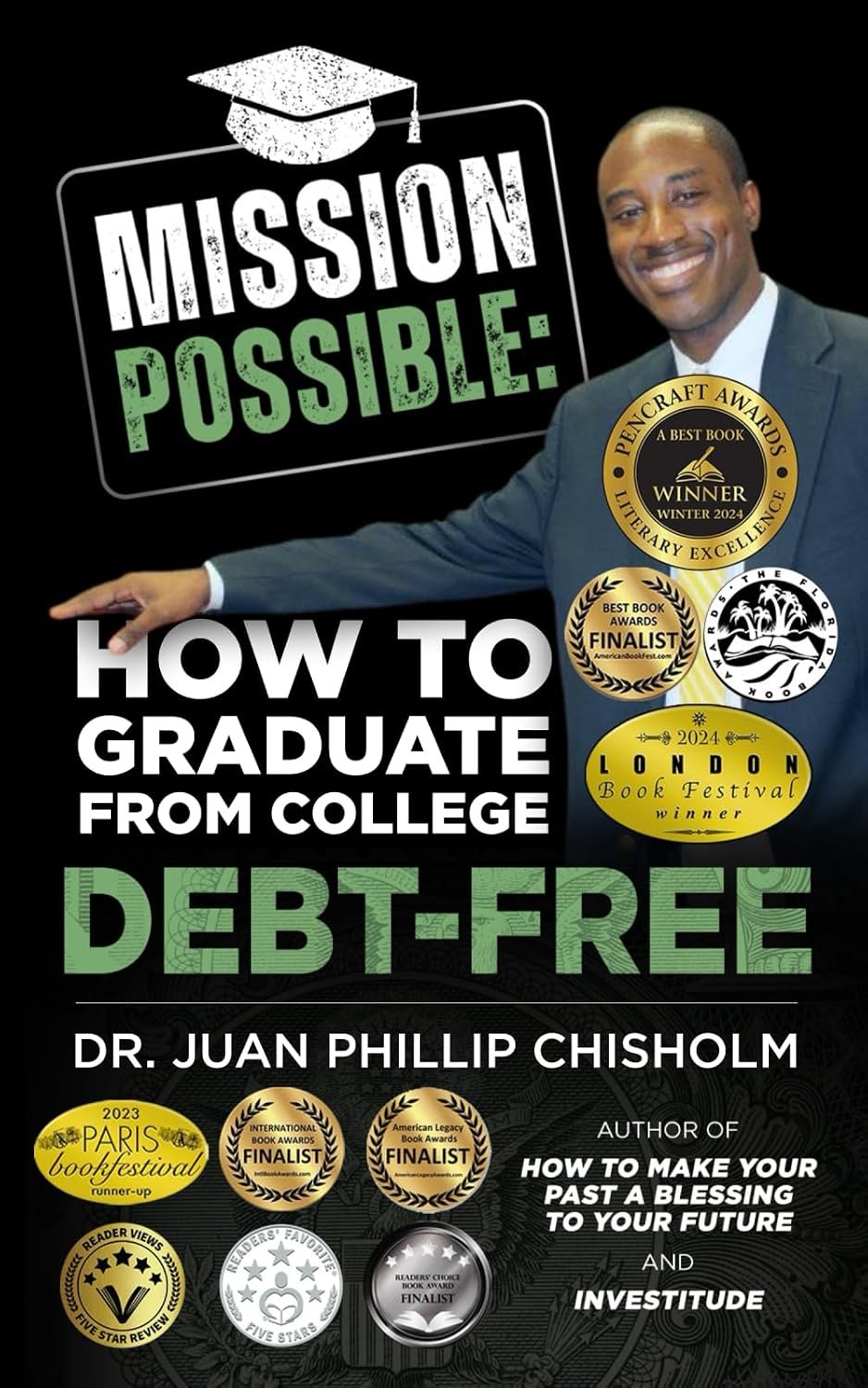
College planning conversations often focus on admission and course choice before families confront the question of how to pay for it. Dr. Juan Phillip Chisholm’s Mission Possible: How to Graduate From College Debt-Free begins from that financial concern. The book’s public description presents scholarships, awards and other funding opportunities as part of a deliberate strategy to reduce or avoid student borrowing. Chisholm also describes his own route through college, law school and an executive education program without student loans. His experience provides the book’s motivational thread, while the practical search for educational funding supplies its intended use.
The title is ambitious. It should be read as a goal and an account of possible strategies, not a guarantee that every student can attend any institution without borrowing. Tuition, living costs, eligibility, scholarship availability and family circumstances vary considerably. The book offers a framework for looking beyond the first financial package placed in front of a student. Its potential value lies in encouraging early, organized research and helping families recognize that tuition is only one part of the cost of earning a degree.
Scholarships Are Work, Not a Lucky Discovery
The public synopsis specifically discusses finding scholarships and awards. Many students think of scholarships as rare major prizes reserved for applicants with perfect records. In practice, opportunities can have different criteria and deadlines; researching them is an administrative project of its own. That general observation explains why a guide devoted to the process can be useful. A family might compare eligibility rules, gather transcripts and recommendations, and keep track of when an application is due. These examples are sensible planning practices, not a claim that the book includes any particular worksheet or database.
A reviewer at Reader Views described the book’s suggestions as practical and noted that pursuing them requires time and effort. That is an important counterweight to the phrase debt-free. Financial aid is not usually found through one shortcut. Applications must be completed accurately, and some opportunities may be highly competitive. Students should verify information through official financial-aid offices and the granting organizations themselves. A book can help readers ask better questions and become more persistent, but it cannot verify that a particular award remains open or that a reader will qualify this year.
Housing, Books and the Hidden Total
The book’s description explicitly includes tuition, housing and books among the expenses families need to consider. That broader view matters. A student who receives substantial tuition assistance may still struggle with transportation, materials, meals or accommodation. The apparent cost of an institution can look dramatically different after these expenses are included. Financial planning therefore requires a total-cost perspective rather than a single headline figure. Students comparing schools should request institution-specific estimates and ask how aid changes after the first year.
The impulse to minimize debt can also lead to unwise choices if it becomes the only criterion. An unfamiliar program may lack the support a student needs, or a highly advertised award may not cover renewable costs. The practical challenge is to combine affordability with educational quality and fit. Chisholm’s mission addresses one crucial part of that decision. Readers will still need to make their own comparisons based on current policies, family resources and realistic academic plans. That does not lessen the book’s relevance; it places financial strategy within responsible decision-making.
The Author’s Personal Path
Chisholm is publicly described as a Florida State University graduate who later earned a law degree at Florida A&M University College of Law and completed an executive program. Public biographies say he did so without student loans. His own experience is central to the book’s credibility as a personal guide. Readers may take encouragement from seeing how one person built an education without following the most commonly feared debt trajectory. Yet experience-based advice always needs adaptation. What worked for one applicant at one time may not apply unchanged to another institution or generation.
That distinction is particularly important for financial literacy. Grants, awards, tax rules and tuition policies change. Readers should treat the book’s principles as a starting point for investigation rather than rely on historic dollar amounts or eligibility criteria without checking official sources. Chisholm also established the Graduate Debt-Free Club, which reflects his continuing interest in helping students and parents navigate these questions. A book born from experience can motivate action, but current decisions need current evidence.
The Difference Between Hope and Certainty
Mission Possible takes a deliberately encouraging tone. The phrase suggests an achievable aim where financial anxiety might otherwise convince families that borrowing heavily is inevitable. Hope can be useful when it prompts a student to seek opportunities they had assumed were unavailable. But an ethical reading keeps the uncertainty visible. Scholarships are not distributed equally, eligibility can depend on circumstances outside the applicant’s control and some educational paths have particularly high costs. Students should never feel that needing financial assistance or a loan represents a personal failure.
A sensible interpretation of the book is that it broadens the set of questions available to families. Have we explored institutional aid and local awards? Are there lower-cost pathways that meet the student’s goals? Have we calculated total expenses rather than only the tuition bill? Do we understand the terms of any remaining borrowing? These questions complement professional aid counseling and official information. They also make a planning conversation more productive even when the final answer does not amount to zero debt.
Recognition and Independent Commentary
The 2025 Independent Press Award program identified Mission Possible as a distinguished favorite in young adult nonfiction. That announcement also summarizes Chisholm’s firsthand educational journey. Independent Reader Views commentary from 2023 described the guide as approachable and particularly relevant to students and parents preparing for college. Such recognition and reader response help establish how the book has been presented publicly, but they do not prove any universal financial outcome. The stronger evaluation is whether the guidance causes a family to examine options more carefully and understand its own numbers.
The edition referenced in the queue corresponds to a paperback with ISBN 9780975511046, widely listed as a 2023 release from Greenlight Books and Publishing. As with any planning resource, editions matter when they include time-sensitive information. Before using a named scholarship or policy, readers should follow its current official documentation. The book’s lasting value would be the habits of inquiry, organization and persistence rather than a frozen snapshot of every aid program.
A Family Conversation Worth Starting Early
Mission Possible can serve high school students, university applicants and the relatives helping them plan. It may also interest people looking back at education decisions and seeking a more structured approach for a younger family member. Its argument is strongest when read as an invitation to start the financial conversation before deadlines reduce available choices. Students benefit from knowing that aid applications, scholarships and living-cost decisions deserve as much attention as selecting a campus.
The book does not remove the complexity of paying for education, nor should it be asked to. It gives a named goal and a personal example around which families can organize effort. Chisholm’s central message is that debt should not be accepted without exploring credible alternatives. That is a valuable starting point regardless of the final balance. Readers who leave the book with clearer questions, better records and a willingness to investigate their options will have taken its most practical lesson seriously.
About the book.
A practical guide discussing scholarships, awards and ways to fund tuition, housing and books, alongside Chisholm’s own experience completing several educational programs without student loans.
Editorial book feature, not paid sponsorship. Independent research-based commentary using publicly available descriptions and author material, not a claim of first-hand full-text review. The cover placeholder will be resolved by the owner’s publishing automation.
Found a book worth opening?
Books worth discovering. Authors worth knowing.
Return to the Journal →