
Autumn & Alibis
A bookstore inheritance, a murder at an apple festival and secrets tucked inside family journals bring danger to an autumnal small town.
Books worth discovering. Authors worth knowing.
A bookstore inheritance, a murder at an apple festival and secrets tucked inside family journals bring danger to an autumnal small town.
J.
An Inheritance in a Town That Never Loses Autumn
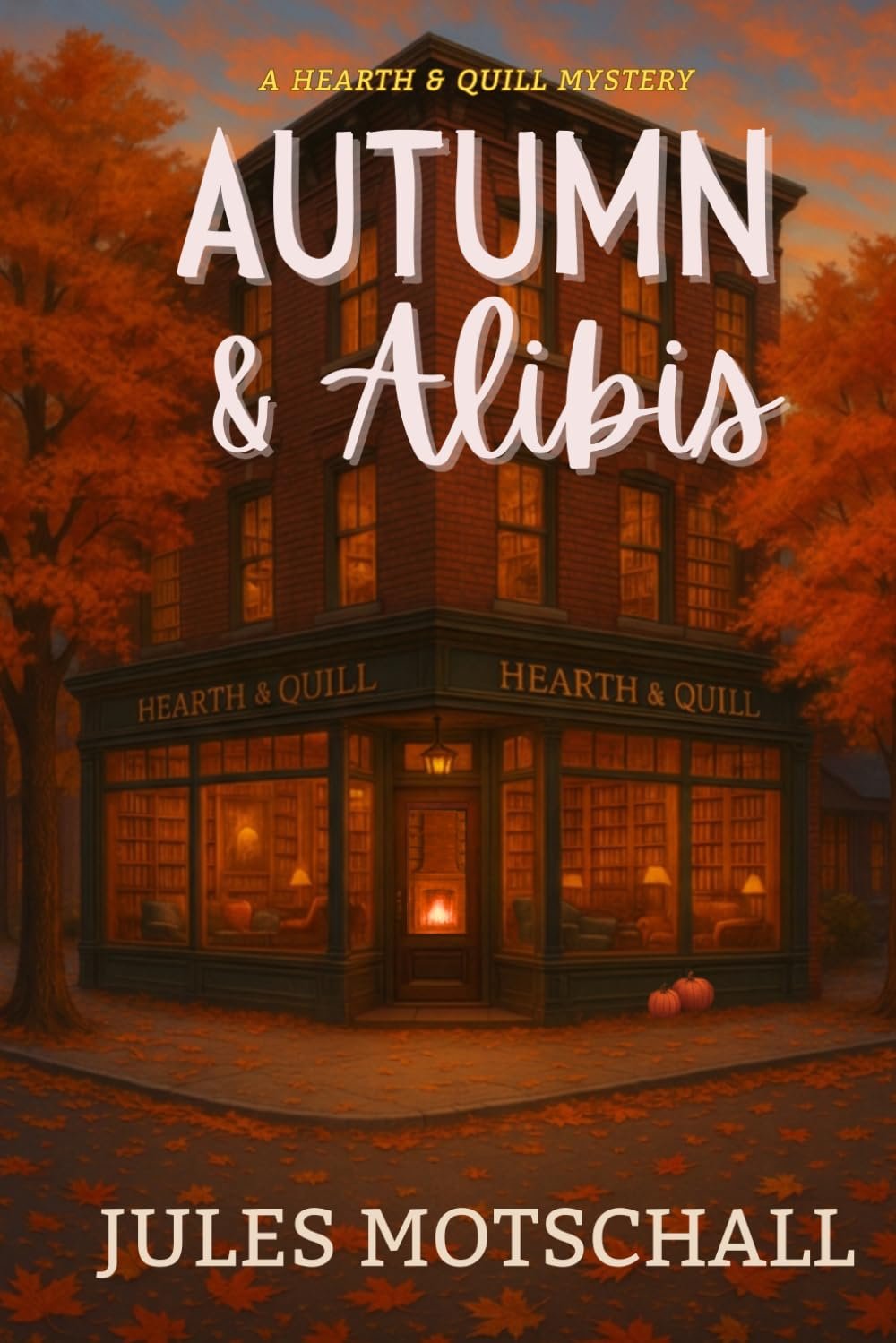
Harper Whitmore comes to Fall, Michigan, hoping an inherited bookstore will provide the fresh beginning she needs. Jules Motschall’s Autumn & Alibis gives that dream a storybook setting: leaves apparently turn without end, cinnamon seems part of the local atmosphere and the Hearth & Quill bookstore offers the comforting possibility of building a life among books. But a welcoming storefront is not necessarily a safe place. The official synopsis reveals concealed passages, old family journals and an Apple Harvest Festival shadowed by the death of a notoriously unforgiving pie judge. A cozy backdrop quickly becomes a landscape of hidden motives.
This is the central pleasure of a bookshop mystery: the world is inviting enough that readers want to stay, while its secrets are unsettling enough to make every interaction significant. Motschall establishes a clear contrast between the ordinary need for belonging and the extraordinary problem of a murder. Harper does not arrive as a professional detective carrying a case file. She arrives as someone hoping to start over. That personal stake can make an investigation feel particularly risky: every person she questions might be a potential friend, a future neighbor or a source of information she will need to keep the store alive.
Why the Hearth & Quill Matters
A bookstore is an unusually fertile setting for a mystery because it stores many kinds of memory. Customers browse stories for pleasure, but the building itself can conceal accounts that residents would rather forget. In the public description, the Hearth & Quill is warm, charming and full of surprises, including secret passageways. Those details promise the satisfying physical geography that cozy mysteries often use: counters and reading corners for informal conversations, tucked-away spaces for discoveries, and a sense that a familiar building can look different once someone learns its history.
The inheritance also creates a natural connection between past and present. Harper’s great-aunt is absent from the story’s opening everyday life, yet her old journals may hold clues. A written record can outlast the person who made it while remaining difficult to interpret. It may reveal only what the writer understood or dared to record. Harper’s task therefore sounds less like assembling one obvious explanation and more like learning how the town tells its own stories. The bookstore gives her a practical home while also placing her inside an unfinished family and community narrative.
The Pie Judge and the Festival
Prudence Sherman, described in the official materials as an especially harsh pie-competition judge, is found dead during preparations for the Apple Harvest Festival. That is a distinctive choice of victim and occasion. A town festival offers abundant public visibility, old rivalries and temporary chaos; a pie competition can turn small reputational disputes into outsized emotions. The murder interrupts an occasion meant to demonstrate communal harmony. The contrast may be amusing at first, but it asks a serious detective-fiction question: how much resentment can accumulate under the cover of friendly traditions?
A good cozy mystery uses an event like this as more than festive wallpaper. People come together, secrets circulate, and official order competes with the informal knowledge held by neighbors. The description does not establish who killed Prudence or why, so any claim about the culprit would exceed the available evidence. What the setup does establish is that the act sends Harper searching through lies, hidden history and the story of a stolen golden-tipped quill. The murder and the missing object give the plot both a human problem and a physical symbol of authorship, memory or ownership.
The People Around Harper
Harper’s investigation is not presented as solitary. The author lists her new friend Maggie and handsome apple-orchard owner Gabe among the people who assist her. Their presence suggests two ways the novel can build an ensemble. Maggie may make the new town less overwhelming by supplying a companion’s perspective, while Gabe connects Harper’s growing personal life to the very landscape and festival at the heart of the mystery. Friendship and possible romance can make readers care about Fall even while they suspect its residents are withholding facts.
Those relationships give the mystery an emotional counterweight. If the town were filled only with ominous strangers, Harper’s temptation to build a life there would be harder to understand. Instead the book’s premise promises warmth and suspicion in the same streets. A new friendship can be comforting and uncertain at once because Harper has no long history by which to judge the person offering help. For a first entry in a series, this balancing act is important. Readers need reasons to revisit the location after the immediate murder has been solved.
Books, Clues and the Stories a Town Protects
Motschall introduces a stolen golden-tipped quill and journals belonging to Harper’s great-aunt. These are fitting objects for a series named after a bookshop. A quill is used to write, yet its disappearance can also make it a kind of erased testimony. A journal preserves writing but may conceal as much as it reveals. Whether the story uses those symbolic possibilities is for the novel to show; the synopsis simply confirms the items as part of Harper’s investigation. They offer a distinctive alternative to mysteries driven exclusively by surveillance or laboratory evidence.
The town’s perpetually autumnal quality similarly deserves attention. Autumn is associated with beauty, harvest and the slow approach of winter. In Fall, Michigan, that mood seems to linger indefinitely. It might offer refuge from the pressures of change, but it can also imply that certain events never truly move into the past. A setting that refuses to leave one season behind is especially apt for a narrative about history somebody wants to rewrite. The sensory appeal of colored leaves is therefore compatible with unease, not opposed to it.
A First Mystery With Room to Grow
Autumn & Alibis is the opening entry in Motschall’s Hearth & Quill Mysteries. The author’s site also lists a subsequent book, which suggests that Fall is intended as more than a one-time backdrop. For newcomers, the first installment presents recognizable cozy ingredients: an amateur sleuth, an intimate community, a distinctive establishment, a seasonal celebration and personal relationships that might develop over time. Yet it also establishes a strong thematic link between what people read, what they write and what the town chooses to remember.
Readers seeking gritty police procedure may find this a different rhythm; the book’s appeal lies in an inviting place made dangerous by its own history. Harper’s fresh start offers the deeper emotional hook: how do you build a home when the people around you may be hiding something essential? The official synopsis stops short of the solution, as it should. What it gives readers is an autumnal world full of both company and caution, and a heroine whose decision to investigate could change how she understands the inheritance that brought her there.
Another reason the setting works is the tension between private reading and collective rumor. A customer may visit a bookstore to get away from the town, only to discover that the town’s hidden story has entered the shelves. Harper’s relationship to the Hearth & Quill therefore changes as she investigates. It is not simply a property she inherited or a picturesque setting readers can admire. It becomes a place where asking questions has consequences, and where the responsibility of preserving stories may involve confronting people who prefer those stories to stay buried.
About the book.
Harper Whitmore inherits the Hearth & Quill bookstore in Fall, Michigan; when pie-competition judge Prudence Sherman dies at the Apple Harvest Festival, Harper investigates with Maggie and orchard owner Gabe.
Editorial book feature, not paid sponsorship. Independent research-based commentary using publicly available descriptions and author material, not a claim of first-hand full-text review. The cover placeholder will be resolved by the owner’s publishing automation.
Found a book worth opening?
Books worth discovering. Authors worth knowing.
Return to the Journal →