
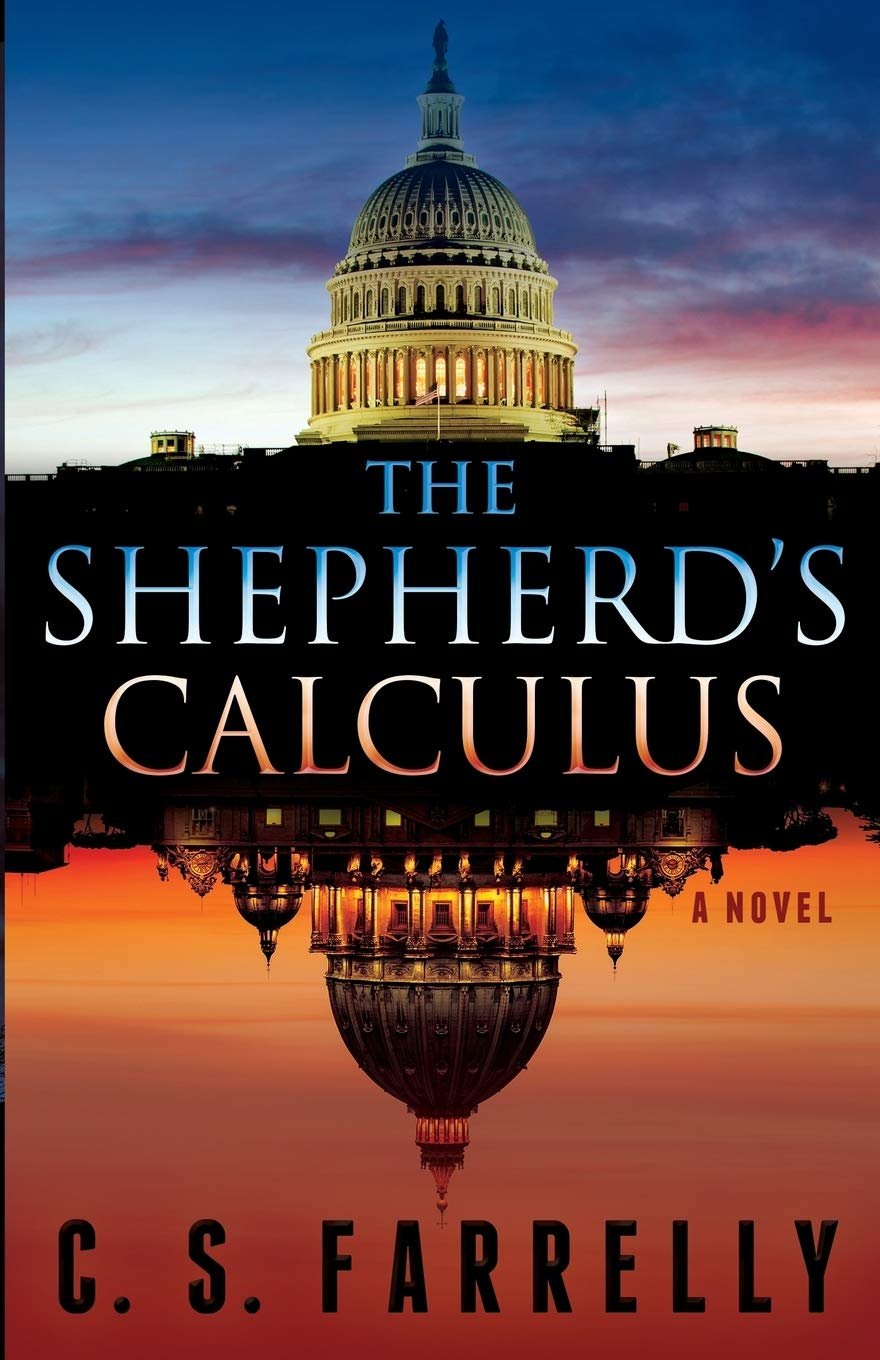
The Shepherd’s Calculus
A journalist’s reckoning with his mentor’s legacy collides with a presidential campaign and an institution desperate to protect itself.
Books worth discovering. Authors worth knowing.
A journalist’s reckoning with his mentor’s legacy collides with a presidential campaign and an institution desperate to protect itself.
S.
A Eulogy That Becomes an Investigation
In C. S. Farrelly’s The Shepherd’s Calculus, journalist Peter Merrick faces the task of honoring Father James Ingram, a mentor whose death should have led to remembrance rather than suspicion. The author’s synopsis establishes the decisive complication: Peter discovers letters in which the priest apologizes to victims of abuse, many returned unopened. He must reconsider whether the person he trusted was implicated in wrongdoing. An ordinary professional assignment becomes a moral inquiry. What does loyalty require when the evidence points away from the version of someone that memory has preserved?
Farrelly makes the personal discovery matter beyond Peter’s private grief. The letters imply lives affected by institutional decisions and by the long silence around allegations. They are not simply clues in a puzzle whose solution restores a comfortable order. Their existence makes the journalist responsible for what he chooses to investigate next. The book’s promotional material describes Peter following a trail of cover-ups toward the hierarchy of the Church and an American election. The thriller grows from a question about a trusted individual into a confrontation with structures able to protect themselves.
Faith, Power and the Numbers Behind Decisions
The title’s calculus is especially apt because the conflict is not reducible to a single villain making a single bad choice. The public synopsis introduces Owen Feeney, head of the U.S. Conference of Catholic Bishops, who faces mounting abuse lawsuits and the possibility of a huge financial payout. Those consequences are framed as a problem for an institution already invested in its public authority. The danger lies in converting moral responsibility into a balance sheet, as though protecting a great organization could justify neglecting particular harmed people.
A calculus implies comparison: costs, benefits, probabilities, winners and losers. Farrelly appears interested in what happens when such reasoning displaces justice. Institutions often claim to serve a community larger than any one individual. In political or corporate language, preserving the institution can sound like a public good. The novel’s premise challenges readers to test where that argument stops being persuasive. The reported allegations and victim accounts remain morally central. The Church’s status and Feeney’s calculations do not make injured people’s interests less urgent or less real.
The President’s Re-election Problem
The second thread brings in President Arthur Wyncott, who is slipping behind a Catholic convert with a compelling public service record. Farrelly’s official synopsis makes electoral arithmetic part of the drama: religious constituencies and Hispanic voters become prized blocs. The administration needs a way to blunt its opponent. In an environment where every political difficulty is seen as an opportunity for strategic intervention, Feeney’s institution and Wyncott’s campaign begin to have overlapping interests. What one needs in reputation or financial relief, the other may provide through policy or influence.
This plotline enlarges the meaning of compromise. Negotiation is a normal part of politics; secrecy becomes alarming when people with power bargain away the rights and safety of those who cannot participate in the bargain. The published material hints at an arrangement connecting the campaign and Church leadership. Readers do not need an invented transcript of their meetings to understand the ethical stakes. The thriller’s suspense asks what a person is prepared to conceal when the survival of a valued organization, office or reputation appears to depend on silence.
Peter Merrick and the Burden of Evidence
A journalist in a thriller often possesses the skill of noticing inconsistencies others would prefer to ignore. Peter begins with affection for Ingram, which makes his reporting emotionally costly. If he had always mistrusted the priest, exposing wrongdoing would be simpler. Instead, the discovery challenges his identity as a person who chose this mentor and admired his work. Farrelly creates tension by making investigation a risk to the investigator’s own narrative. The truth could damage not only powerful institutions but also Peter’s understanding of the formative relationships in his life.
The author’s synopsis does not promise that Peter begins as flawless or that every suspicion is resolved exactly as expected. It does establish that his inquiry leads toward hidden transactions and unanswered obligations. A useful reading question is how Peter distinguishes evidence from anger, grief or loyalty. Responsible journalism depends on documenting what can be established, even when the result is uncomfortable. The book dramatizes this professional obligation amid intense political pressure. For readers, its interest may lie as much in the discipline of refusing easy answers as in the discoveries that investigation makes possible.
The Role of an Idealistic Insider
An independent review identifies Ally Larkin, a committed Catholic and recent graduate working on Wyncott’s re-election campaign. She provides a useful counterpoint to Peter: someone who encounters institutional compromise from within a system she initially wants to serve. For a political thriller, an insider’s perspective can reveal the incremental nature of bad choices. An employee may enter a campaign believing they are helping a good candidate, only to discover that some colleagues measure success differently. The distance between an organization’s advertised principles and its internal conduct can be unsettling.
Ally’s religious identity also complicates any simplistic treatment of faith as the villain. Farrelly’s scenario appears concerned with political exploitation of institutions and with abuse concealed by authorities, not with the proposition that all believers act alike. The distinction matters. A novel addressing faith and corruption can make room for sincerely principled people who find themselves betrayed by their leaders. Peter and Ally approach the problem from different directions. The attraction of their parallel stories lies in the shared demand to decide what fidelity to one’s values actually requires.
A Sensitive Subject Without Easy Catharsis
Because the plot addresses sexual abuse and attempts to cover it up, the novel requires care in how it is introduced. This feature is not a retelling of individual victims’ experiences, and it does not use their suffering as a sensational hook. The public descriptions make clear that accountability is a central question. Fiction involving institutional abuse can illuminate mechanisms of silence, denial and reputational protection, but no thriller resolution can replace the real-world responsibility owed to survivors of such harm. Readers should know the subject matter before choosing the book.
The novel’s political setting may also encourage comparisons with actual elections. Farrelly has described drawing inspiration from recognizable patterns of political scandal and contemporary events. That context is different from a claim that Peter, Wyncott or Feeney represent a particular real-world person. They are fictional characters moving through a constructed conspiracy. Treating the invented plot as a report would flatten the literary project. Its purpose is to test the moral contradictions that readers can recognize in many institutions without attributing the specific fictional acts to anyone outside the book.
A Debut Built for Moral Tension
Farrelly’s website identifies The Shepherd’s Calculus as her debut novel and details an involvement in research and theatre. Those interests fit a story that depends on multiple perspectives, dialogue and the public performance of conviction. External reviews likewise describe a political thriller concerned with the compromises made in the name of institutional survival. One review emphasizes the contrast between blind faith and blind ambition; another notes the way personal character and systemic power interact. These are published critical responses, not a claim that this feature has independently read the entire novel.
The material establishes an original publication around 2017 and a Cavan Bridge Press edition, though page counts vary slightly across listings. Readers looking for a purely escapist mystery should note the religious and political subject matter. For those who welcome serious ethical questions inside a fast-moving conspiracy, the story offers an unusually pointed premise. Its thriller elements exist to make the cost of moral calculation tangible. Who chooses the variables, and whose pain disappears when decision-makers reduce their duty to strategy?
The Question That Lingers
The book’s most compelling idea is that people can defend their harmful choices by appealing to a greater good. Protect the faithful. Win the election. Preserve a revered mentor’s memory. Keep an institution functioning. Each phrase may sound reasonable in isolation. Farrelly’s plot asks readers to notice the person who pays when a noble-sounding justification becomes permission to avoid the truth. Peter Merrick’s discovery begins as a private rupture, but it reveals a public reckoning that many people would prefer never to face.
The Shepherd’s Calculus will appeal to readers of political thrillers, investigative mysteries and character-driven fiction about divided loyalties. Its value as a book feature does not require announcing how the election ends or precisely where each revelation leads. The published premise already supplies the essential challenge: genuine leadership means more than preserving influence, and trust must remain answerable to evidence. The novel invites its readers to examine the difference between doing what keeps an institution safe and doing what is right for the people it exists to serve.
About the book.
Peter Merrick finds Father James Ingram’s returned apology letters after the priest dies; President Arthur Wyncott faces an election challenge; bishop Owen Feeney faces abuse lawsuits and sees an opening for political cooperation.
Editorial book feature, not paid sponsorship. Research-based commentary from named public sources, not a first-hand complete-book review. The cover placeholder will be resolved by the owner’s publishing automation.
Found a book worth opening?
Books worth discovering. Authors worth knowing.
Return to the Journal →