
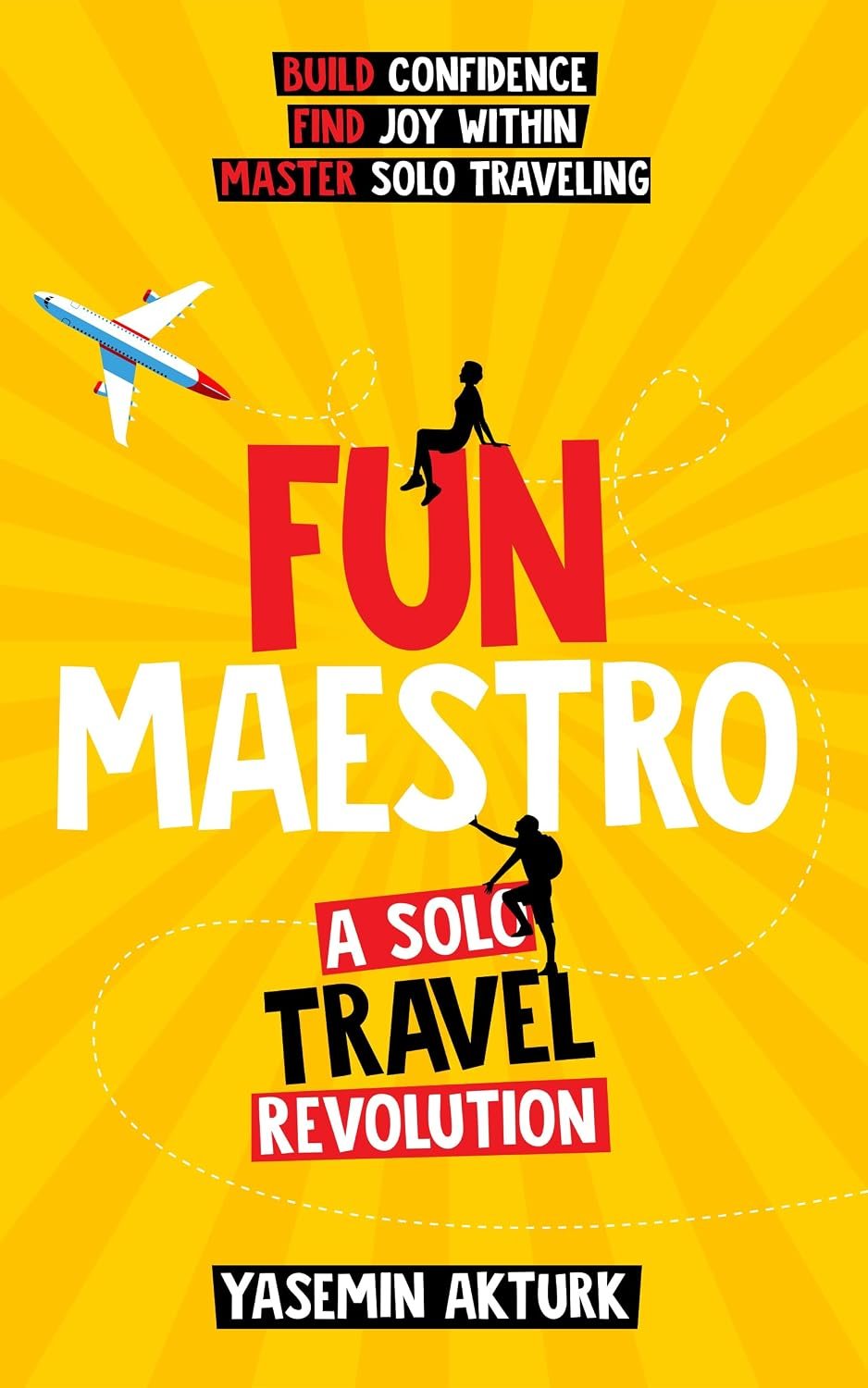
Fun Maestro: A Solo Travel Revolution
What solo travel can teach about joy, confidence, and choosing company.
Books worth discovering. Authors worth knowing.
Fun Maestro announces a “solo travel revolution,” but Yasemin Akturk’s stated aim is not to convince everyone to abandon companionship.
An original critical assessment, grounded in verified public book descriptions.
Fun Maestro announces a “solo travel revolution,” but Yasemin Akturk’s stated aim is not to convince everyone to abandon companionship.
Travel as an argument for agency
Fun Maestro announces a “solo travel revolution,” but Yasemin Akturk’s stated aim is not to convince everyone to abandon companionship. Her book combines personal accounts, budget-conscious travel suggestions, exercises in confidence and reflection on the pleasures of being alone. That is a subtler proposition than the familiar inspirational command to “go anywhere.” The subject is agency: being able to decide what gives an experience meaning without making another person’s availability its precondition. The author’s public biography identifies her as a Berlin-based artist originally from Turkey, whose travel experiences feed both her visual work and her writing. That creative context helps explain why the book frames travel as a practice of self-discovery as well as a logistical undertaking.
The distinction between solitude and isolation
A solo traveler may spend a day among strangers while still directing the day alone. The paradox offers fertile ground for reflection. Solitude is not the same as loneliness; independence is not the refusal of connection. The publisher’s description explicitly promises suggestions for meeting others on the road alongside ways of finding contentment in one’s own company. That pairing is its most persuasive idea. Too much popular travel advice describes courage as indifference to fear and self-reliance as never needing help. A more credible approach recognizes that asking for directions, negotiating boundaries and forming temporary alliances can themselves be forms of confidence. The available description does not reveal how carefully Akturk handles particular risks, but its paired interest in inner growth and social contact is well chosen.
The everyday behind the grand claim
The phrase “revolution” creates a high rhetorical temperature. The practice it names is often made of small, unheroic choices: eating alone in a café, getting lost and recovering, setting a workable budget or revising an itinerary because exhaustion has arrived. A useful guide earns its transformational language by attending to these practical details. Akturk’s book is advertised as offering real stories and budget-conscious advice rather than a conventional destination-by-destination guide. That is a valuable distinction for buyers. Someone looking for train schedules, lodging inventories or country-specific visas should consult current travel resources; those tools change too quickly for a general motivational volume to replace them. The book is better understood as a companion to planning, not the plan itself.
An artist’s eye and the traveler’s assumptions
There is an appealing kinship between making art and moving through unfamiliar places. Both can require attention before interpretation. The traveler brings assumptions about safety, beauty, hospitality and identity; travel may unsettle them, but it can also confirm the stereotypes a traveler is unwilling to question. A serious reading of the book should ask how attentively it treats the places and people encountered as subjects in their own right rather than props in a personal transformation story. The author’s artistic background makes this question especially interesting. Without full-text access, it would be reckless to claim the memoir episodes succeed or fail at that task. The useful editorial point is to identify it as a measure of the book’s cultural as well as personal depth.
A useful, bounded recommendation
Fun Maestro looks best suited to prospective solo travelers who need confidence as much as information, and to readers interested in the psychology of independence. It may also appeal to established travelers looking for a language for what they have learned about themselves in unfamiliar settings. It is less suitable as a stand-alone safety manual or a comprehensive country guide. The description’s promise of practical exercises gives it more substance than a book relying solely on enthusiasm, although their quality needs firsthand inspection. Its attractive core is the idea that joy is a skill of attention rather than a reward dispensed by travel. When held to that reasonable claim, rather than the expansive word “revolution,” the project deserves a place in the conversation about why people choose to travel alone.
Whose freedom is being described?
Solo travel is often marketed as a universal possibility, but the conditions that make it achievable are unequal. Time off work, money, health, passports, social identity and safety affect which journeys a person can take and how others respond to them. A guide promising courage should not imply that confidence can erase those structural differences. Akturk’s advertised budget advice may help make the topic more practical, but affordability is only one condition among many. This is an important consideration when evaluating a travel book that speaks in the language of personal revolution. The best use of its encouragement may be to help readers make realistic, self-directed decisions within their own circumstances, not to shame those who cannot or do not wish to travel far. Independence has many scales, including local excursions and the simple decision to do something enjoyable alone.
Travel as an education in being a guest
The ethical side of discovery is easy to neglect when a narrative makes every encounter a lesson about the traveler. Places are not blank pages waiting for a visitor’s reinvention; they are homes, workplaces and living histories for other people. An artist-traveler may be especially alert to details, but noticing is not the same as understanding. Akturk’s approach would be most rewarding if it encouraged readers to remain curious about what they cannot immediately interpret, and to practice respectful attention to difference. Her public account foregrounds human connection, giving a plausible basis for that hope without confirming how it is realized in individual chapters. This perspective also deepens the title’s interest in joy. Happiness need not consist of collecting memorable experiences for later display. It can arise from a temporary suspension of one’s familiar habits, and from encountering other people without demanding that they become part of a personal success story.
The freedom to come home differently
One measure of a journey is what remains after the traveler returns to a familiar room. Solo travel may cultivate adaptability and attention, but its value cannot be measured only in places visited. Akturk’s focus on finding joy in ordinary moments suggests a book interested in carrying the lessons of travel into a less dramatic daily life. That modest application may prove more useful than its expansive subtitle. For a hesitant reader, discovering that a solitary afternoon can be worthwhile might matter more than booking an ambitious international itinerary. The book is most persuasive when read as permission to make choices, not as a demand to become the adventurous person pictured in a travel advertisement.
About the book.
This review examines the documented premise and its critical implications; literary execution cannot be completely assessed without a full text.
Non-sponsored editorial review according to the MarketAnyBook queue. Based on publicly accessible descriptions and bibliographic evidence; it is not a claim of full-book firsthand reading. Assessments of unverified interior craft are withheld.
Found a book worth opening?
Books worth discovering. Authors worth knowing.
Return to the Journal →