
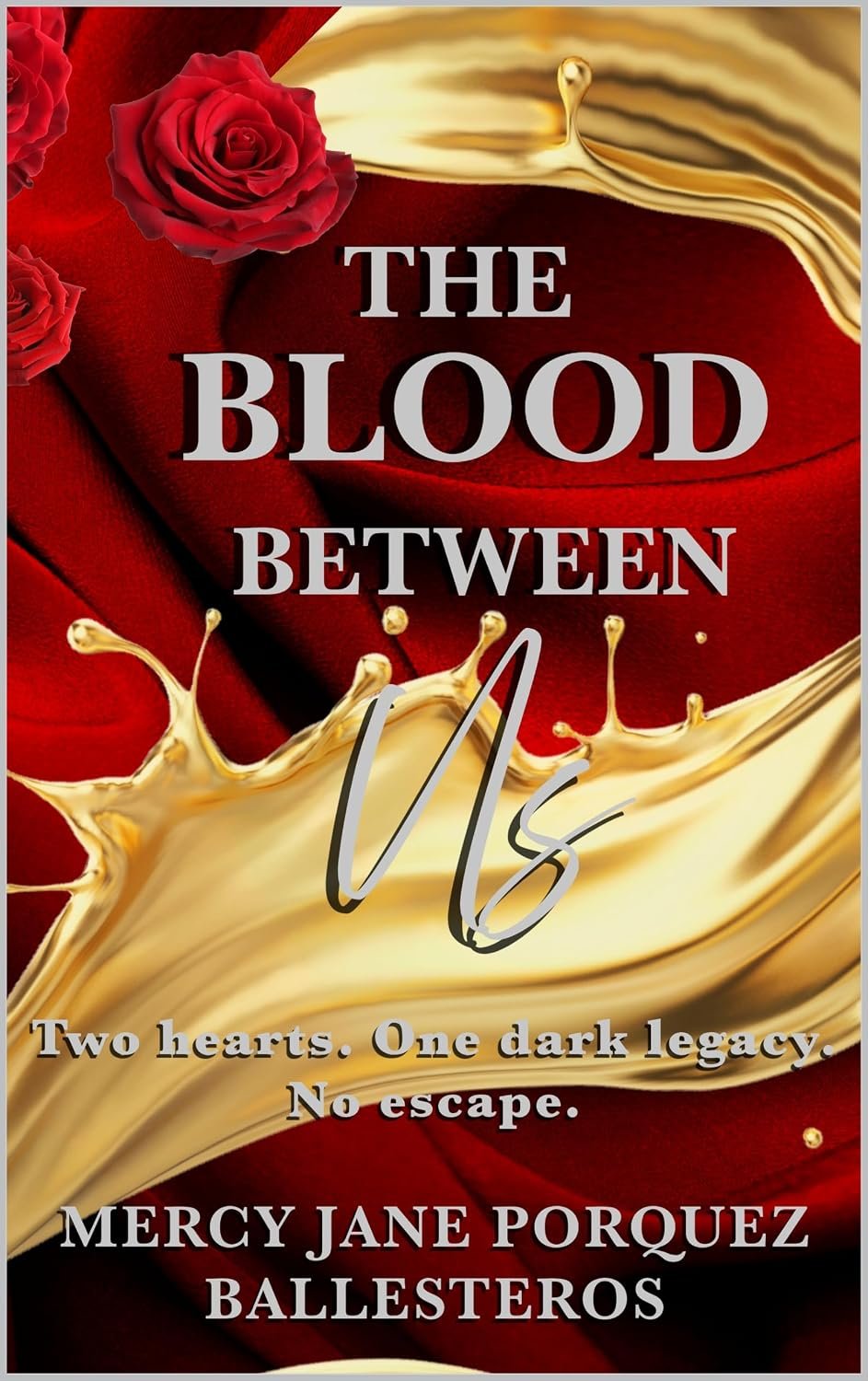
The Blood Between Us
When the person who spared a life is tied to the crime that shattered it.
Books worth discovering. Authors worth knowing.
The advertised premise of Mercy Jane Porquez Ballesteros’s The Blood Between Us is not merely that two people fall in love while danger approaches.
An original critical assessment, grounded in verified public book descriptions.
The advertised premise of Mercy Jane Porquez Ballesteros’s The Blood Between Us is not merely that two people fall in love while danger approaches.
A romance built over a moral fault line
The advertised premise of Mercy Jane Porquez Ballesteros’s The Blood Between Us is not merely that two people fall in love while danger approaches. Grace Martin survived the murder of her parents fourteen years earlier and has spent her adult life seeking answers. Declan Moretti, the powerful businessman whose orbit she enters, knows the secret she does not: he was present that night, was ordered to kill her and chose to let her live. A relationship between these two is therefore structurally different from an ordinary enemies-to-lovers arrangement. The suspense is not simply whether Grace will uncover the truth, but what a romantic narrative can responsibly do once she does. The published synopsis provides these essential facts; the review does not assume knowledge of the novel’s complete resolution.
The cost of keeping the reader informed
Because the description shares Declan’s culpable connection with Grace’s past, the reader enters with a kind of dramatic knowledge denied to the heroine. That arrangement can turn otherwise tender moments uneasy. A gesture of protection may appear both caring and compromised; silence may register as shame, calculation or another form of control. It also sharpens the thriller’s underlying ethical difficulty. A reader who knows more than Grace cannot simply treat her attraction as an uncomplicated sign of destiny. The point is not that morally troubling romance is illegitimate. Rather, the genre’s power comes from acknowledging the gap between emotional desire and moral judgment, then allowing the characters to meet that gap without disguising it as an easily solved misunderstanding.
Violence as inheritance
The title names blood as a connection and a wound. The publisher positions the story amid a feud, concealed contracts, family betrayal and an ongoing threat against Grace. Those elements place the intimate relationship inside a larger machinery of inherited violence. Crime and romantic suspense often make a private choice stand against an entrenched family system; here that confrontation has particular force because Grace’s search for justice leads toward a man implicated in the original injustice. The intellectually interesting question is whether the plot allows forgiveness to be an autonomous decision rather than a requirement of the romantic ending. Critical discussion should not supply an answer without the book in hand. Readers who want romance to carry meaningful consequences will find that question central to the novel’s appeal.
The promise and risk of the morally gray hero
Declan’s position as a CEO gives the book another asymmetry: wealth, access and information are concentrated in one character, while the other is searching for truth under conditions he partly controls. That is fertile material for tension, but it carries an obvious danger of making power attractive enough to excuse coercion. A professional review must distinguish the force of such a premise from the quality of its handling. Public descriptions and secondary commentary indicate a slow-burn, emotionally dark romantic thriller; they cannot establish that every scene negotiates agency, trauma and pacing successfully. The title is best understood as inviting an argument with its own romance conventions, not as demanding that the reader endorse everything its characters choose.
Who should follow Grace’s investigation?
Readers drawn to dark romantic suspense, corporate secrets, conflicted protectors and revenge narratives may find considerable interest here. Readers who prefer a clear moral separation between love interest and perpetrator should know that the central premise deliberately erases that safety. The story also involves parental murder, childhood trauma and threatened violence, making content sensitivity relevant. Its strongest established element is a genuinely consequential romantic obstacle: if Grace learns who Declan is, the relationship itself becomes evidence in a case she has carried for years. The open question is whether the book’s eventual answers earn the emotional weight of that setup. For a reader willing to inhabit discomfort rather than demand immediate reassurance, the premise merits attention.
The suspense in the unsaid
A secret becomes narratively powerful when the reader can imagine its disclosure changing the whole moral meaning of earlier scenes. Here every protective act by Declan threatens to become retrospectively contaminated once Grace understands his connection to the murders. The heroine’s investigative drive is therefore not separate from the romance; it is the force most likely to break its apparent security. That gives the plot an unusually strong organizing conflict. There is also a danger in delaying the truth for so long that readers begin to experience withheld information as authorial convenience rather than psychological reality. The most credible version of this story would give Declan reasons for silence that remain intelligible without making them exculpatory, and would allow Grace to continue thinking as an investigator even when she feels drawn to him. How closely the finished novel meets that demanding standard is a question for direct examination.
What forgiveness cannot be made to do
Dark romance sometimes invites its audience to equate empathy with pardon. Yet understanding why a violent person acted does not obligate a survivor to accept a relationship with that person. Ballesteros’s premise is worth discussing because it has the potential to put those ideas into direct conflict. Grace is not merely searching for the truth behind her family’s destruction; she is seeking the freedom to decide what that truth means for her own future. A romance that treats her choice as freely made must give it consequences, even if those consequences complicate the preferred ending. The book’s combination of investigative suspense and emotional desire is consequently more ethically ambitious than a conventional redemption arc. It may also provoke readers who do not accept its ultimate romantic terms. That possibility is not a flaw in itself. It is part of what makes this particular premise difficult and worth examining.
Why this is not simply a revenge plot
A conventional revenge narrative moves toward retribution; this romance keeps introducing forms of attachment that make retribution emotionally costly. That friction may leave some readers dissatisfied, especially if they believe a loving resolution cannot coexist with the crime at the story’s origin. The discomfort is not something to smooth away. It is the novel’s defining wager: that the pursuit of truth and the desire for intimacy can confront each other without either becoming meaningless. The premise gives an audience something substantial to dispute, which is a stronger basis for critical attention than a promise of irresistible chemistry alone.
About the book.
This review examines the documented premise and its critical implications; literary execution cannot be completely assessed without a full text.
Non-sponsored editorial review according to the MarketAnyBook queue. Based on publicly accessible descriptions and bibliographic evidence; it is not a claim of full-book firsthand reading. Assessments of unverified interior craft are withheld.
Found a book worth opening?
Books worth discovering. Authors worth knowing.
Return to the Journal →