
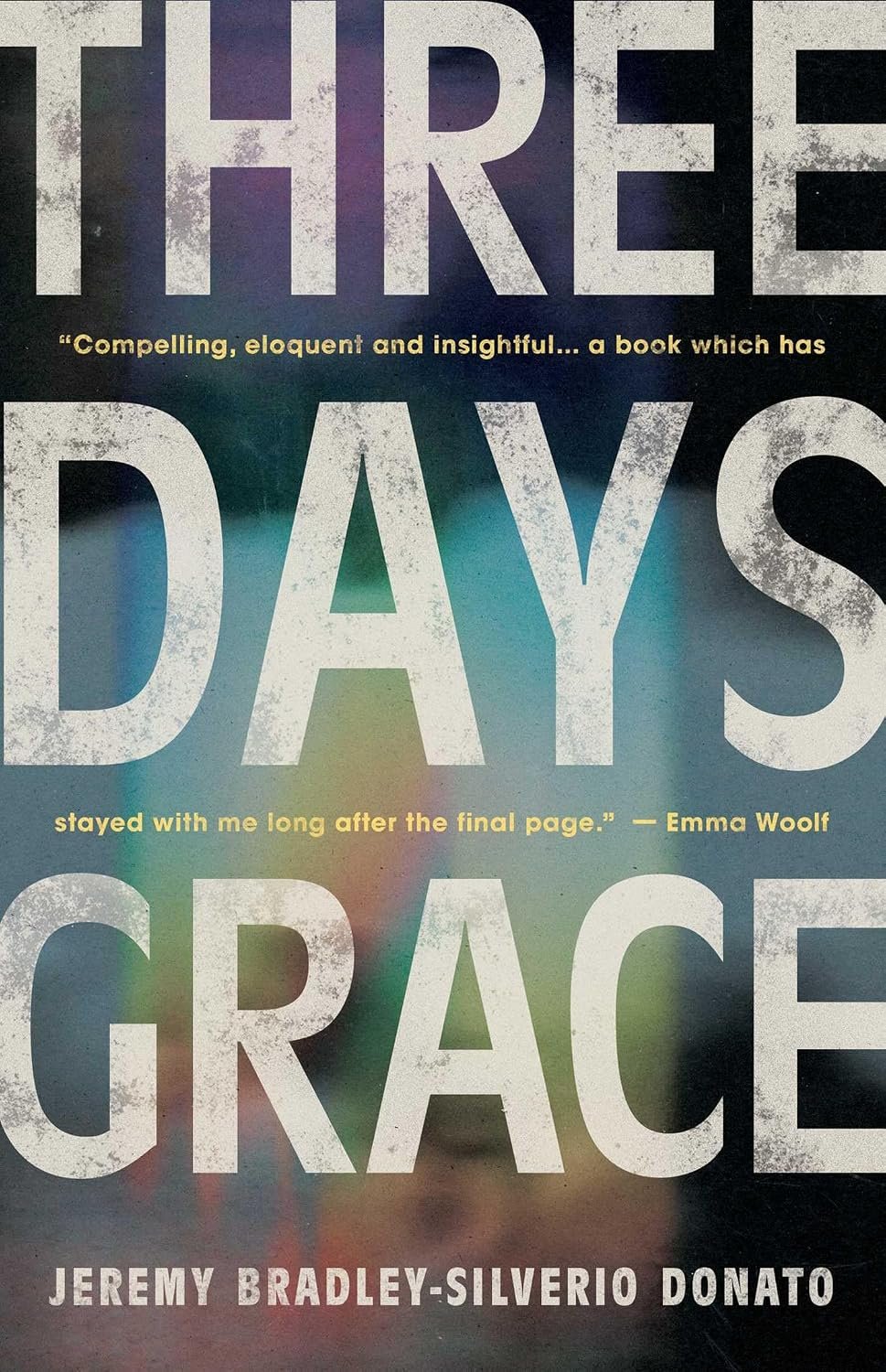
Three Days Grace
Three Days Grace is built around a farewell that refuses to remain polite. Five acquaintances gather in a Paris hotel as Lynne and her wife Susan prepare to travel to South Africa. Their guests…
Books worth discovering. Authors worth knowing.
Three Days Grace is built around a farewell that refuses to remain polite. Five acquaintances gather in a Paris hotel as Lynne and her wife Susan prepare to travel to South Africa. Their guests include Lynne’s distant son Nick, Susan’s friend Laslo and a former professor named Marc. What should be an evening of departure exposes long-buried…
Considered reviews, grounded in the book’s documented promise.
Three Days Grace is built around a farewell that refuses to remain polite. Five acquaintances gather in a Paris hotel as Lynne and her wife Susan prepare to travel to South Africa. Their guests include Lynne’s distant son Nick, Susan’s friend Laslo and a former professor named Marc. What should be an evening of departure exposes long-buried resentments and leads toward the painful history of two brothers, one present and one absent. Jeremy Bradley-Silverio Donato’s announced design is intimate rather than sprawling: a small group, a confined social occasion, and the knowledge that relationships rarely remain as orderly as people present them.
The farewell as an unstable structure
A departure party is an ingenious dramatic frame because it combines obligation with the expectation of an ending. Guests must perform warmth even when history gives them reasons to feel otherwise, while the hosts can imagine that a journey will free them from difficult questions. By situating the crisis at the threshold of a trip, the novel can make evasion visible: everyone knows time is limited, yet everyone also has a reason to postpone honesty. The author and publisher identify the gathering as a catalyst, but the art depends on the rhythm of interruption, silence and confrontation inside the actual scenes. A strong chamber novel turns seemingly small changes of tone into events. Its suspense arises from what a guest can no longer keep unsaid.
The absent brother as an active force
The plot synopsis identifies two brothers—one absent, one present—and a traumatic inheritance at the center of the work. Absence here need not mean narrative emptiness. A missing person can govern the behavior of everyone who remains, especially when grief and blame have never found a shared language. This makes family identity less a stable biography than a struggle over interpretation. Who is authorized to tell the past? Whose memory becomes official? Who has been protected by silence? These are strong questions for a book about the legacy of damage. The publisher describes the trauma but not every event behind it, so there is no basis for recounting the secret as though already revealed.
Queer intimacy outside a narrow coming-out plot
The publisher presents the novel through an LGBTQ+ lens and describes Lynne and Susan as a married couple. That framing offers an opportunity to portray queer adulthood not as a single declarative event but as one strand in a dense network of family responsibilities and older emotional injuries. A marriage may be established and still have unresolved fault lines; an adult child can carry grievances that neither partner can simply explain away. A serious reading would examine whether each character is granted a complicated interior life and whether queer identity is treated as a fact of existence rather than a plot mechanism. The synopsis supplies enough to make this question relevant, not to guarantee its achievement.
Paris, memory and the limits of escape
The city’s role goes beyond travel glamour. Paris can function as a meeting place for people whose histories have unfolded elsewhere, a place where familiar hierarchies appear briefly suspended. Yet changing cities does not cancel emotional inheritance. Donato’s promotional description explicitly uses the language of memory and hidden histories; an author-published excerpt introduces Nick before the reunion at a moment of suspended action. That evidence points to a narrative interested in the uneasy boundary between an ordinary present and a past that keeps pressing into it. The book’s effectiveness will depend on whether movement between time frames clarifies character or adds opacity for its own sake.
Grace without absolution
The title invites a theological reading even when no explicit doctrine is assumed. Grace can mean a gift that arrives undeserved, a pause in punishment, or the possibility of extending kindness to someone who remains culpable. The novel’s advertised concern with betrayal and truth makes these meanings productively unstable. Forgiveness is not the same as agreement, and disclosure is not automatically healing; sometimes an exposed secret creates more complicated obligations than an unspoken one. A demanding reader will want the story to resist hurried reconciliation. A three-day frame promises urgency, but psychological plausibility still requires that some injuries remain difficult after the gathering ends.
The anatomy of an ensemble
A five-person gathering gives a novelist an unusual number of possible alliances. One character can listen while another speaks, exchange a look across the room, or unintentionally become the audience for an accusation that belongs elsewhere. Such small actions allow a group scene to reveal what a solitary confession cannot: the distribution of power among people who remember different versions of the same event. Three Days Grace appears designed to exploit precisely this social pressure. Lynne’s role as mother, Susan’s as spouse and the visitors’ differing attachments make a simple division into victims and villains unlikely to satisfy. The narrative’s achievement would lie in giving each figure enough distinct interest to remain intelligible even when their claims collide. Published materials identify the ensemble, not whether every member receives equal narrative depth.
Trauma and the danger of the explanatory key
Family fiction can make a past injury function as a universal explanation for every flawed adult choice. That is narratively efficient but psychologically flattening. A trauma may shape habits of intimacy, yet people remain capable of contradictory motives, selfishness, generosity and error that cannot all be traced to one origin. Donato’s use of an absent brother and an unfinished family history sets up this risk alongside its dramatic opportunity. The most resonant resolution would acknowledge influence without erasing responsibility. Grace, in that frame, does not require a character to become innocent before being treated humanely. Readers interested in serious psychological fiction should look for that balance rather than expecting every disclosure to lead immediately to reconciliation.
Who will value this book
Readers who enjoy psychologically charged family drama, ensembles whose politeness conceals conflict, and literary fiction concerned with queer lives and inherited trauma should consider this novel. The publisher confirms a Paris hotel gathering and a specific cast, but the evaluation here is of that documented design and an author-provided opening, not an assertion that every stylistic choice has been independently assessed.
Scope of this assessment
This is a research-based editorial review drawn from identified bibliographic, author and publisher sources. It considers the work’s documented premise and the critical questions it invites, without claiming a complete firsthand reading. No unverified scene, character action or ending is asserted.
About the book.
An evidence-bounded critical introduction to literary family drama with LGBTQ+ themes. Published descriptions support the stated premise; interpretations are identified as editorial analysis, not confirmed plot details.
This is an unsponsored, research-based editorial review, not a claim to firsthand reading of the complete book.
Found a book worth opening?
Books worth discovering. Authors worth knowing.
Return to the Journal →