
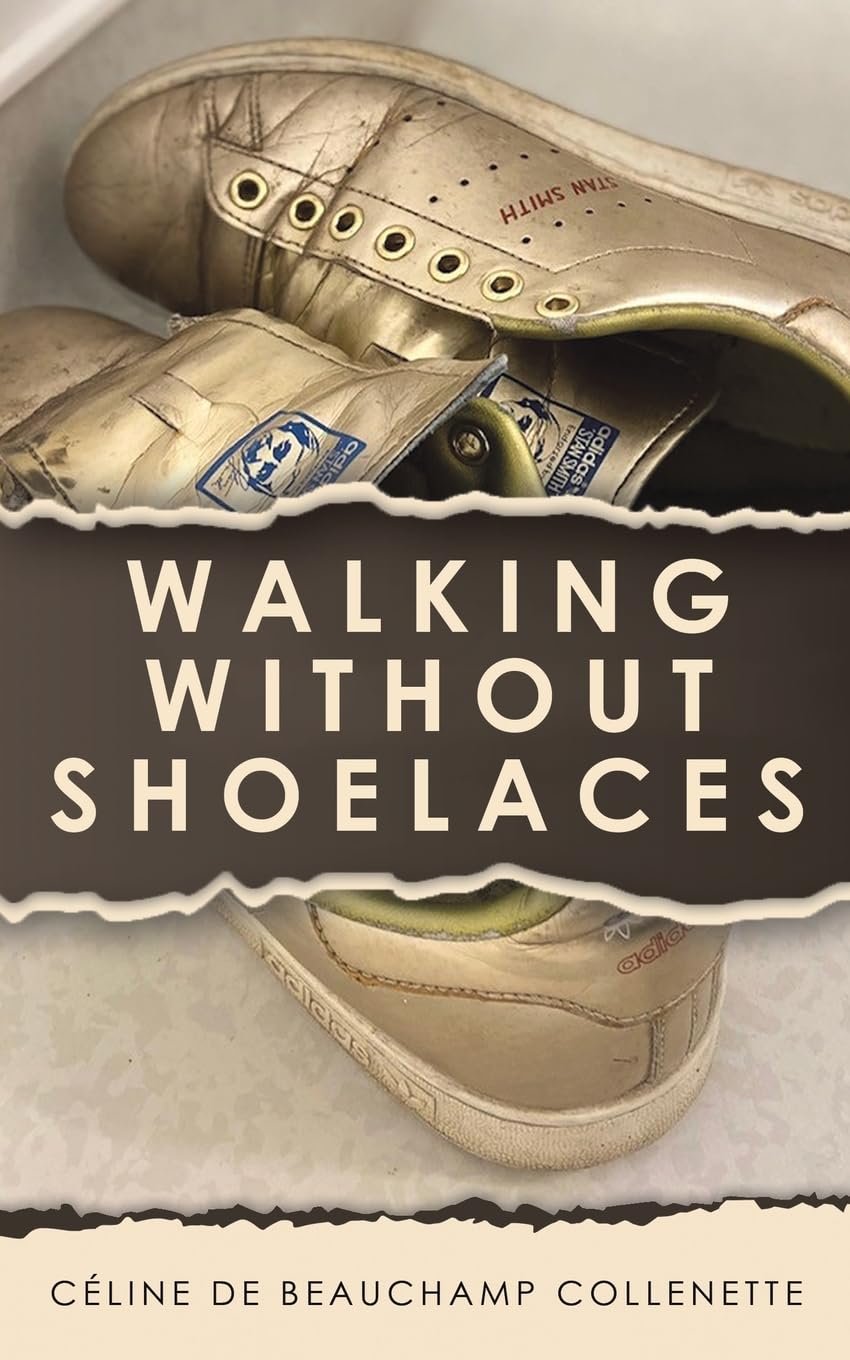
Walking Without Shoelaces
A candid memoir about vulnerability, recovery, and refusing to measure a life only by resilience under pressure.
Books worth discovering. Authors worth knowing.
A candid memoir about vulnerability, recovery, and refusing to measure a life only by resilience under pressure.
Walking Without Shoelaces by Céline de Beauchamp Collenette is introduced by its publisher as a candid account of rebuilding life after a major psychological breakdown.
What happens when resilience stops being enough
Walking Without Shoelaces by Céline de Beauchamp Collenette is introduced by its publisher as a candid account of rebuilding life after a major psychological breakdown. The description places the author in the months before her admission to a psychiatric facility in France and recalls how a grim joke about work becoming unbearable turned into a much more serious reality. Crucially, the book’s advertised emotional center is not a heroic performance of recovery. It is the desire to stop being praised for enduring repeated blows and to find room for vulnerability. That shift makes the memoir distinct from the kind of inspirational narrative that treats survival as an endless competition in toughness. To be resilient is often valuable; to be required to display resilience at every moment can become exhausting. The book’s central appeal, as described, lies in its refusal to confuse recovering with proving invulnerability. It invites the reader into an experience of depletion and reorientation rather than offering a universally replicable formula for mental health.
The language of taking punches
The publisher’s description returns to images of being knocked down and getting back up. As a cultural metaphor, that story is familiar: the person who never quits is admirable, and every fall is supposed to strengthen them. Collenette’s account appears to question what happens when applause for endurance masks the fact that someone has been hurt. A person can be competent, outwardly steady, and still unable to continue under the same pressures. That is not an explanation of every mental-health crisis; it is an interpretive response to this specific memoir’s published framing. The most interesting turn comes when the narrator wants to be seen while fragile instead of only when overcoming adversity. This suggests a different measure of support. Can people make room for someone whose needs are not neatly resolved by encouragement? Can a workplace or family listen without immediately converting distress into a motivational lesson? Readers do not need to have had a comparable breakdown to recognize those questions. At the same time, the memoir’s personal account should never be generalized as diagnostic advice.
A crisis situated in a real life
Unlike a novel, a memoir carries an implicit promise that the writer is presenting their own lived experience, shaped through memory and perspective. The retailer descriptions identify a psychiatric admission and the author’s effort to make sense of life afterward. That is sufficient to introduce the subject, but it does not grant permission to invent a diagnosis, medication history, relationships, or an exact timeline beyond what is public. It is also important to respect the difference between the author’s reflections and medical evidence. Recovery can involve many forms of support, and one person’s path cannot stand in for a clinical standard. The narrative may offer readers companionship and language for difficult feelings without functioning as a treatment program. The title Walking Without Shoelaces suggests exposed movement, as if proceeding without one small source of readiness or control. That metaphor is an editorial interpretation, not a quotation from a chapter. It seems consistent with a book concerned with moving through the world after familiar ways of coping have failed.
The courage of not performing strength
A key promise of the published description is the author’s wish to inhabit a place where simply being can be enough. That is a substantial departure from the expectation that suffering must yield public achievement. Social narratives often demand a tidy arc: crisis, insight, triumphant new life. A truthful discussion of recovery should allow that progress may be uneven and private. There may be days defined by rest, limited capacity, or the choice not to explain oneself. This does not establish that Collenette narrates those exact days; it identifies the broader tension her stated aim engages. Readers encountering such material can pay attention to the difference between genuine support and an audience waiting for an uplifting conclusion. Fragility is not the opposite of dignity. It can be a condition in which dignity matters most, because the usual markers of productivity or composure are unavailable. The emotional possibility offered by this memoir is that self-worth need not be measured solely by performance under pressure.
Place, distance, and the meaning of a new beginning
The published synopsis locates part of the crisis and psychiatric care in France, and the title’s accompanying descriptions identify the book as the first in a larger walking trilogy. Place therefore supplies context, but the material does not support a chapter-by-chapter map of towns, journeys, or institutions. What can be discussed is the role of environment in a recovery memoir. Familiar spaces can become associated with work demands or experiences one would rather not repeat. A new location can offer possibilities while failing to erase what a person carries inwardly. The most careful reading does not treat geographical change as guaranteed healing. Instead, it asks how practical circumstances and emotional interpretation interact. In any autobiographical writing about a crisis, the narrator’s choice of which places to describe is part of the storytelling. Readers may find themselves alert to whether a location represents confinement, relief, or simply the ordinary world continuing around someone in pain. The precise meanings must come from the text rather than from guesses built around the location alone.
Reading with sensitivity rather than expectations
Memoirs of mental distress can be validating, but they can also be demanding. The title and official description prepare readers for a serious account of breakdown and hospitalization. Readers should choose the time and emotional setting in which to encounter it, particularly if similar experiences remain raw. A compassionate reading need not ask the author to represent everyone, nor should it scrutinize private moments as if they were evidence in a court. One person’s memoir combines the remembered events with the perspective available when writing them. It can be emotionally true to its author while differing from another person’s experience. It is useful to distinguish any lessons a reader draws from instructions the book explicitly gives. The description emphasizes a journey of rebuilding and vulnerability; it does not establish a clinical protocol, guaranteed outcome, or universal theory of resilience. This article therefore avoids medical claims and encourages readers who need professional support to seek it through appropriate channels independent of a book recommendation.
Who should read Walking Without Shoelaces
This memoir may resonate with readers who have questioned the pressure to be endlessly capable, or who are interested in how people rebuild identity after a period of severe psychological strain. It may also help friends and family members think more carefully about the language they use when someone is suffering. Readers seeking a technical guide to psychiatric care or a guaranteed recovery program should look elsewhere; this is presented as personal testimony. Those sensitive to discussion of mental breakdown and hospitalization should be aware of the subject before reading. The volume’s promise is not that every reader will emerge ‘fixed,’ but that a candid account can make vulnerability less isolated and allow a different idea of strength to come into focus.
About the author
Céline de Beauchamp Collenette is the author of Walking Without Shoelaces, described by book listings as the first volume in The Walking Trilogy. Public publisher material frames it as her account of breakdown and reconstruction. No diagnosis beyond that wording is assumed here, and personal details not established by reliable source descriptions have been omitted. The feature is an introduction grounded in published metadata, not a clinical evaluation of its author or readers.
About the book.
Personal memoir; rebuilding after mental-health crisis. A candid memoir about vulnerability, recovery, and refusing to measure a life only by resilience under pressure.
Sponsored book feature. Original research-based commentary, not firsthand complete-book reading. The owner’s Python automation will resolve the cover placeholder.
Found a book worth opening?
Books worth discovering. Authors worth knowing.
Return to the Journal →